
Horse Chestnut Tree in Blossom: Story
By the spring of 1887 Vincent van Gogh had been in Paris for the best part of a year, living with his brother Theo and working through a change in his painting that had nothing gentle about it. He had arrived from Antwerp with a palette of browns and greys built on Dutch tradition, and within months he was scraping most of that away, looking instead at what Pissarro, Signac and the younger painters around Montmartre were doing with colour set down in short, separate touches. He took his easel out to the parks and the fringes of the city, to Asnières and the gardens near his lodgings, and painted what was in front of him with very little added incident.
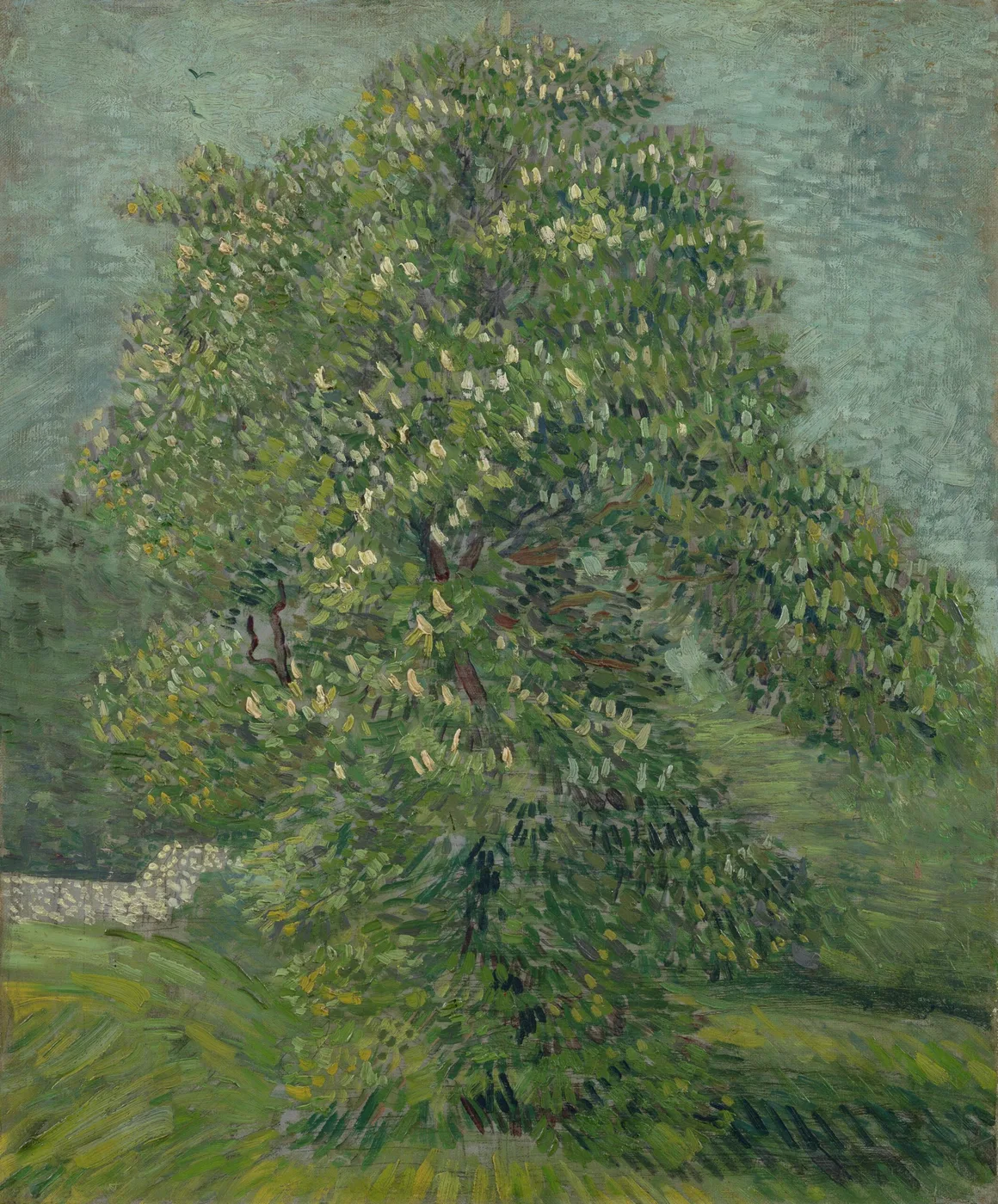
Horse Chestnut Tree in Blossom, painted that year, belongs to this run of spring pictures. There is no path, no bench, no figure walking through. It is a single tree, seen close and looked at hard, which is very much the point.
Paris, and a New Way of Seeing Colour
The change in Van Gogh’s painting through 1886 and into 1887 was not a matter of subject but of method. Dutch peasant scenes gave way to the things within walking distance of Montmartre: rooftops, riverbanks, flowering trees along the boulevards and in the parks. He was reading the Impressionists and the younger Neo-Impressionists at close range, borrowing their broken colour without adopting the strict dot of Seurat’s method wholesale.
Horse chestnuts were, and still are, a familiar sight in Parisian parks and avenues, their blossom appearing in stiff upright clusters that gardeners and painters alike have long called candles. For an artist testing a new way of building form entirely out of colour and touch, a tree in full flower gave him exactly what he needed: dense, irregular masses of green and white that could not be rendered with an outline and had to be built stroke by stroke instead.
A Tree That Fills the Whole Canvas
The composition is almost defiantly simple. A single chestnut tree, roughly conical in shape, occupies nearly the entire painted surface, its crown pushing up and out towards the edges until sky is reduced to a narrow, pale blue-green band on either side.
Pale cream and white touches mark the blossom, gathered most thickly through the upper and left portions of the crown, where the paint sits noticeably lighter against the surrounding green. Lower down and towards the base, the tree grows darker and denser, the individual clusters harder to separate from one another.
A trunk is just visible through the centre of the canopy, picked out in reddish brown strokes that appear and disappear behind the leaves rather than forming a continuous line. In the upper left corner a small dark shape, a single bird in flight, is the only other living thing in the picture, and it is easy to miss.
Below the tree, a low stretch of pale stone wall runs along the lower left, and the foreground opens into grass rendered in loose, horizontal strokes of green and ochre. At 46.5 by 56 centimetres, the canvas is not a large one, which suits a picture built around a single close, sustained act of looking rather than a wide view.
Paint Laid Down in Short, Deliberate Touches
Nothing in the foliage is blended or smoothed. Van Gogh built the crown from hundreds of short, separate strokes of green, ranging from a dark, almost blue-black shade through olive and sage to a bright yellow-green where light catches the top of the tree.
Each stroke follows the direction of a leaf or a cluster of leaves, so the brushwork itself describes the structure of the tree rather than an outline doing that work. Seen up close, the surface reads almost as a mosaic; stood back from, it resolves into the recognisable mass of a flowering chestnut.
The blossom is handled the same way, with small dabs of near-white and pale pink-cream set directly against the green rather than glazed over it, so the flowers seem to sit forward on the surface of the canopy. It is a fast, physical way of painting, and the picture keeps that sense of a tree observed in one sustained sitting rather than built up over many.
How the Painting Sits in a Room
A picture made almost entirely of green and broken light behaves differently depending on what is around it. In a room with soft, changing daylight, the tree’s canopy shifts with the hour, the cooler blue-greens of the sky and shadow coming forward in the morning, the warmer yellow-greens catching more light later in the day.
Hung in a room with plants, or simply with plenty of daylight, the painting keeps company with what is already there rather than competing with it. It rewards the kind of looking Van Gogh gave the tree itself: not a glance, but a few minutes spent letting the strokes separate and reassemble.
The painting now held by the Van Gogh Museum shows an artist mid-change, testing colour against colour on a subject that asked nothing of him but attention. It remains one of the more direct and unguarded pictures from his Paris years, a tree in flower and very little else.
Sizes and materials for Horse Chestnut Tree in Blossom are listed on its product page.
More from this collection
Bring this painting home
Choose a hand-painted oil reproduction for real brushwork, or an archival canvas print for a crisp museum-image edition. Every size preserves the original proportions.
View this work & options
Further reading
Verify the original in the Van Gogh Museum collection record and continue through related works in the catalogue.