
Still Life with Earthenware and Bottles: Story
Nuenen, a winter of practice
In 1885 Vincent van Gogh was living in Nuenen, in his parents’ parsonage in the Brabant countryside, working through a long, deliberate apprenticeship in tone and form. He had set himself a strict programme: model heads, hands and simple objects in a narrow range of browns, greys and greens until he could render weight and volume without leaning on colour to do the work. Still Life with Earthenware and Bottles belongs to that programme, painted in the same months that produced The Potato Eaters and its many studies of peasant hands and faces.
He had no need to travel for subjects. A kitchen table, a few empty bottles and whatever crockery came to hand were enough. The discipline was the point: to paint what stood in front of him honestly, without flattering it, until the picture itself carried conviction.
Six vessels and a wooden table
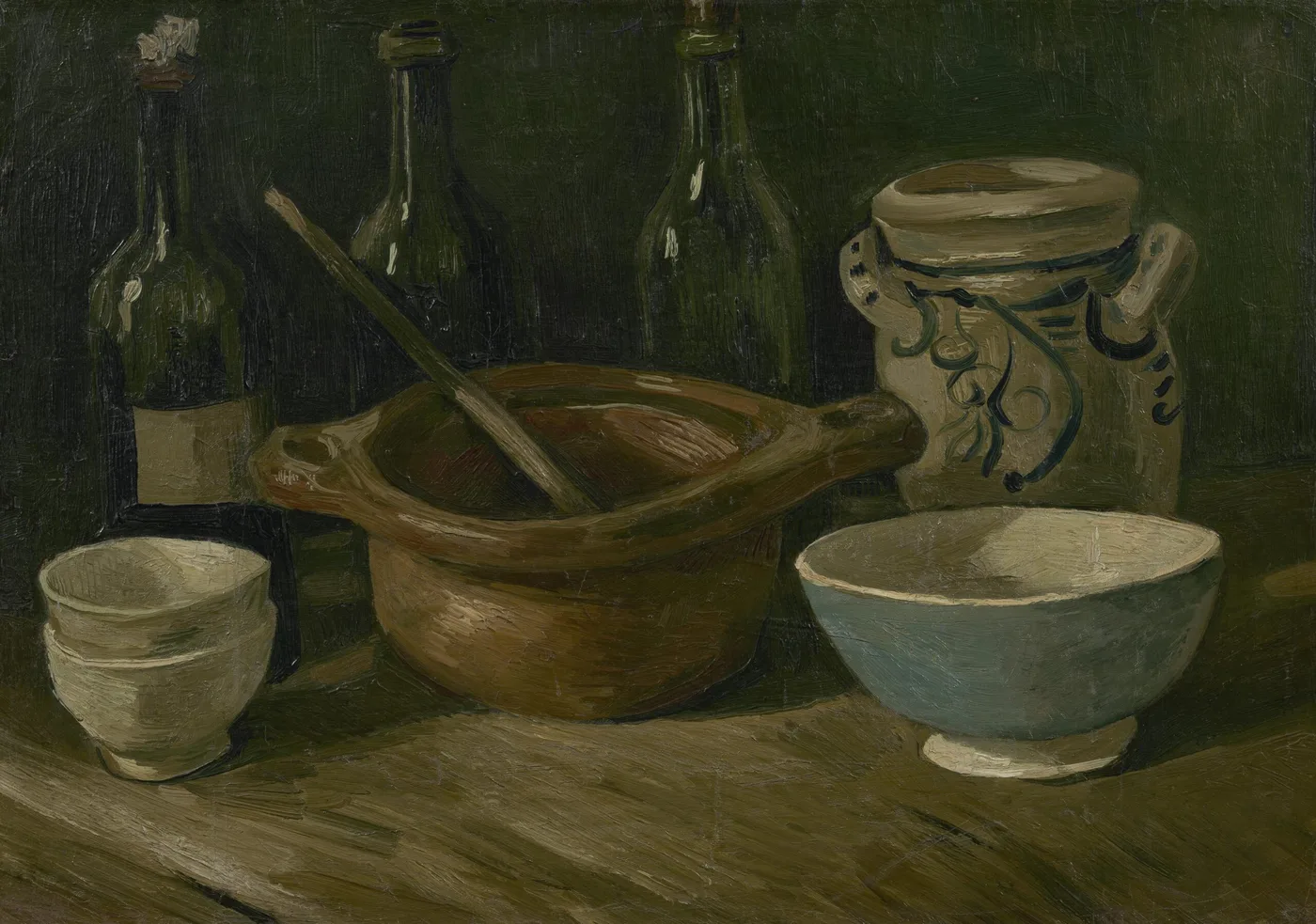
Three dark glass bottles stand in a row at the back, their necks catching thin points of light against a background painted almost black-green. In front of them sits a two-handled earthenware pan, its reddish-brown clay warmed by a diagonal shaft of light, with a wooden spoon or stick propped inside it at an angle that breaks the pan’s curve.
To the right stands a taller stoneware jar, pale grey-cream, its shoulder marked with a loose, dark scrolling pattern that Van Gogh sets down in a few quick, confident strokes. Beside it, a shallow bowl in soft blue-grey turns its pale interior toward the viewer, its rim catching the same light that falls on the pan.
At the front left, two small cups or bowls are stacked one inside the other, their cream glaze the lightest note in the painting after the jar. Everything rests on a bare wooden table, its boards painted in loose, dry strokes of ochre and brown that run diagonally toward the viewer.
The original measures 56 by 40 centimetres, a modest scale that suits the intimacy of the subject. Nothing here is meant to be read from across a room; it rewards the kind of close, unhurried looking that a kitchen table itself invites.
Working in near darkness
The palette is deliberately narrow. Van Gogh builds the whole picture from variations on brown, green-black and grey, allowing himself only the pale blue of the one bowl and the bone white of the cups as relief. Within that narrow range he still finds a full scale of value, from the near-black of the background to the single bright highlight on the stoneware jar’s rim.
The brushwork is broad and physical. He lays paint on in short, loaded strokes that follow the turn of each form, thicker and more visible on the lit pan and jar, thinner and more scumbled in the shadowed bottles and background. Nothing is blended to a smooth finish; the paint keeps the record of the hand that placed it.
Light enters from the upper left and falls hardest on the earthenware pan and the stoneware jar, leaving the bottles as near-silhouettes and the table in soft half-shadow. That single directional light is what holds six separate objects together as one grouping rather than a row of studio props.
A study that became a painting
Van Gogh painted many such groupings in Nuenen, few of which he ever intended for sale. They were exercises: a way of testing how far tone alone could carry weight, roundness and distance without the help of drawn outline or bright colour. Still Life with Earthenware and Bottles shows how far that testing had already taken him by 1885, a year before he left for Antwerp and then Paris, where his palette would open out completely.
What survives from that discipline is visible here in the sureness of the modelling: the pan reads as heavy and full, the bottles as hollow and light, the jar as solid stoneware, all argued through paint alone rather than through detail or ornament. It is a small, plain picture that asks to be read slowly rather than glanced at.
In a room
Hung in a kitchen, dining room or study, this painting behaves less like decoration and more like a second, quieter table in the room, dark enough to recede at a distance and detailed enough to hold attention up close. Under warm evening light the browns and greens deepen further and the pale bowl and jar seem to step forward; under cooler daylight the same objects sit further back, and the single blue note reads more clearly.
It is a picture that changes with the room’s own light rather than fighting it, much as the original does today in the Van Gogh Museum, where it hangs among the other Nuenen studies that mark the beginning of his career.
Sizes and materials for Still Life with Earthenware and Bottles are listed on its product page.
More from this collection
Bring this painting home
Choose a hand-painted oil reproduction for real brushwork, or an archival canvas print for a crisp museum-image edition. Every size preserves the original proportions.
View this work & options
Further reading
Verify the original in the Van Gogh Museum collection record and continue through related works in the catalogue.