
The Reaper (after Millet, 1889): Story & Meaning
A Copy Made Without a Field in Sight
By the autumn of 1889 Vincent van Gogh had committed himself to the asylum at Saint-Rémy-de-Provence, and for long stretches he was not permitted, or not well enough, to walk out among the wheat he loved to paint. What he had instead was a small stock of black-and-white prints after Jean-François Millet, sent down from Paris by his brother Theo.
Van Gogh set about turning these grey engravings into colour, working in a spare cell that had been given over to him as a studio. He thought of the process as translation rather than copying, the way a musician might read another composer’s score and play it back in a different key.
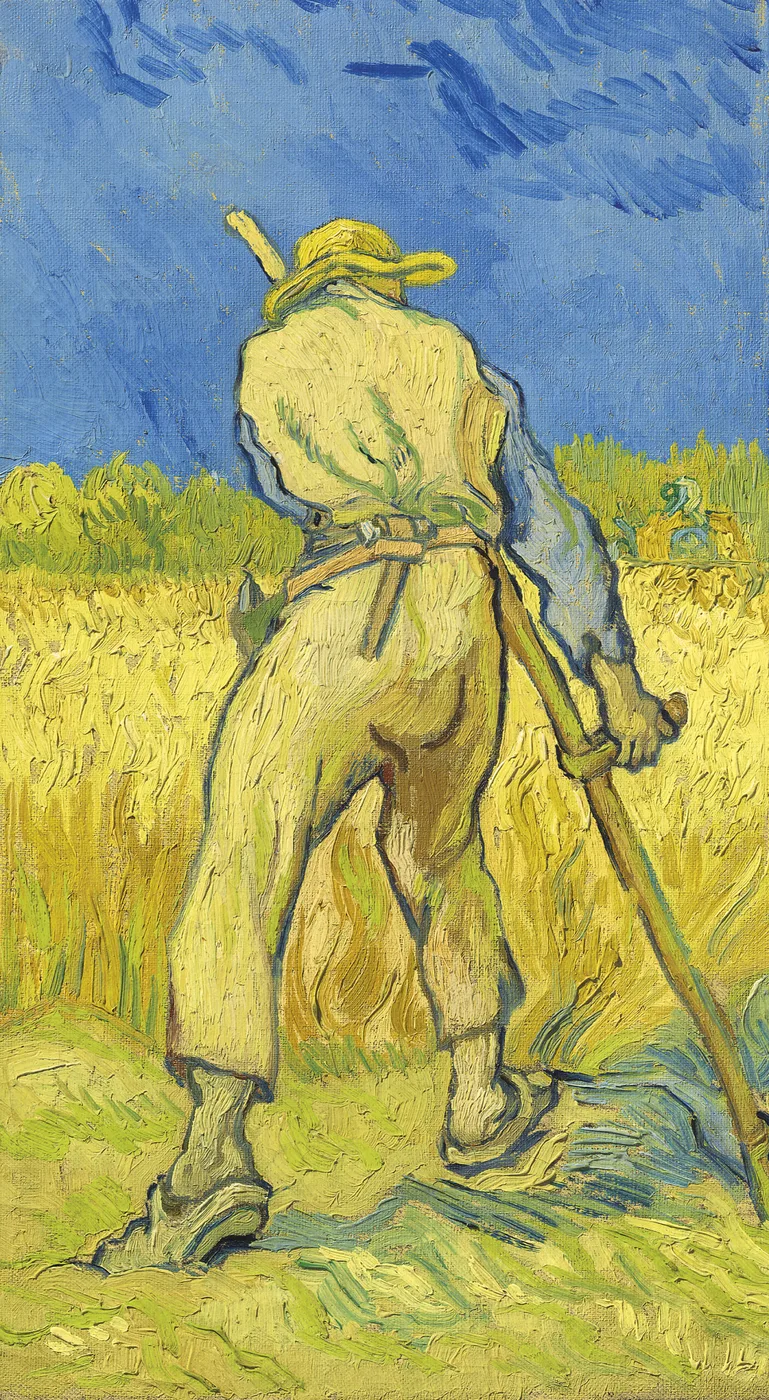
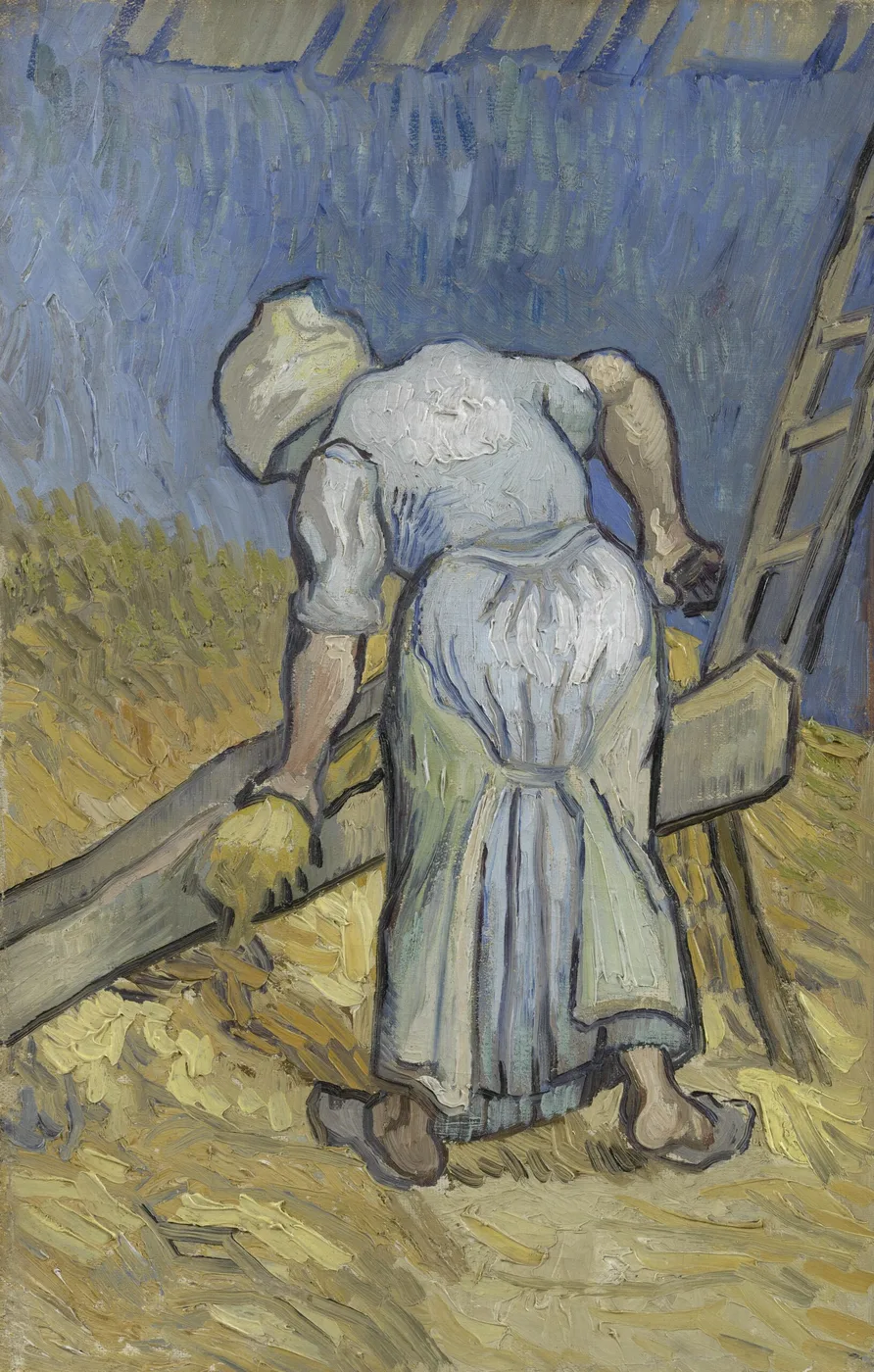
The Reaper (after Millet) belongs to that project. Painted in 1889 on a small, upright canvas measuring 25 by 43.5 centimetres, it takes Millet’s engraved harvester and renders him in the raw, unmixed colour that Van Gogh had spent the previous three years teaching himself to trust.
One Man, Seen From Behind, Bent Double
The painting gives us a single reaper from the back, cut off at the waist by the angle of his own labour. He is folded almost in half, his head down under a straw hat, his whole weight driven into the long-handled scythe gripped in both hands.
His clothing is plain: a pale cream smock and loose trousers the colour of the grain around him, with a blue jacket pulled off his shoulders and knotted at his waist by the sleeves. That one note of blue against all the yellow is the only thing that separates the man from the field he is cutting.
His boots are worn and heavy, planted in a patch of ground rendered in cool blue-green shadow, the one passage in the picture where the temperature drops. Behind him the wheat runs back in short, packed strokes of chrome yellow and ochre until it meets a low green line of hedge and trees.
In the upper right corner, small and easy to miss, sits a second, tinier figure worked in the same yellows, a distant echo of the man in front that keeps the harvest from feeling like the work of one lone body. Above it all the sky is pure, deep cobalt, laid on in long diagonal strokes that sweep the same direction as the bent stalks below.
Colour Doing the Work of Line
Millet’s original reaper was built from tone, from careful greys moving into black. Van Gogh had no interest in matching that; instead he let a handful of pure colours carry the entire structure of the figure and field.
The yellow of the wheat is never one flat wash. It shifts from pale straw to hot chrome to touches of green shadow, each change laid down as a distinct, visible stroke rather than blended smooth.
Against that heat, the cobalt sky and the single blue jacket act as ballast. It is a simple complementary pairing, yellow against blue, but Van Gogh pushes both to their fullest saturation, so the contrast reads before any detail of the figure does.
The brushwork itself has direction and urgency. Strokes in the field follow the lean of the grain, strokes in the sky curve and rush overhead, and the whole surface has the packed, worked-over density of a canvas built up quickly, in short sessions, by a man who trusted his hand more than his eye that year.
A Subject Van Gogh Kept Returning To
The reaper was not a passing borrowing. In the same year Van Gogh painted his own harvesters cutting wheat beneath a burning sun, working the motif again and again from the asylum grounds and from memory.
Millet’s figure gave him a ready-made version of that same subject, a man reduced to pure physical effort, bent under the weight of the work and the season. Taking it up in his own colour let Van Gogh sit with an image he had already made personal, without needing a model or a field in front of him.
There is no drama added to the scene, no visible face, no gesture toward the viewer. The reaper simply works, and the painting asks the eye to stay with that single, repeated motion rather than look for a story around it.
Living With It
Hung in a room that gets real daylight, this small canvas changes with the hours the way the original subject would have. Morning light picks out the cool blue of the jacket and the shadowed ground; by afternoon the yellows take over and the whole picture seems to warm up.
It rewards a wall where it can be looked at up close, since so much of its force is in the direction and thickness of individual strokes, not in a grand overall effect. Set among quieter, more resolved pictures, it holds its own by sheer physical insistence, a small painting that refuses to sit still.
Sizes and materials for The Reaper (after Millet) are listed on its product page.
More from this collection
Bring this painting home
Choose a hand-painted oil reproduction for real brushwork, or an archival canvas print for a crisp museum-image edition. Every size preserves the original proportions.
View this work & options
Further reading
Verify the original in the collection record and continue through related works in the catalogue.