
View of Arles, Flowering Orchards: Story
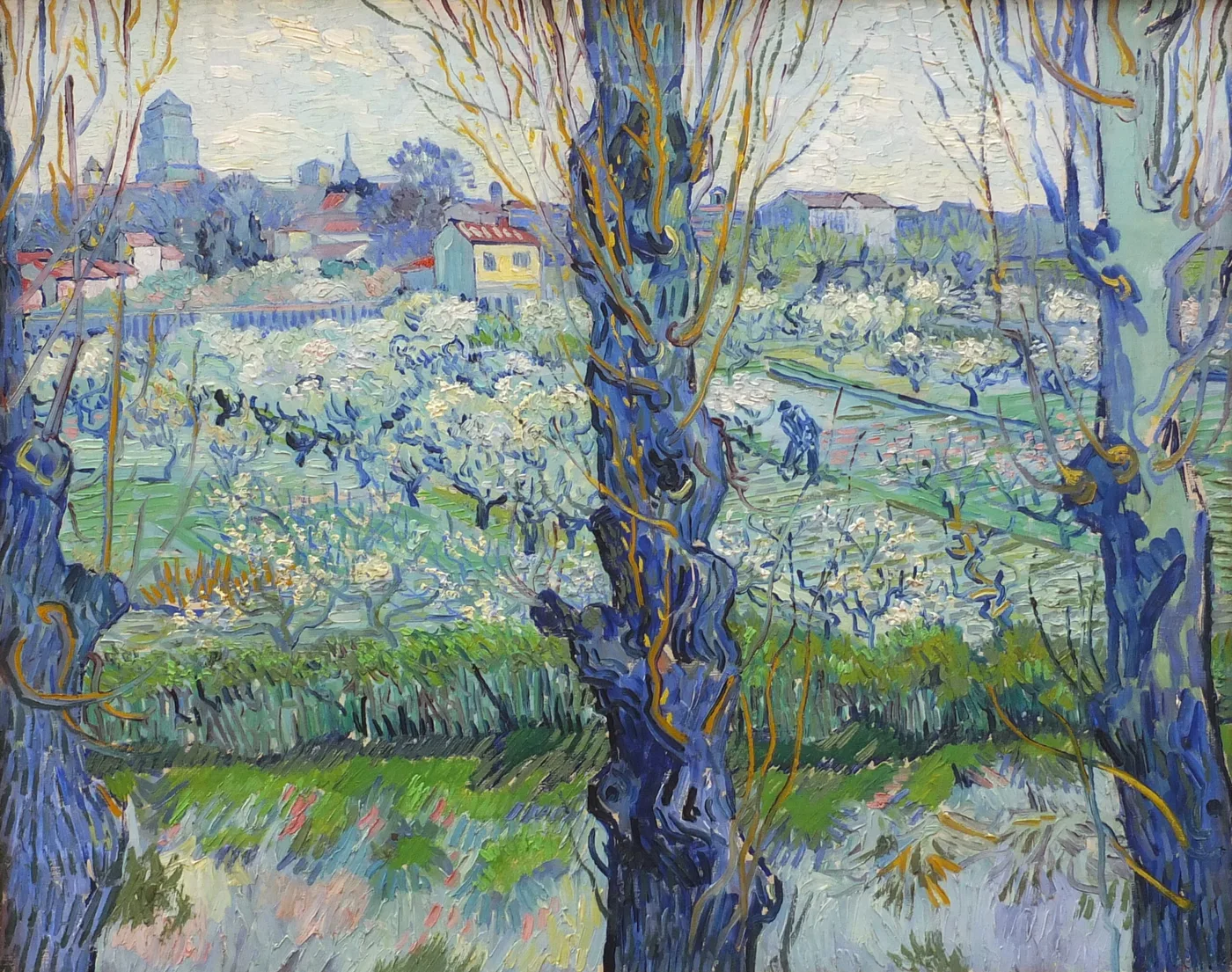
In April 1889 Vincent van Gogh was allowed out of the hospital at Arles for a few hours at a time, painting within a short walk of the ward where he had been recovering since the breakdown of the previous December. The orchards on the edge of town were in flower, and he had already spent weeks that spring chasing the blossom before it dropped, moving from tree to tree with his easel. View of Arles, Flowering Orchards is one of the last pictures from that campaign, painted only weeks before he left Arles for the asylum at Saint-Remy in May.
What sets this canvas apart from the earlier orchard studies is the vantage point. Rather than standing among the blossoming trees, Van Gogh set himself back and let a stand of pollarded trunks cut across the whole width of the picture, so the orchard, the fields and the town of Arles are all seen through a kind of screen.
Painting through a fragile spring
The months before this picture had been the hardest of Van Gogh’s time in the south. He had injured his ear in late December 1888, spent time under care, and by April 1889 was still moving between the hospital and short spells of independence. Painting was part of how he held himself together, and the orchards gave him a subject that was close by, quick to work and finished within the season.
He had already painted several orchard scenes that spring, but this one looks past the blossom to the town itself, its rooftops and a tower breaking the skyline. Within weeks he would leave Arles for good, so the picture also marks the close of the period that had produced the Yellow House, the sunflowers and the night cafe.
A stand of trunks across the foreground
Three heavy trunks rise the full height of the canvas, cropped at top and bottom so they read as a screen rather than a group of trees. Van Gogh painted them in deep blue-black, built up in twisting ropes of pigment, with the pale ochre of the pollarded scars and new shoots breaking through the dark bark.
Between the trunks the ground drops to a strip of grass and standing water, touched with pink and pale reflected light. The trunks block off part of the view at every turn, so the eye has to search past them to find the orchard and the town beyond, rather than taking the whole scene in at once.
Blossom, tiled roofs and a pale sky
Through the gaps, a band of fruit trees carries white and pale pink blossom in short, loaded dabs, thinning out into green fields streaked with the ochre of open ground. A single figure, reduced to a few strokes, bends over the crop in the middle distance, the only sign of work going on beyond the orchard.
Behind the blossom the town of Arles sits low along the horizon, its roofs a mix of ochre and red tile, a yellow-walled house standing out among them, and a church tower rising above the rest. The sky is not the high blue of a Provencal summer but a pale, slightly overcast white-grey, the kind of light that mutes colour rather than sharpening it.
The overall range stays cool and green, blues and blue-greens against white blossom, with warmth kept to small notes: the ochre of the trunks, a red roof, a streak of pink at the waterline. It gives the picture a held-back, early-season feel rather than the heat of high summer.
Paint built up trunk by trunk
The handling changes across the canvas. The trunks are the densest passage, paint laid on thickly and dragged into ridges that follow the twist of the wood, almost carved rather than brushed. The blossom is worked in short, separate touches, each dab standing for a cluster of flowers rather than a single petal.
Further back, the town is painted more thinly and quickly, roofs and towers reduced to a few flat strokes of colour. That drop in density does real work: it pushes Arles into the distance and keeps the foreground trunks as the part of the picture the paint itself insists on.
On a wall, through the changing light of a room
Hung where daylight reaches it, the picture shifts more than most landscapes do. In flatter light the cool blues and greens dominate and the trunks read almost as pattern, a screen across the wall. As the light warms toward evening, the ochre in the bark and the pink at the base of the trunks come forward, and the sense of a specific season, one particular April, returns.
The scale helps that shift along. At 92 by 72 centimetres the trunks are close to life size, so the picture holds its own at a distance across a room and still rewards standing close enough to see the ridges of paint. The original is held by the Bavarian State Painting Collections in Munich, and remains one of the clearest statements from Van Gogh’s last weeks in Arles, painted with a steadiness that the year around it did not have.
Sizes and materials for View of Arles, Flowering Orchards are listed on its product page.
More from this collection
Bring this painting home
Choose a hand-painted oil reproduction for real brushwork, or an archival canvas print for a crisp museum-image edition. Every size preserves the original proportions.
View this work & options
Further reading
Verify the original in the Bavarian State Painting Collections collection record and continue through related works in the catalogue.