
Wheatfield behind Saint-Paul’s with a Reaper: Story
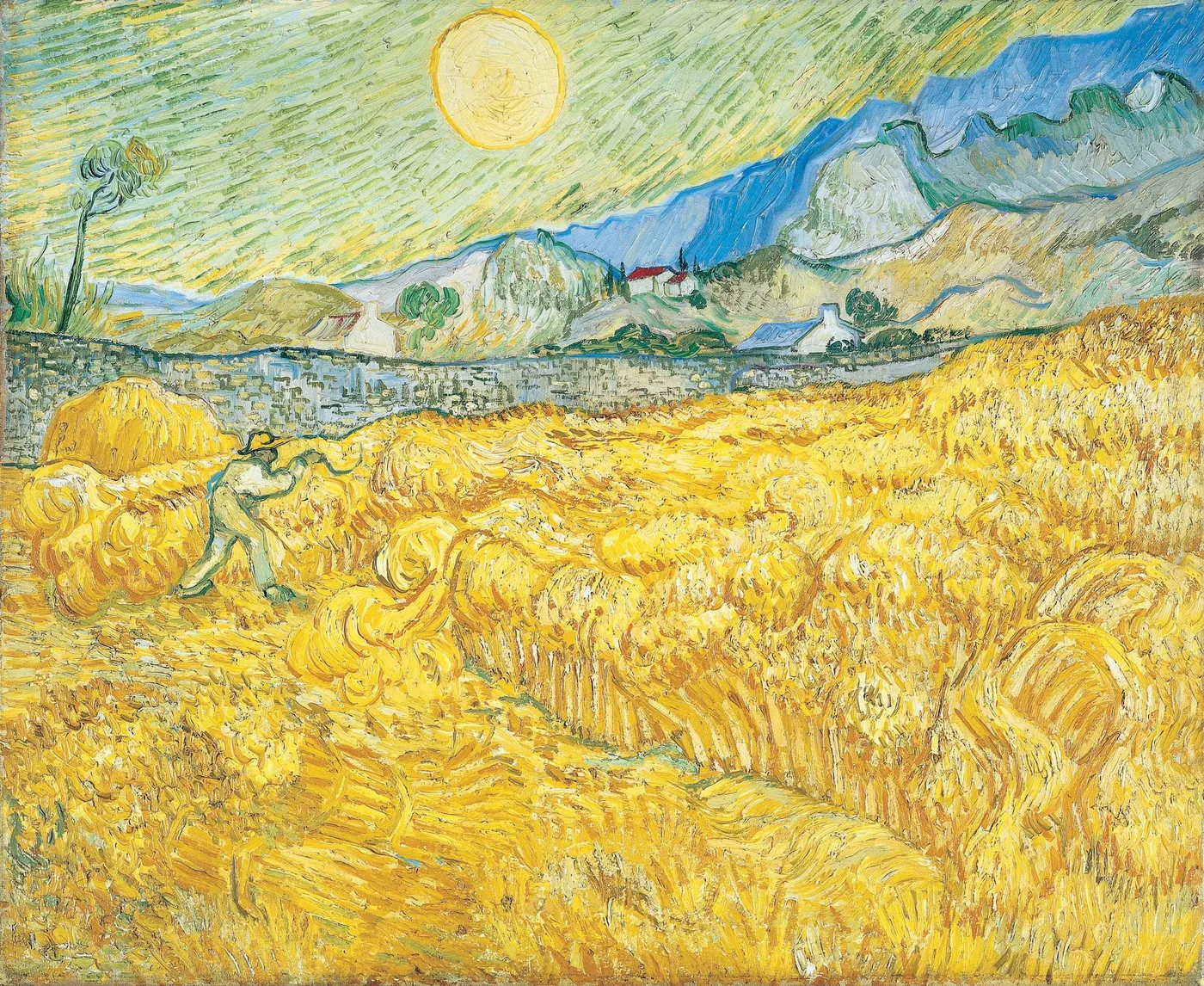
In May 1889, Vincent van Gogh admitted himself to the asylum of Saint-Paul-de-Mausole at Saint-Rémy-de-Provence. The doctors gave him a small room and, eventually, a second one to use as a studio, its window facing a walled wheatfield hemmed in by the low hills of the Alpilles. He could not leave the grounds easily, so that field became his subject through an entire agricultural year, watched, repainted and re-seen as it turned from green to gold to stubble.
The Wheatfield behind Saint Paul’s Hospital with a Reaper, painted in 1889, belongs to that sequence. It is a canvas of 72.5 by 59.5 centimetres, and it is held today by the Museum Folkwang. Van Gogh returned to this same enclosed plot again and again that summer, and this version catches it at the point of harvest, a single figure cutting his way through standing grain.
A View Earned Through Confinement
The wall that crosses the middle of the canvas was real. It marked the edge of the asylum grounds, and beyond it Van Gogh could see, but not easily reach, the village roofs and the mountain wall of the Alpilles. Painting the same restricted view so many times was not a lack of imagination on his part. It was closer to a discipline, a way of testing how much a single motif could hold.
He had written to his brother Theo about the wheat and the reaper as an image that sat somewhere between labour and mortality, a man working steadily through a crop that stands in, loosely, for a human span. That thought does not need to be read into the picture to feel it. The reaper is small against the field, bent to his task, and the field itself seems to have no end.
What the Canvas Actually Shows
Low in the composition, just left of centre, the reaper works with a scythe, his straw hat and pale shirt catching light against the surrounding gold. A stook of cut wheat rises beside him like a second, stiller figure. Around him the grain runs in curling, overlapping sweeps that fill nearly two-thirds of the picture surface.
The stone wall runs horizontally behind the field, and past it sits a strip of village, a red-roofed house, a scatter of trees, before the land lifts into the blue-grey silhouette of the Alpilles. A single tall shrub or sapling stands at the upper left, its top breaking into the sky like a small exclamation. Above it all hangs the sun, painted as a flat pale disc ringed in white, neither dawn nor noon exactly, more a constant presence than a specific hour.
The eye lands first on that gold field, then is pulled down and left to the reaper, the one moving thing in an otherwise settled landscape. Everything else, the wall, the village, the hills, sits still around him, so the whole painting reads as a single figure caught mid-motion inside a landscape that has already been fixed.
How the Paint Itself Moves
Van Gogh built the wheat from short, insistent strokes of yellow, ochre and touches of white, laid in directions that follow the lean of the grain rather than any flat, even fill. Up close the field is a mass of individual marks. From a distance those marks resolve into swell and shadow, so the field seems to shift as if a wind were passing through it.
The sky is handled with the same restless hatching, but in cooler tones, olive and pale green streaked through with light blue, the brush moving in long diagonal strokes that seem to radiate outward from the sun. That green sky sits in direct tension with the yellow field beneath it, an unusual pairing that gives the whole canvas a slightly charged, unsettled air even though nothing in the scene is moving fast.
The mountains are painted more calmly, in flatter planes of blue, and the wall in grey and pale stone tones, so that the picture cools and quiets as it recedes. The nearer the paint gets to the reaper and his field, the more agitated and thick it becomes, as though the intensity of the brushwork itself were standing in for the heat and effort of the harvest.
Living With This Field
Hung in a room that gets real daylight, this painting keeps changing. Morning light tends to sharpen the contrast between the cool green sky and the hot gold field, while evening light softens that edge and lets the whole surface glow more evenly, closer to the way the scene must have looked from Van Gogh’s own window at a particular hour.
It rewards being looked at twice, once from across a room, where the field reads as a single sweep of gold and the reaper as a small dark accent within it, and once up close, where the individual strokes separate out and the labour of the paint becomes as visible as the labour of the man it depicts. Few landscapes ask so plainly to be read at both distances at once.
Sizes and materials for The Wheatfield behind Saint-Paul’s Hospital with a Reaper are listed on its product page.
More from this collection
Bring this painting home
Choose a hand-painted oil reproduction for real brushwork, or an archival canvas print for a crisp museum-image edition. Every size preserves the original proportions.
View this work & options
Further reading
Verify the original in the Museum Folkwang collection record and continue through related works in the catalogue.