
The Sower (after Millet): Story, Meaning & Brushwork
By the spring of 1889 Vincent van Gogh had committed himself to the asylum of Saint-Paul-de-Mausole at Saint-Rémy-de-Provence, and for long stretches he was not permitted outside its walls to paint from life. Without fields or peasants in front of him, he turned to the one painter he had never stopped admiring: Jean-François Millet. Van Gogh kept black-and-white prints of Millet’s peasant subjects and set about reworking them in oil, treating the older artist’s compositions as a kind of borrowed scaffolding on which to build his own colour.
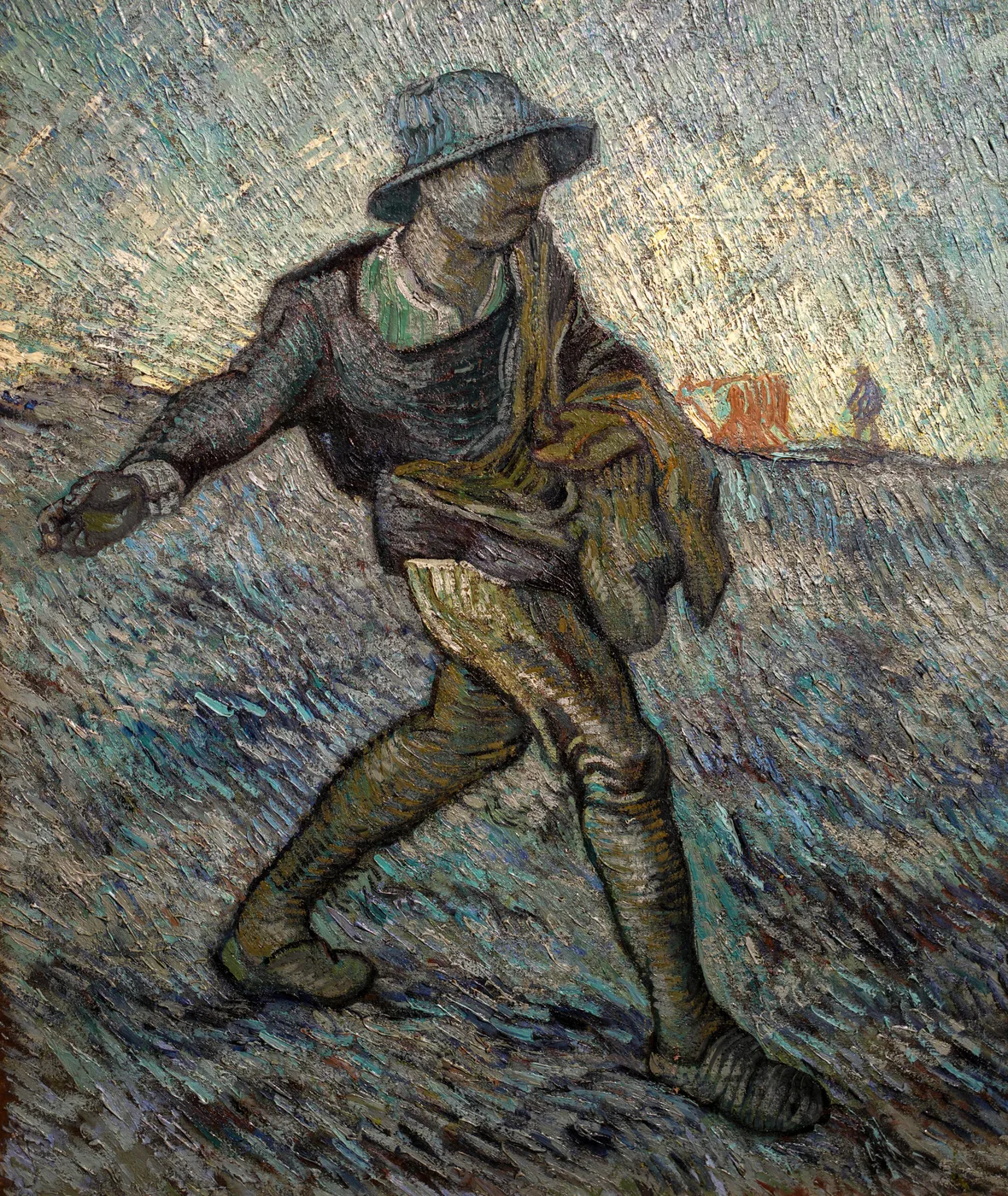
The Sower (after Millet), painted in 1889 and now in the collection of the Kröller-Müller Museum, is one result of that work. It measures a modest 55 by 64 centimetres, close in size to a study rather than a grand statement, and it shows how completely Van Gogh could remake another artist’s design while changing almost nothing of its structure.
Working from Millet, Not Copying Him
Van Gogh did not think of these pictures as copies. He called them translations, comparing his role to that of a musician playing another composer’s score in his own key. The drawing, the pose, the fall of the figure’s stride all come from Millet.
Everything else is Van Gogh’s. Where Millet’s print offered only tone and line, Van Gogh supplied colour, texture and a nervous, unresting brush that no engraving could have suggested.
This was not a passing exercise. Millet had been his model for years, the artist he pointed to when he wanted to explain what he meant by painting peasant life with dignity rather than sentiment. Reworking him at Saint-Rémy let Van Gogh keep faith with that subject at a moment when illness had cut him off from working outdoors.
The Figure in the Field
A young man strides down a sloping field, planted low in the picture and filling most of it. His right arm swings back across his body, fingers loosely curled around the last of the seed, while his left leg drives forward into the next stride.
He wears a broad, round-brimmed hat, a dark jacket over a pale shirt with a touch of green at the collar, and a canvas seed-bag slung across his hip, its folds picked out in ochre and rust. Heavy trousers and thick, ridged boots ground him in the furrows he is walking.
Behind him the field runs back to a low horizon. A small building or hay-cart glows in orange-red, and a single distant figure stands near it, small enough to measure just how much ground the sower still has to cover.
A Field Built from Strokes, Not Colour Fields
What strikes the eye first is not colour so much as texture. Van Gogh has laid the whole surface, sky, field and figure alike, in short, directional strokes that run like combed fibres, so the paint itself seems to describe the furrows and the weather.
The palette is cooler and more restrained than the sunlit, saffron-and-violet Sower he had painted the year before. Here the ground and sky sit in close greys, blue-greens and slate, broken by the warmer olive and brown of the sower’s clothes and that one hot passage of orange in the distance.
Nothing in the picture is flat. Even the sky is hatched into short diagonal marks, so that light and cloud read as movement rather than as a smooth wash overhead. The effect is closer to woven cloth than to conventional landscape painting.
Labour Repeated Every Year
Millet’s original sower had already carried a weight of meaning: the peasant as a figure of endurance, sowing in the same gesture his father and grandfather had used, indifferent to who was watching. Van Gogh kept that reading intact.
For Van Gogh the subject also carried a private charge. He wrote often about the sower and the reaper as figures who worked within the turning of the seasons, and about wanting his own work to hold something of that same steady repetition, made at Saint-Rémy during a year when steadiness was exactly what his health denied him.
The cooler light of this version, so different from the blazing sun of his other sowers, gives the scene a quieter, more overcast mood, less a hymn to harvest than a record of work simply continuing.
Living With the Painting
Hung where daylight reaches it, the picture changes more than most. In flat light the hatched strokes read as texture and the figure holds the eye; in raking light, morning or lamplight from the side, the ridges of paint catch and throw small shadows across the whole surface, and the field seems to shift underfoot.
From across a room the sower’s stride and the one warm patch of orange in the distance are what carry. Close up, the picture breaks into thousands of short, separate marks, and it is only at a step or two back that they resolve again into field, sky and figure.
Sizes and materials for The Sower (after Millet) are listed on its product page.
More from this collection
Bring this painting home
Choose a hand-painted oil reproduction for real brushwork, or an archival canvas print for a crisp museum-image edition. Every size preserves the original proportions.
View this work & options
Further reading
Verify the original in the Kröller-Müller Museum collection record and continue through related works in the catalogue.