
Self-Portrait with Pipe and Straw Hat: Story
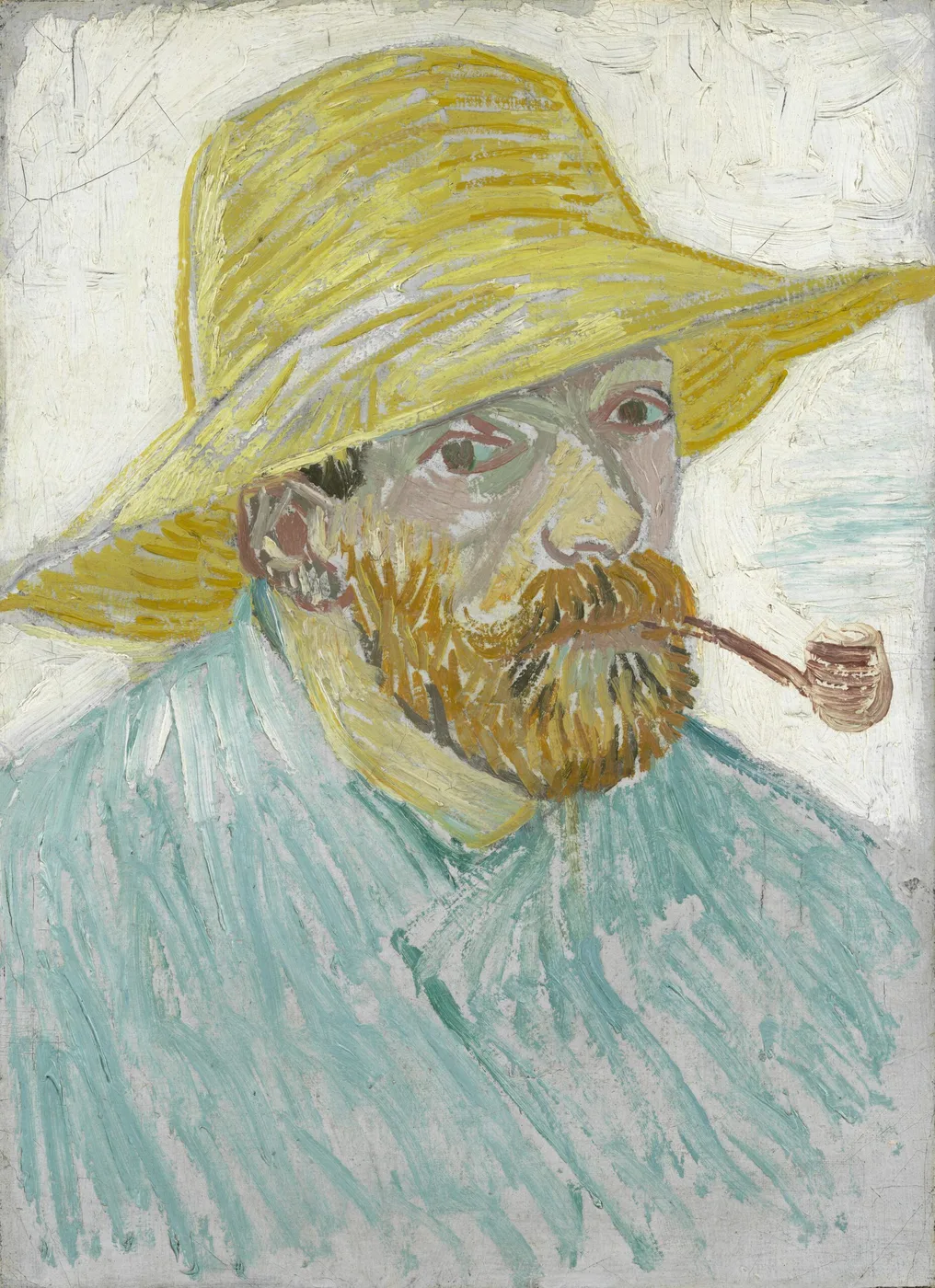
By the spring of 1887, Vincent van Gogh had been living in Paris for over a year, and he was running out of models he could afford. His brother Theo kept the household going on a dealer’s modest income, and sitters cost money Vincent did not have to spare. So he turned the mirror on himself, again and again, using his own face to work through everything he was learning from the painters around him. This small canvas, thirty by forty-two centimetres, is one result of that self-imposed apprenticeship.
A face used as a laboratory
Van Gogh had arrived in Paris still painting in the dark, earthy manner of Nuenen and Antwerp. Within months he was looking hard at Impressionism, at the broken colour of Pissarro and Signac, at the flat planes and bold outlines coming out of Japanese prints that were being traded and collected all over the city.
He could not afford to hire the models he needed to try these ideas out properly, so he sat for himself instead. Over roughly two years in Paris he painted more than twenty self-portraits, each one a different test of colour, brushwork or mood, and this is among the most direct of the group.
The straw hat is not a studio prop chosen for effect. It was ordinary countryman’s headgear, the kind he had worn and painted on peasants back in Brabant, and here it sits oddly, almost defiantly, over a face that is otherwise all Paris: alert, watchful, worked in colour rather than shadow.
What the canvas actually holds
The hat all but fills the top half of the picture, its wide brim tipped down at an angle so that half the face falls into its shade. Van Gogh has built it from long radiating strokes of yellow and ochre, with cooler grey-blue laid into the weave where the straw catches shadow, so that the hat reads as woven and dimensional rather than flat.
Below it, the face turns slightly away from the viewer while the eyes stay fixed on them, a small tension that gives the portrait its alertness. The skin is not painted as skin usually is: green runs along the cheekbone and around the eye socket, pink flushes the nose, and ochre and white sit side by side in short, separate touches rather than blended tones.
A reddish pipe is clenched in the beard, its stem reaching out to the right of the canvas and breaking the symmetry of the composition. The beard itself is a thicket of quick strokes, ginger and brown shot through with white and black, built up with the same economy of means as the hat above it.
The shoulders drop away in loose, scratchy strokes of blue-green, a jacket or smock rendered almost as a field of hatching rather than a described garment. Behind the figure the background is left thin and pale, a warm off-white worked over with faint diagonal strokes that let the canvas weave show through, more sketch than finished setting.
Colour doing the work of light
Nothing here is modelled with traditional light and shade. Instead Van Gogh sets colour against colour: the gold of the hat against the pale ground, the green of the shadowed cheek against the warm ochre of the lit side, the blue-green of the jacket against the orange of the beard.
This is the lesson he had been absorbing from the Neo-Impressionists that spring, that a face could be built from complementary touches placed side by side rather than smoothed into a single flesh tone. He never adopted their strict pointillist method wholesale, but the habit of letting small strokes of contrasting colour do the modelling stayed with him for the rest of his life.
The result is a face that seems to vibrate slightly even in stillness, held together less by anatomy than by the balance of warm and cool patches across it. It is an unfinished-looking picture in places, and that roughness is part of what makes it feel like a working document rather than a formal likeness.
A small canvas that holds its ground
At thirty by forty-two centimetres, this is a modest object, closer to a study than a grand portrait, and that scale suits what it is: a private exercise, painted quickly, not a commissioned statement. Seen close, in the kind of light a study or a hallway gives it, the individual strokes separate out, gold next to grey, green next to pink, and the picture becomes almost abstract.
Step back, or let the light in a room shift toward evening, and those same strokes resolve into a face again, one that meets your eye from under the brim of a hat with a directness few formal portraits manage. The original hangs today in the Stedelijk Museum Amsterdam, where it stands as one of the plainer, more searching entries in Van Gogh’s long run of Paris self-portraits, less about vanity than about a painter teaching himself to see in colour.
Sizes and materials for Self-Portrait with Pipe and Straw Hat are listed on its product page.
More from this collection
Bring this painting home
Choose a hand-painted oil reproduction for real brushwork, or an archival canvas print for a crisp museum-image edition. Every size preserves the original proportions.
View this work & options
Further reading
Verify the original in the Stedelijk Museum Amsterdam collection record and continue through related works in the catalogue.