
La Berceuse: Story, Meaning & Brushwork
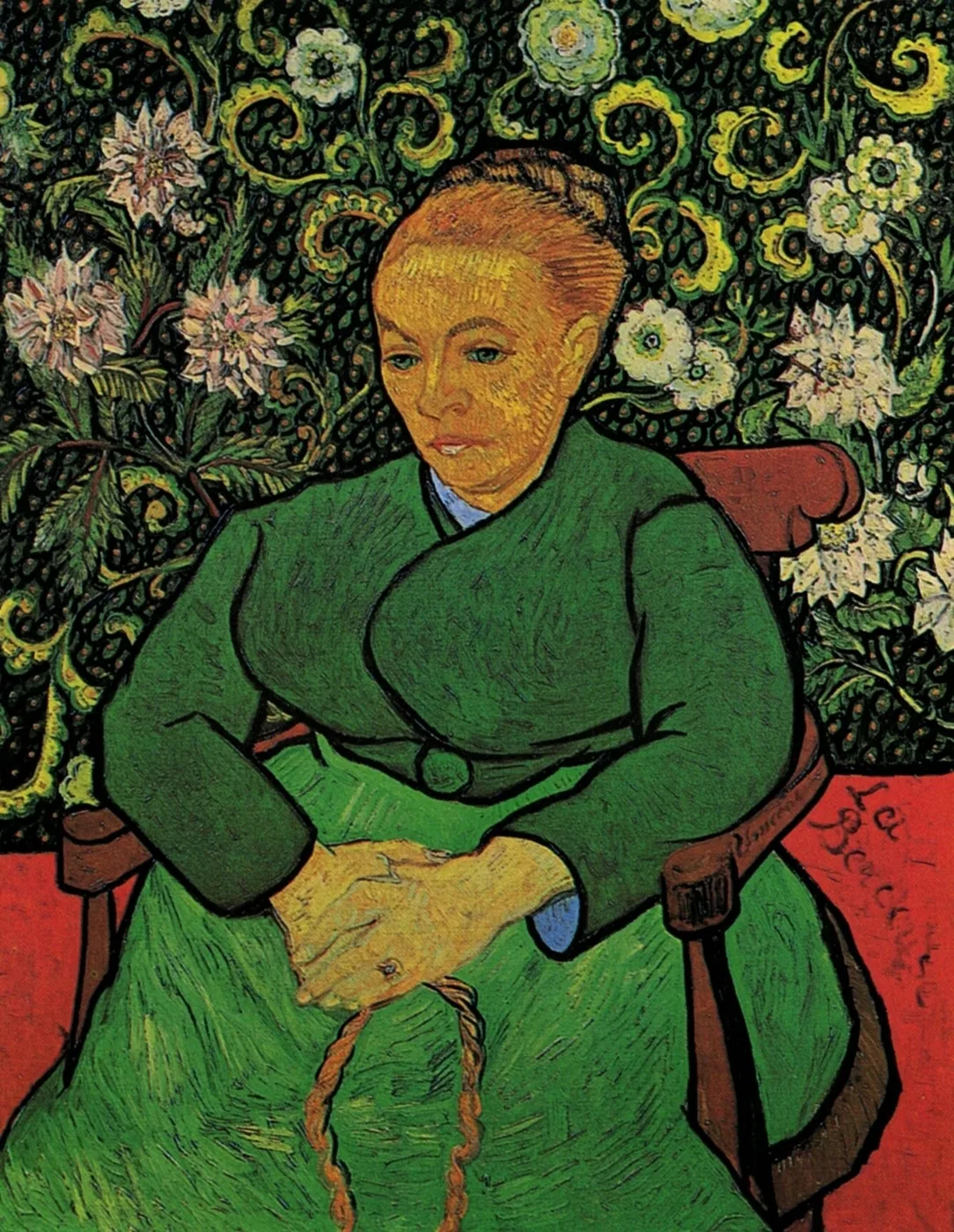
By the winter of 1888 into 1889, Vincent van Gogh was painting through a crisis. Paul Gauguin had left Arles after their shared household in the Yellow House collapsed, and Van Gogh had cut off part of his own ear and been admitted to the town’s hospital. Between spells of illness he kept working, and one of the paintings he returned to again and again that winter and into the spring of 1889 was a portrait of Augustine Roulin, the wife of his friend the postman Joseph Roulin, seated with the cord of a cradle in her hands.
He called it La Berceuse, a French word that means both the woman who rocks a cradle and the lullaby she sings while doing it. Van Gogh was not aiming for a conventional likeness. He wanted a picture that would work on the nerves the way a song does, something that could sit in a room and quietly change the temperature of it.
A postman’s wife, painted from memory of comfort
Augustine Roulin had recently given birth, and the cradle whose cord she holds is outside the frame entirely. We never see the child. What we see is the gesture of rocking, reduced to a woman’s clasped hands and a length of rope disappearing off the bottom edge of the canvas.
Van Gogh painted the Roulin family repeatedly during his time in Arles, and by the time he came to Augustine he had already spent months studying her husband’s face, her son’s, her daughter’s. This was not a commission in the ordinary sense. It was a portrait built on familiarity, painted by an artist who had eaten at their table and needed, that winter, the reassurance of a household that still held together.
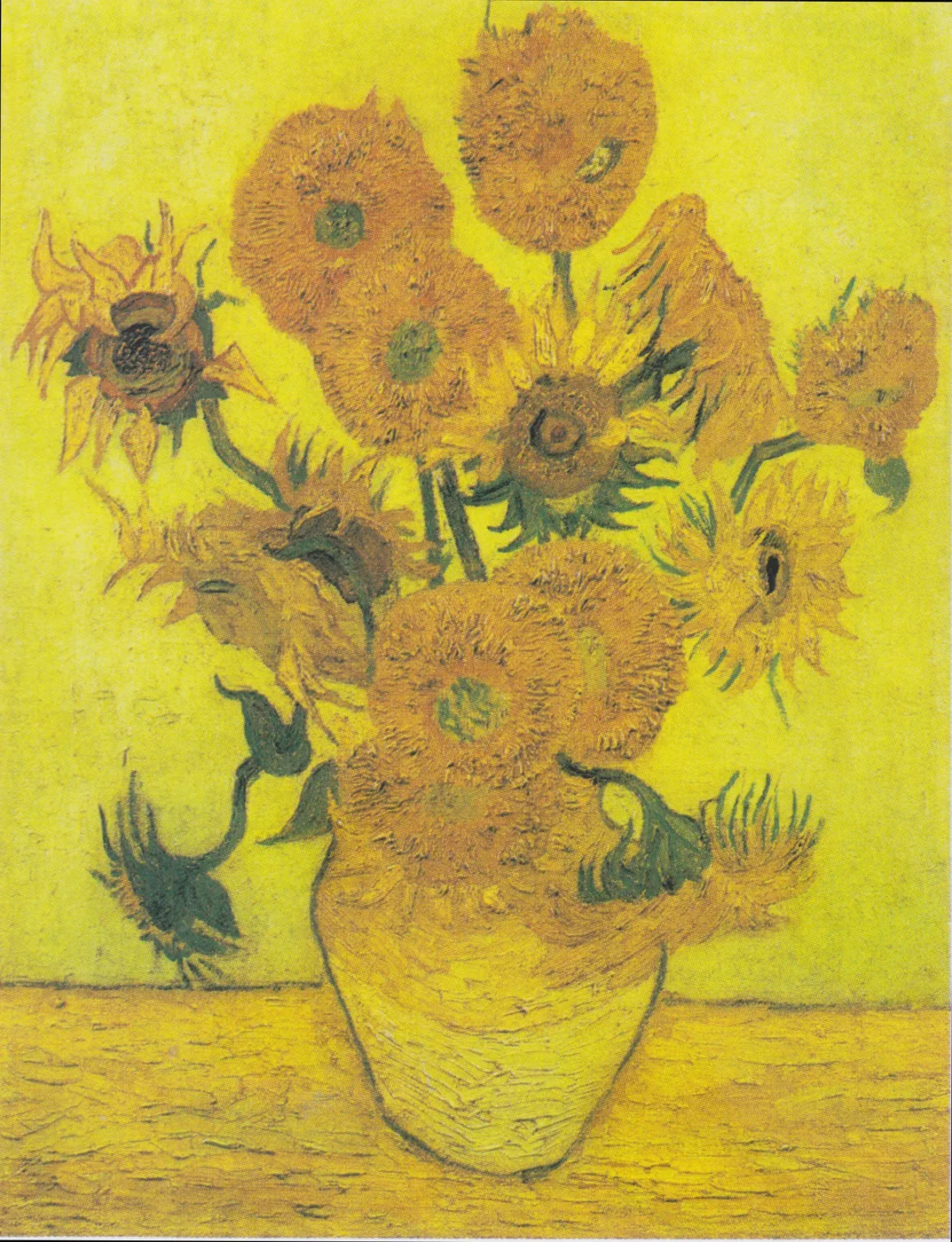
He wrote of wanting the picture to hang between two of his sunflower canvases, like the centre panel of an altarpiece, so that the whole arrangement would glow like a votive image. He also imagined it reaching an audience he would never meet: sailors far from home, for whom an image of a woman singing a child to sleep might stand in for everything they had left on shore.
What the eye meets first
Madame Roulin fills most of the seventy three by ninety two centimetre canvas, seated squarely in a wooden armchair with her hands folded in her lap. She wears a heavy green dress buttoned high at the throat, with a glimpse of pale blue at the collar and cuffs, and her red hair is pulled back tightly from a broad, sallow face.
Her gaze does not meet ours. She looks slightly to one side, past the viewer, with an expression that reads as tired rather than sorrowful, a woman resting between tasks rather than posing for a picture. The rope she holds falls in loose loops toward the bottom of the canvas, the one detail that explains everything else about her posture.
Behind her, the wall dissolves into a dense, patterned wallpaper of swirling green stems and white and pink flowers, painted with the same insistence Van Gogh brought to his cypresses and wheatfields. The pattern reads almost as static, a field of ornament that has nothing to do with a real interior and everything to do with mood.
Colour built to ring rather than blend
Van Gogh worked here in blocks of strong, unmixed colour rather than gradual shading. The green of the dress sits against the red of the floor and the darker green of the wallpaper ground in the kind of complementary pairing he had been reading about and testing all year, chosen for the way the colours intensify each other rather than for naturalism.
Her face and hands are built from warm ochres and oranges, applied in short, directional strokes that follow the structure of cheekbone and knuckle. Black outlines hold the whole composition together, running around the collar, the chair arm and the folded hands, giving the figure the flattened, graphic clarity of a printed image rather than a modelled one.
The brushwork changes character from passage to passage. The dress is built from long, loaded strokes that follow the fall of the fabric, the wallpaper from short dabs and looping lines that never quite resolve into individual flowers, and the rope from a few economical lines that let the eye finish the coil on its own.
Five attempts at the same consolation
Van Gogh was not satisfied with a single version. He painted La Berceuse five times between December 1888 and the following spring, adjusting the background colour and the pattern of the wallpaper from one canvas to the next while keeping Augustine’s pose and expression essentially unchanged. He treasured the set as a group, seeing them less as repetitions than as variations on a single idea he wanted to get exactly right.
This version is now held by the Kröller-Müller Museum, one of the homes for the group of paintings he made in that burst of concentrated effort. Seeing it in the flesh makes clear how much the picture depends on scale: at close range the wallpaper breaks into hundreds of separate, almost frantic marks that only settle into a pattern once the viewer steps back.
Living with the picture
Hung on a wall, La Berceuse behaves less like a portrait and more like the ornament Van Gogh intended it to be, a field of green and red that holds its own from across a room and rewards a closer look with the tangle of the wallpaper and the particular tiredness in Augustine Roulin’s face. Morning light tends to cool the greens; lamplight in the evening pulls the reds and ochres forward and makes the whole surface feel warmer, closer to the glow Van Gogh described wanting for it.
It is a picture that asks to be lived with rather than glanced at once, which was exactly the point. Van Gogh built it out of colour relationships strong enough to keep working on the eye long after the story behind it has been read and set aside.
Sizes and materials for La Berceuse are listed on its product page.
More from this collection
Bring this painting home
Choose a hand-painted oil reproduction for real brushwork, or an archival canvas print for a crisp museum-image edition. Every size preserves the original proportions.
View this work & options
Further reading
Verify the original in the Kröller-Müller Museum collection record and continue through related works in the catalogue.