
Vineyards at Auvers: Story, Meaning & Brushwork
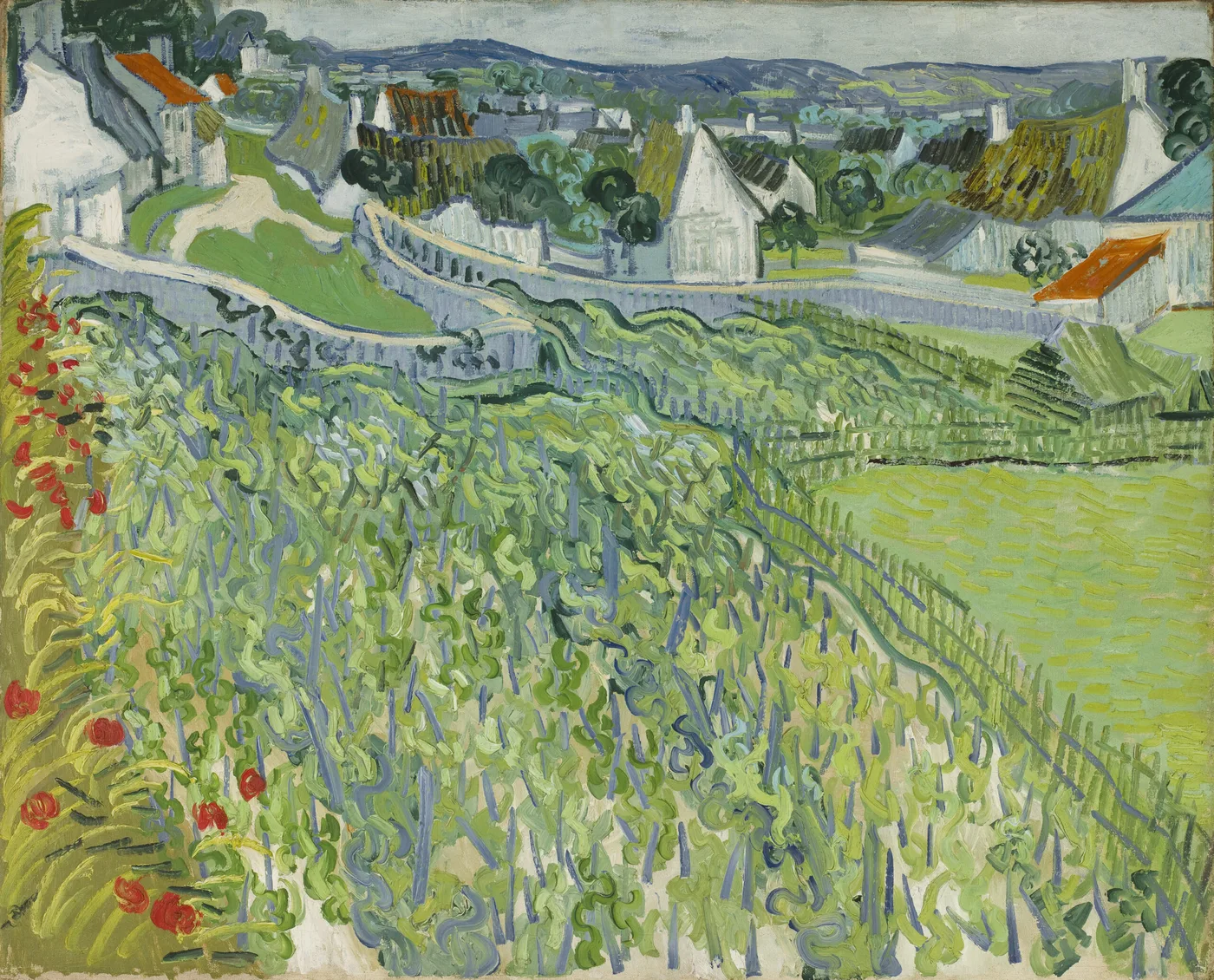
By May 1890 Vincent van Gogh had left the asylum at Saint-Remy and settled in Auvers-sur-Oise, a village north-west of Paris where he could work under the informal watch of Dr Paul Gachet. He had ten weeks left to live, and he used them at a pace that still startles anyone who tries to count the canvases: landscapes, portraits, wheatfields, one after another, often a picture a day. Vineyards at Auvers, painted in 1890, belongs to that final burst of work, when the countryside around the village supplied him with subject after subject almost faster than he could paint it.
He was not new to vines as a subject. Two years earlier in Arles he had painted the Red Vineyard, the only picture he is recorded to have sold in his lifetime. At Auvers he returned to the theme on a hillside above the village, looking down over rows of young vines toward the roofs and church tower below.
Auvers in the Early Summer of 1890
Auvers-sur-Oise was, and still is, a working village set among wheatfields, orchards and vineyards on the slopes above the River Oise. Van Gogh chose it partly for Gachet’s presence and partly because Pissarro and Cezanne had painted there before him, drawn by the same undulating farmland and thatched cottages.
The vines on the hillside would have been low and newly leafed at that point in the season, staked in long parallel rows that followed the fall of the land. It is exactly this kind of unremarkable, cultivated slope, the sort a resident would walk past without a second look, that Van Gogh kept returning to in these final weeks.
A Hillside Seen from Above
The viewpoint is high and looking down, as though the painter had climbed partway up the slope and turned to face the vines running away beneath him. Rows of staked vines fill almost the entire lower two-thirds of the canvas, curving and dipping with the contour of the hill before the land levels out toward a low wall and a scatter of houses.
Beyond the wall, Auvers itself climbs into the middle distance: white-walled cottages with steep orange-tiled and thatched roofs, a church spire, a huddle of trees, and then a band of soft blue-grey hills closing the view under a pale, even sky. In the lower left corner a cluster of red poppies and tall grass breaks into the vine rows, the only note of bright red in the whole composition.
A path or low wall winds diagonally across the middle ground, giving the eye a route from the near vines up into the village and out to the hills, a device Van Gogh used often in his Auvers landscapes to knit foreground and distance into one continuous, breathing space.
Green Against Grey-Blue
The picture is built almost entirely from greens: acid yellow-green in the sunlit vine leaves, deeper sage and olive in the shaded rows, a cooler blue-green in the fields to the right. Against this, the vine stakes and trunks are laid in as slate blue and violet-grey strokes, a colour that recurs in the roofs, the distant hills and the shadows under the eaves, tying the whole hillside together.
The sky offers almost no drama, just a pale wash of grey-blue and cream that lets the eye stay on the land. Colour, rather than tonal contrast, carries the sense of depth here: the greens cool and grey as they recede toward the hills, while the poppies and orange roof tiles stay warm and sit forward in the picture plane.
The Rhythm of the Brush
Every row of vines is built from short, curling, almost calligraphic strokes, laid down fast and packed close together, so that the whole slope reads as a single vibrating surface rather than a field of individual plants. The stakes are drawn in with longer, straighter marks of blue-grey that cut against the curls of the leaves and give the rows their structure.
The houses and roofs are painted more flatly, in broader patches of white, orange and green, which lets them sit quietly behind the restless foreground. It is a working method typical of these last weeks at Auvers, when Van Gogh painted directly and rapidly from the motif, trusting the loaded brush to keep pace with what he saw.
At 79.5 by 64.2 centimetres, the canvas is large enough for that brushwork to read clearly from across a room, each stroke of the vine rows still legible as an individual mark rather than dissolving into texture.
On a Wall, Through the Day
Hung where daylight reaches it, the painting shifts with the hours much as the real hillside would have. Morning or overcast light draws out the cooler blue-greys in the vine stakes and hills; a warmer lamp in the evening pulls the yellow-greens and the orange roof tiles forward.
It suits a room where there is space to stand back from it, since the high, sweeping viewpoint and the long diagonal of the path reward a moment of just looking rather than a glance in passing. The original hangs in the Saint Louis Art Museum, one of the clearest surviving records of how Van Gogh looked at the ordinary, cultivated land around him in the last summer of his life.
Sizes and materials for Vineyards at Auvers are listed on its product page.
More from this collection
Bring this painting home
Choose a hand-painted oil reproduction for real brushwork, or an archival canvas print for a crisp museum-image edition. Every size preserves the original proportions.
View this work & options
Further reading
Verify the original in the Saint Louis Art Museum collection record and continue through related works in the catalogue.