
Portrait of Eugene Boch (The Poet): Story
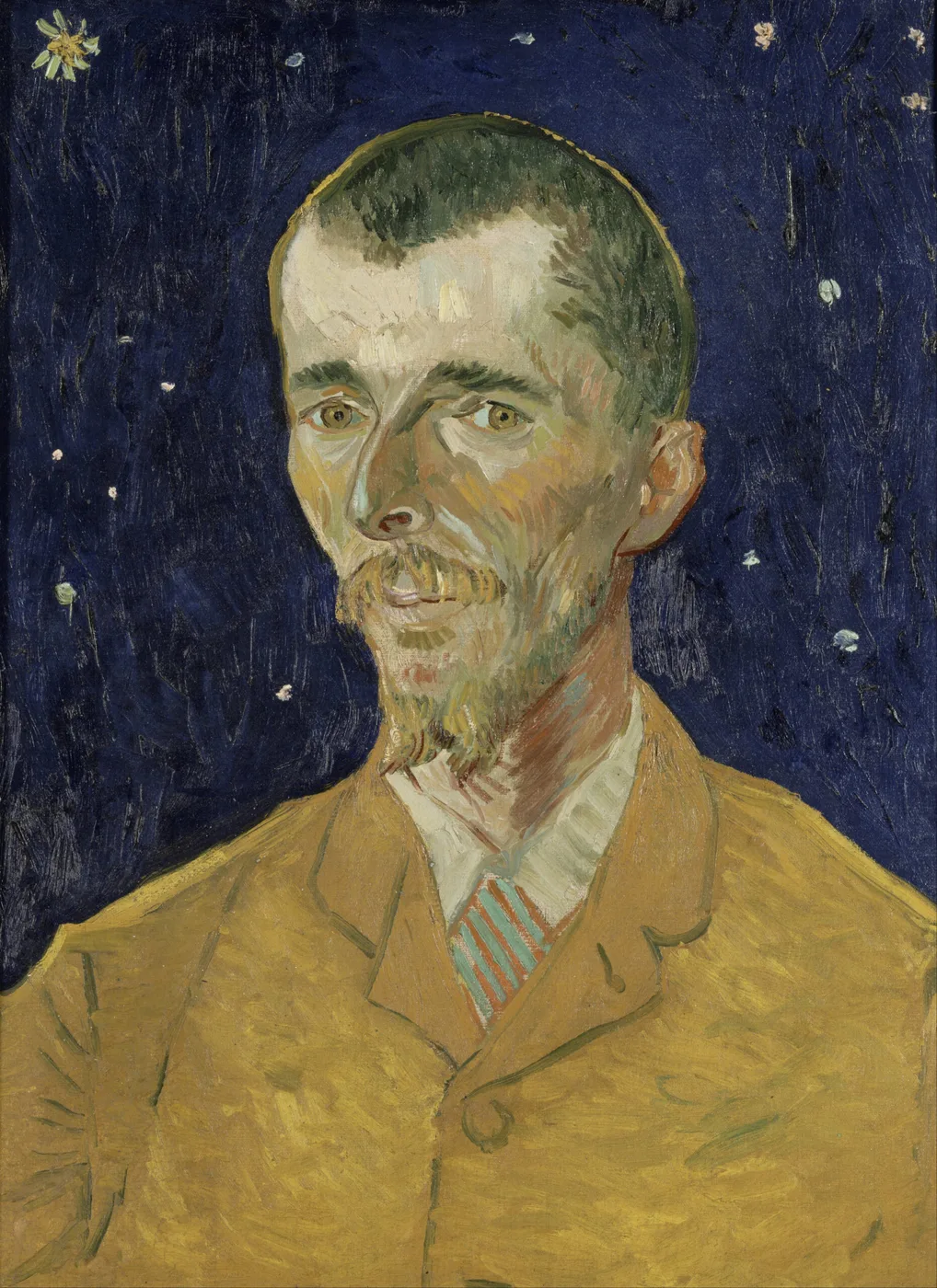
In the late summer of 1888 Vincent van Gogh was living in the Yellow House in Arles, trying to turn a rented set of rooms into a working artists’ colony. Few painters ever took him up on the invitation. Eugène Boch, a Belgian painter in his early thirties who had come south to work at nearby Fontvieille, was one of the small number who did, and van Gogh asked to paint him before he left.
Boch worked in paint, not verse, but van Gogh looked at his long face and fair colouring and saw something closer to a poet than a fellow craftsman. He gave the finished canvas its own nickname, “The Poet”, and treated the sitting as licence to invent rather than record. The result, painted in Arles in 1888, is one of the more unusual portraits to come out of that year.
A Face Built From Sharp Edges
Boch’s head is angled slightly, his gaze carried off to one side rather than meeting the viewer directly. The forehead is high and pale, the hairline already retreating, and van Gogh has let pale yellow and white catch along the crown where the light is strongest.
Around the eyes and jaw the skin turns green and ochre, mixed straight into the flesh tones rather than kept as shadow. It gives the face a slightly feverish cast, amber eyes set deep under dark brows, a long straight nose, a thin reddish-gold beard trimmed close along the chin.
Below the collar a striped tie, blue and rust against a starched white shirt, is one of the few passages painted with any restraint. Everything above it, the skin especially, is built from small adjustments of colour rather than line.
A Night Sky With No Real Stars in It
Van Gogh set that head against a ground of almost pure dark blue, worked in long diagonal strokes that read, from a distance, like the weather itself moving behind the sitter. Scattered across it are small flecks of white and pale gold, not drawn as recognisable constellations but placed loosely enough to suggest them.
He wrote to his brother Theo around this time about wanting to paint a dreamer’s portrait against “the richest, most intense blue” he could find, so that a fair head would sit there “like a star in the depths of an azure sky”. This canvas is that idea carried out in paint rather than description.
In the upper left corner a single pale flower interrupts the field of blue, small and slightly out of place, more a private mark than a botanical detail. It is easy to miss and, once noticed, hard to stop looking for.
Cloth Painted Like Weather
Boch’s coat is a heavy mustard yellow, laid on in broad, visibly directional strokes that curve around the shoulder and fall in straighter lines down the chest. Van Gogh has not tried to disguise the brushwork here as he did, to some extent, on the face.
The paint sits thick, ridged, almost woven, in obvious contrast to the thinner, more worked surface of the skin above the collar. Between the coarse gold of the coat and the smoother modelling of the head, the eye is pulled upward, back to the face, every time it wanders.
That contrast between built-up cloth and closely handled flesh is one of the things that keeps this small canvas, only 45 by 60 centimetres, from reading as a conventional likeness. It behaves more like an idea worked out at close range than a record of an afternoon’s sitting.
Living With It, Through the Day
Hung in a room that gets any daylight at all, the blue ground behaves differently by the hour. Morning light flattens it toward black; by late afternoon, with the sun lower and warmer, the same passage can lift toward a genuine midnight blue, and the scattered flecks start to read again as something closer to stars.
Under lamplight in the evening the coat takes over, that mustard yellow warming further and pulling the whole picture toward gold. The face, caught between the two fields of colour, shifts with them rather than staying fixed, which is a fair description of how van Gogh seems to have wanted a portrait to work.
The original hangs in the Musée d’Orsay in Paris, one canvas among many from a short, intensely productive stretch of van Gogh’s time in the south. Small as it is, it carries more of his ambition for portraiture, the wish to paint not a likeness but a state of mind, than its size would suggest.
Sizes and materials for Portrait of Eugène Boch are listed on its product page.
More from this collection
Bring this painting home
Choose a hand-painted oil reproduction for real brushwork, or an archival canvas print for a crisp museum-image edition. Every size preserves the original proportions.
View this work & options
Further reading
Verify the original in the Musée d'Orsay collection record and continue through related works in the catalogue.