
Still Life with a Bouquet of Daisies: Story
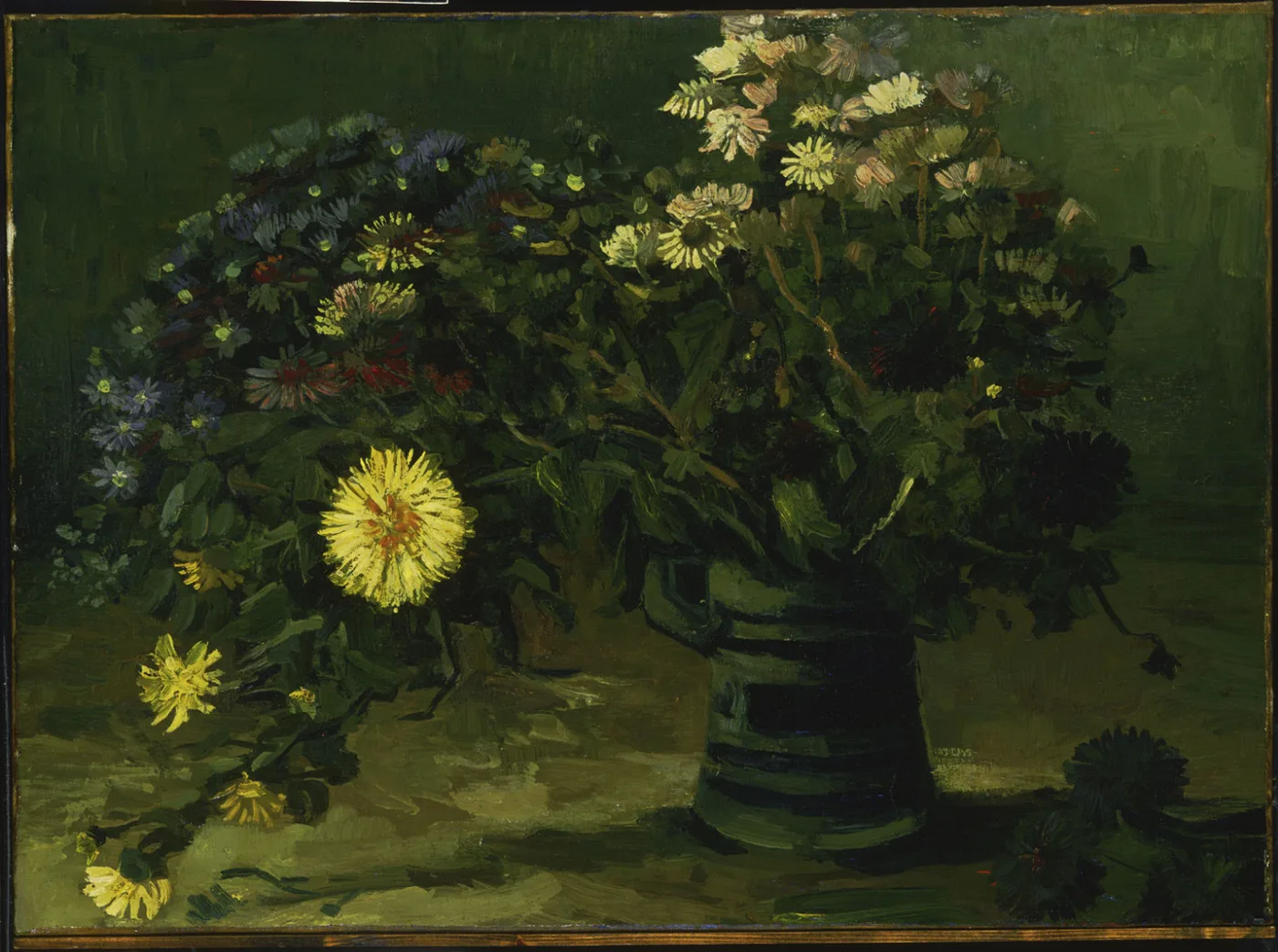
Vincent van Gogh arrived in Paris in the early months of 1886 with almost nothing settled about how he wanted to paint. He moved into his brother Theo’s apartment, gave up the murky brown interiors he had built his reputation on in Nuenen, and set about teaching himself colour from scratch. Still Life with a Bouquet of Daisies, painted that same year, is one of the results: a canvas made not to be sold or shown, but to be worked through, brush in hand, until something about seeing had changed.
Flowers were the cheapest and most patient subject available to him. A bunch bought or gathered would hold its pose for a few days, long enough to try the same jug and the same blooms again and again, hunting for how one green sat against another. Dozens of these studies survive from his first year in the city, and this canvas is among them, unsigned, undated by the artist’s own hand, working notes rather than a finished statement.
What sets this particular painting apart is how little it borrows from the brighter Paris he would soon discover. The colour is still close, still earthbound. It reads as a hinge picture, made just before the city’s light fully got into his work.
A Crowded Jug on a Bare Table
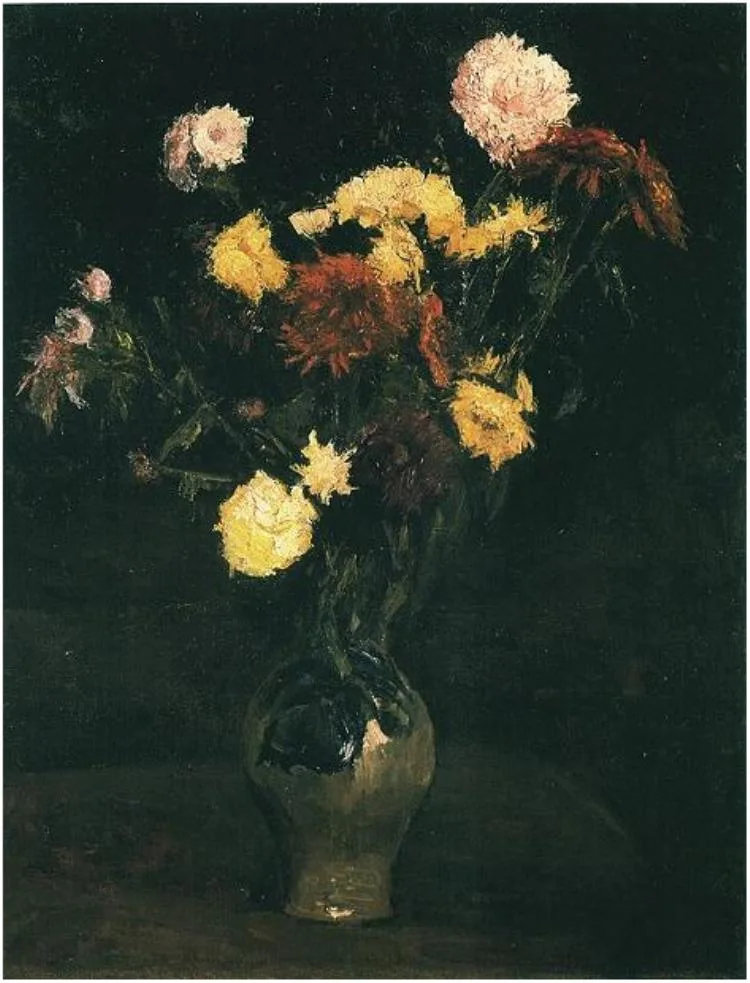
A single stoneware jug, banded in darker green, stands slightly right of centre on a plain tabletop. Out of its narrow neck rises a dense, top-heavy mass of flowers, so full that the jug almost disappears under the weight of what it is holding.
The bouquet mixes several kinds of late-summer bloom. White and pale cream daisies open flat-faced toward the viewer, small mauve and lilac asters cluster at the left, and a few deep maroon flowerheads sit half-swallowed in shadow toward the back of the arrangement.
At the lower left, two or three bright yellow dandelion-like flowers have dropped or been laid loose on the tabletop, apart from the jug altogether. They are the first thing the eye catches, before it climbs back up into the tangle of paler blooms above.
Painting Almost Entirely in Green
Van Gogh sets the whole scene against a flat, dark olive-green backdrop, with a slightly lighter green table beneath. Jug, leaves, stems and background all sit within a narrow band of the same colour family, so the picture holds together as one dim, enclosing space rather than a room with defined edges.
Against that low key, the flowerheads carry almost all the picture’s light. Each petal is laid down as a short, loaded stroke, dabbed rather than blended, radiating outward from a darker centre in yellow, cream or pale pink.
The leaves and stems are handled more loosely, dragged and hooked in longer marks that describe mass rather than individual form. Van Gogh is not drawing each stem so much as finding the shape the whole bouquet makes against the wall behind it.
The canvas itself is small, 57.2 by 41.6 centimetres, close to the size of the bouquet it shows. That scale matters: this is a picture meant to be studied at arm’s length, on a tabletop or an easel, not viewed across a gallery floor.
A Step Before the Brighter Paris Pictures
Within a year or so of painting this jug of daisies, Van Gogh would be laying down pure cadmium yellows and cobalt blues learned from Impressionist and Neo-Impressionist canvases he saw in Paris dealers’ windows. That shift has not happened yet here.
What this still life shows instead is the groundwork for it: an artist deliberately narrowing his subject to a single jug of flowers so he could concentrate on nothing but colour relationships, without a landscape or a figure to distract him. The darkness of the palette is not timidity, it is control, a way of testing how far pale petals could be pushed to glow against a field of green before the picture stopped reading as a bouquet at all.
The painting is now held by the Philadelphia Museum of Art, part of a public collection where it can still be seen and studied in person.
How It Reads on a Wall
In low or evening light, the picture sits close to monochrome, and the flowerheads seem to surface out of the green rather than sit in front of it. Little by little, as the eye adjusts, the maroon and mauve blooms buried in the shade become visible.
Under stronger daylight, the same canvas opens up. The variety Van Gogh built into a narrow colour range, the pinks, lilacs and creams tucked among the yellow, becomes easier to separate and follow, and the two loose flowers on the tabletop step forward from the rest.
Seen either way, it rewards a second and third look rather than a single glance. That is, after all, what it was made for: not a finished display piece, but a study in how much a painter can find in one ordinary jug of flowers if he keeps looking.
Sizes and materials for Still Life with a Bouquet of Daisies are listed on its product page.
More from this collection
Bring this painting home
Choose a hand-painted oil reproduction for real brushwork, or an archival canvas print for a crisp museum-image edition. Every size preserves the original proportions.
View this work & options
Further reading
Verify the original in the Philadelphia Museum of Art collection record and continue through related works in the catalogue.