
Four Withered Sunflowers: Story & Meaning
A Painter Taking Stock in Paris
By 1887 Vincent van Gogh had been in Paris for close to two years, sharing rooms with his brother Theo and working his way through everything the city had to teach him. He had arrived with the muddy, potato-coloured palette of Nuenen still in his hand, and he was leaving it behind fast, unsettled by what he saw in the studios and salons around him.
He was looking hard at the Impressionists, at Signac and Seurat’s broken colour, at the flat planes of Japanese prints pinned to café walls. None of it was copied outright. Instead he tested it, painting his way through the ideas rather than reading about them, and a still life of cut flowers on a table was as good a testing ground as any.
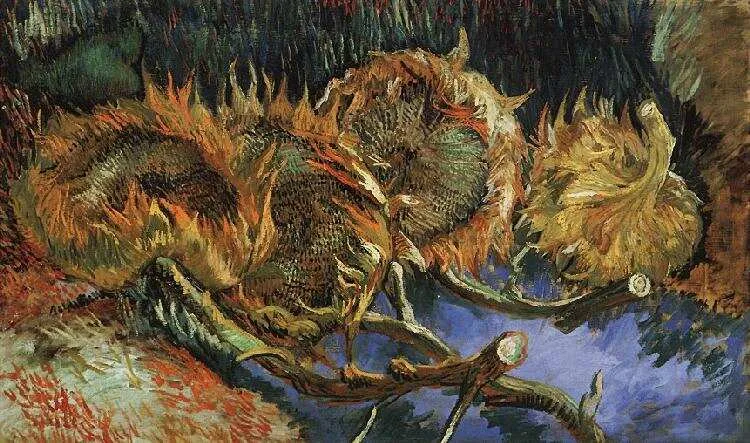
That year he painted several groups of sunflowers, not standing proud in water but cut at the stem and set down flat, already turning. This picture, later known as Four Withered Sunflowers, belongs to that run of studies, made in Paris a full year before he ever reached the south of France.
Four Heads, Laid Low
Four sunflower heads lie across the canvas on their sides, not arranged upright in a vase. Two thick, woody stems curve out of the lower half of the picture toward the viewer, gnarled and cut clean at the end, holding the flowers down like a hand pressing them to the table.
The head at the left keeps the most of its shape and colour, its petals still fanning out in a ring of orange and red. Moving right across the canvas the heads collapse further into themselves, petals curling under, the last one reduced almost to a ragged crest of pale gold against the wall behind it.
The setting gives almost nothing away. A dark ground of green, blue-black and flecks of dull red fills the upper half of the canvas, while the right edge warms to a rusty ochre, as if the artist changed his mind about the light in the room partway through.
Colour Turned Loose
Van Gogh builds each head from short, direct strokes that follow the actual shape of the thing they describe, curving round the seed disc, radiating out along a petal. The paint sits proud of the canvas in places, laid on thickly enough that the brushmarks read as texture as much as colour.
The oranges and browns of the flowers sit against a ground shot through with blue and violet shadow, particularly beneath the stems, where the paint darkens almost to black. That contrast does most of the work: without it the heads would flatten into the background rather than push forward from it.
Look closely at any one seed disc and the mark-making turns almost obsessive, hundreds of small dabs standing in for the packed florets of a real sunflower head gone to seed. It is a kind of looking most painters would not bother with on a subject already dying.
A Study Before Arles
A year later, in Arles, Van Gogh would paint the sunflower still lifes that made the flower his own, bright heads standing upright in a vase against flat yellow walls. Four Withered Sunflowers, painted at 100 by 60 centimetres, is where the groundwork for those pictures was laid, though the mood here is nothing like the later triumph.
These flowers are not celebrated at their peak. They are shown past it, drooping and drying, and the picture is more interested in structure and decay than in the decorative brilliance the Arles paintings would later chase. It reads as research: how does a sunflower head actually sit, fold and lose its colour once it is cut.
The larger canvas gave him room to let each head carry real weight, close to life size, so the still life reads less like a tabletop arrangement and more like a study of four separate subjects that happen to share a surface.
On a Wall, in Changing Light
The original hangs today in the Kröller-Müller Museum, its dark ground and thick impasto rewarding the kind of close, unhurried look a museum wall allows. That same darkness is what makes the picture change so much with the light around it.
In low or evening light the background all but disappears and the orange heads seem to float free of everything else. Under a stronger, more direct light the brushwork itself comes forward, every ridge of paint catching a small shadow of its own, and the picture turns from an image into an object you can see was made by hand.
Sizes and materials for Four Withered Sunflowers are listed on its product page.
More from this collection
Bring this painting home
Choose a hand-painted oil reproduction for real brushwork, or an archival canvas print for a crisp museum-image edition. Every size preserves the original proportions.
View this work & options
Further reading
Verify the original in the Kröller-Müller Museum collection record and continue through related works in the catalogue.