
Marguerite Gachet at the Piano: Story & Meaning
In May 1890 Vincent van Gogh left the asylum at Saint-Remy and settled in Auvers-sur-Oise, a village north of Paris chosen partly for its quiet and partly for the presence of Dr Paul Gachet, a physician with an interest in art and in troubled artists. Van Gogh had roughly ten weeks left to live, though nobody around him knew it. He painted at a rate that still startles cataloguers, often a canvas a day, turning the fields, the church, the thatched cottages and the people of Auvers into subjects.
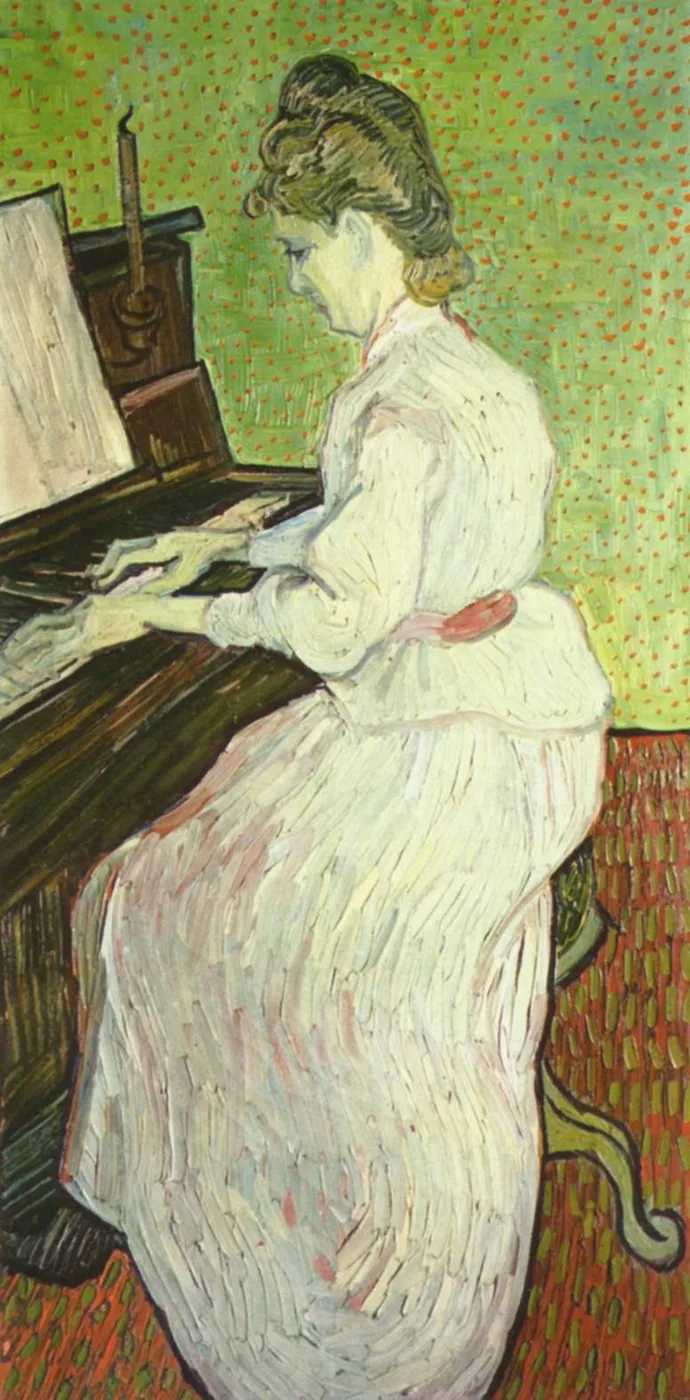
Among those people was the doctor’s own household. Van Gogh painted Marguerite Gachet twice within his final month there, and this canvas, dated to June 1890, is the more private of the two. It shows her at the piano, absorbed in playing, unaware of being watched. There is no sense of a sitting arranged and held; the picture reads as a moment caught mid-note.
A Daughter at the Keyboard
Marguerite sits in profile at an upright piano, her whole attention on the keys. Her hands are raised over the instrument, fingers finding a chord, and a sheet of music stands open on the rest in front of her. A small candle holder rises from the piano’s case beside her, unlit, part of the furniture of an ordinary evening.
She wears a pale, rose-tinted gown, more white than pink at a distance, gathered at the waist by a coral sash that is the single strongest note of colour on her figure. Her hair is drawn up loosely, a few strands loosened at the neck, the kind of detail that comes from painting a real person rather than inventing a type.
Behind her the wall is a field of green stippled all over with small red dots, and beneath her feet the floor is laid in warm red tile, itself flecked with green. The room narrows into these two fields of colour, wall and floor, with Marguerite and the dark bulk of the piano set between them like a hinge.
A Portrait Meant to Hang as a Pair
Marguerite Gachet was nineteen that summer, the doctor’s only daughter, and Van Gogh seems to have planned this canvas with a partner in mind: a portrait of her mother, in the manner of the paired domestic portraits by earlier masters that he had studied and admired. The unusually tall, narrow format, 50 by 102.5 centimetres, is itself a clue to that ambition, a shape suited to hanging alongside another of the same proportions.
Whether the companion piece was ever begun is not something the picture itself can tell us. What survives is this one canvas, complete in its own right, a portrait of a young woman occupied with music in her family’s house.
It sits within a small group of works Van Gogh made of the Gachet household that summer, evidence of how quickly he had been drawn into the domestic life of the one household in Auvers that took him in.
Colour Handled Like Sound
The paint across the wall is laid on in short, separate dashes, green over green with the red dots dropped in almost like notes struck at intervals, a rhythm that has more in common with the piano being played than with any conventional wallpaper pattern. It is a device Van Gogh used elsewhere that summer, but here it does real work, filling the room with a kind of visual sound.
Against that active field, Marguerite’s dress is built from longer, softer strokes, pale and slightly chalky, so that she reads as still even while her hands are in motion. The coral sash and the warm red floor answer each other across the canvas, holding the composition together at top and bottom.
The piano itself is painted darker and more loosely, browns and blacks worked quickly, a solid shape against which the pale figure and the green wall both gain their brightness. Nothing in the handling is laboured; the whole picture has the directness of work done in a single sustained sitting.
In a Room, and as the Light Changes
Hung in a room today, the painting keeps that same quality of an overheard moment rather than a posed likeness. Marguerite does not face the viewer, does not perform for anyone; the eye is invited to watch her the way one might glance in on someone practising alone in the next room.
Its colours shift with the light around it. In cooler daylight the green wall reads as the dominant field, the red dots quietening into texture; under warmer evening light the pink of the dress and the red of the floor come forward, and the painting feels less like a study in green and more like a study in warmth.
The original hangs at the Kunstmuseum Basel, one of the works from Van Gogh’s final weeks at Auvers-sur-Oise that shows him working not toward crisis but toward quiet, focused observation, a young woman, a piano, an ordinary June evening turned into paint.
Sizes and materials for Marguerite Gachet at the Piano are listed on its product page.
More from this collection
Bring this painting home
Choose a hand-painted oil reproduction for real brushwork, or an archival canvas print for a crisp museum-image edition. Every size preserves the original proportions.
View this work & options
Further reading
Verify the original in the Kunstmuseum Basel collection record and continue through related works in the catalogue.