
Portrait of Armand Roulin: Story, Meaning & Brushwork
By the fourth week of a stay in Arles, Vincent van Gogh had mostly stopped hiring models. Professional sitters cost money he did not have, and posed too stiffly for what he wanted from a face. Instead he turned to the people around him: the postal worker who drank with him, the innkeeper’s daughter, and, that same year, an entire family who happened to live down the street from the Yellow House.
Portraits of People He Knew
The family belonged to Joseph Roulin, a postal employee in Arles whom van Gogh had befriended not long after arriving in the south. Roulin sat for him repeatedly through 1888, and in time so did his wife and each of their children.
Armand was the eldest of the Roulin children, on the edge of adulthood and already apart from the household routines of his younger siblings. He was old enough to be painted less as a child and more as a young man deciding who he was going to be.
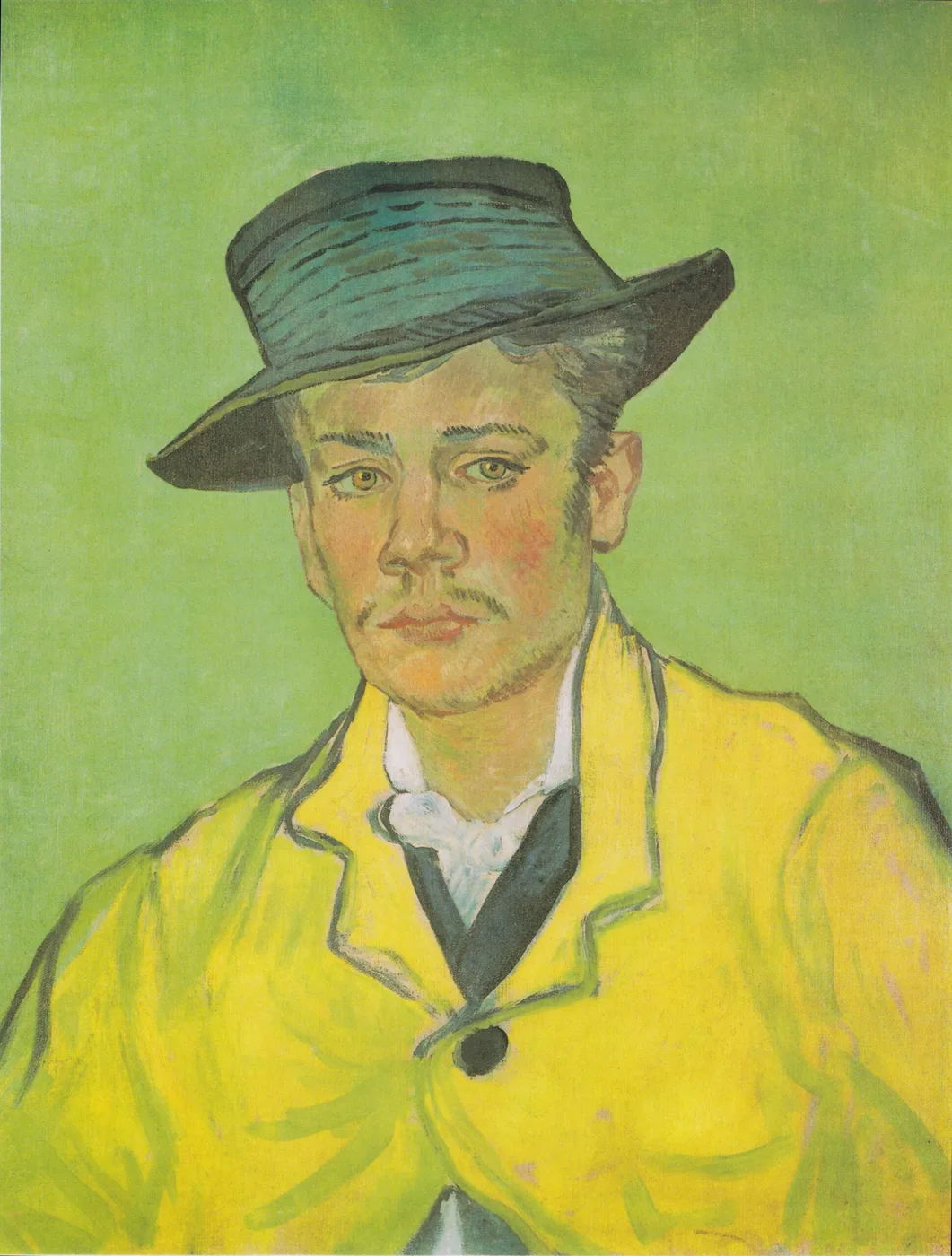
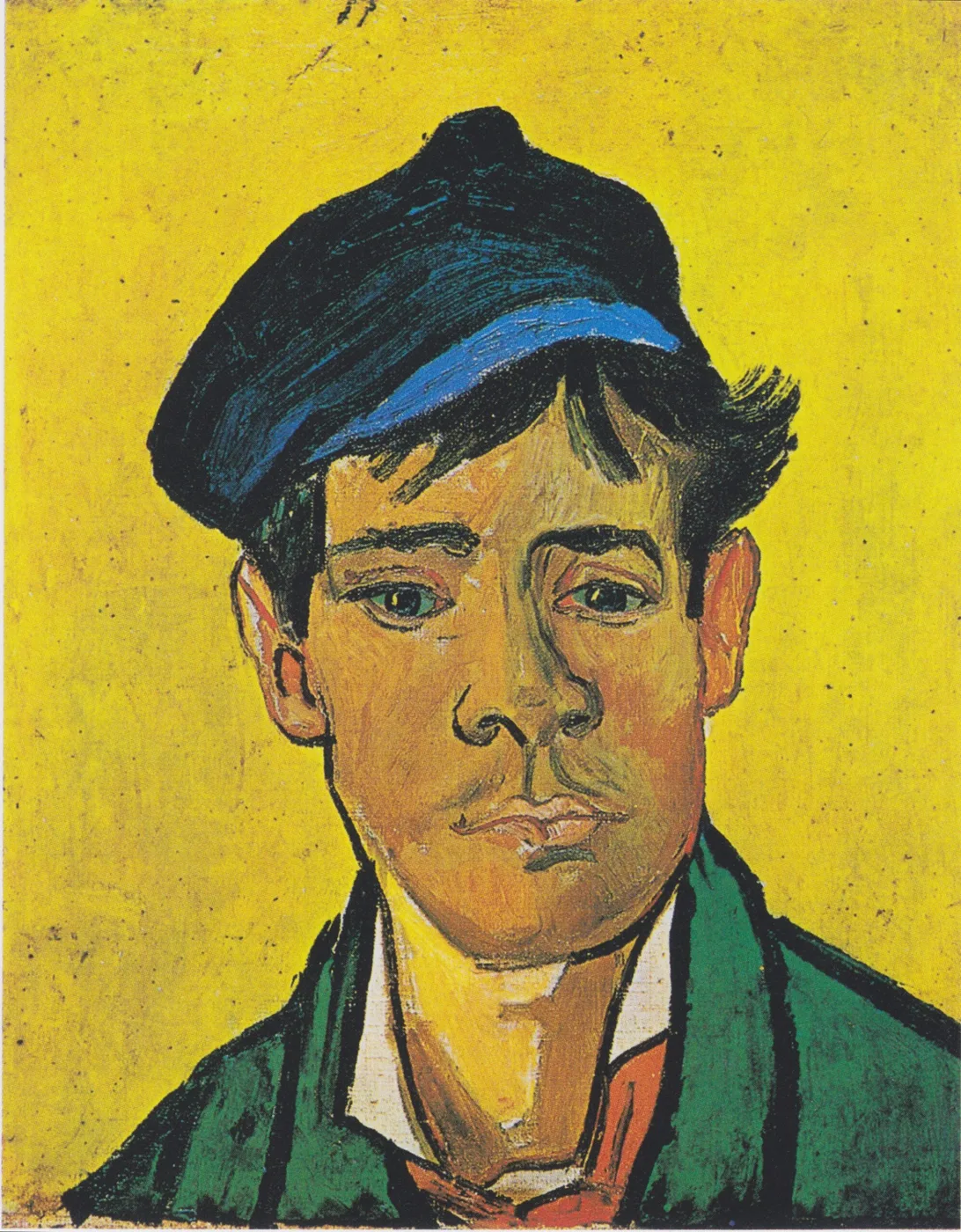
Van Gogh painted him twice that year. This picture, showing Armand in a bright yellow coat against a plain green ground, is one of the two, and it carries a settled, direct quality that suggests a sitter and a painter who already knew each other well.
Yellow Against a Field of Green
The coat takes up most of the canvas. It is an unmodulated, almost lacquered yellow, broken only by a dark button, a triangle of white shirt and a black cravat knotted loosely at the throat.
Behind him the wall is green, paler and cooler near the head, deepening slightly toward the edges of the canvas. Van Gogh had used exactly this kind of pairing before, setting a warm colour against its opposite so that each pushes the other to its full strength.
Between the two fields sits Armand’s face, painted in softer, warmer tones: rose in the cheeks and the tip of the ear, ochre and pink across the forehead and jaw. The effect is of a head lit from within a much stronger colour field, rather than lit by any obvious source of daylight.
A dark, wide-brimmed hat sits low over his brow and throws his eyes into shadow. Under it his gaze is steady and a little guarded, meeting the viewer without quite offering anything away.
The Hand That Built the Paint
Look closely at the hat and the brushwork changes character entirely from the coat beneath it. Short diagonal strokes of blue-green and near-black build up the crown and brim, laid one against another so the felt seems to have a nap and a weight of its own.
The green background is handled more loosely still, in visible sweeps that leave the canvas weave showing through in places. None of it is blended smooth; van Gogh was working fast, in thick, wet paint, and left the marks of that speed on the surface.
A dark outline, almost like a wire, runs around the shoulders and collar of the coat, holding the flat yellow shape against the green behind it. That kind of contour, borrowed loosely from the printmaking and cloisonné painting he admired, gives the whole figure a slightly graphic, poster-like clarity.
The face is the one area painted with more care and more small adjustments, the brush moving in shorter, more descriptive strokes around the eyes, nose and moustache. It is where van Gogh slowed down, and it shows.
Two Sittings, One Son
That van Gogh returned to Armand for a second portrait says something about how he worked through the Roulin family that year. He was not simply collecting likenesses; he was studying the same people repeatedly, adjusting pose, costume and colour scheme each time.
1888 was an intense working year for him, crowded with self-appointed projects, and the Roulins gave him sitters he did not have to pay, persuade or explain himself to. Painting Armand in his own coat and hat, rather than in a costume chosen for the picture, kept the portrait tied to an actual person rather than a type.
The painting is dated to that year and measures 54.1 by 65 centimetres, a scale close to life size for a head and shoulders, close enough that the sitter’s gaze reaches the viewer at something like its original intensity.
In a Room, Through Changing Light
Museum Folkwang in Essen holds the painting today, where the yellow and green sit under gallery lighting chosen to keep both colours honest. In a domestic room the same canvas behaves differently through the day, the green wall behind Armand shifting from acid to a duller olive as the light drops, the yellow coat holding its charge longer than almost anything else in the room.
Hung at eye level, the portrait keeps doing what it was built to do in 1888: a young man in a hat, caught between colours that will not quite settle down around him, looking back at whoever happens to be looking at him.
Sizes and materials for Portrait of Armand Roulin are listed on its product page.
More from this collection
Bring this painting home
Choose a hand-painted oil reproduction for real brushwork, or an archival canvas print for a crisp museum-image edition. Every size preserves the original proportions.
View this work & options
Further reading
Verify the original in the Museum Folkwang collection record and continue through related works in the catalogue.