
Self-Portrait with Glass: Story, Meaning & Brushwork
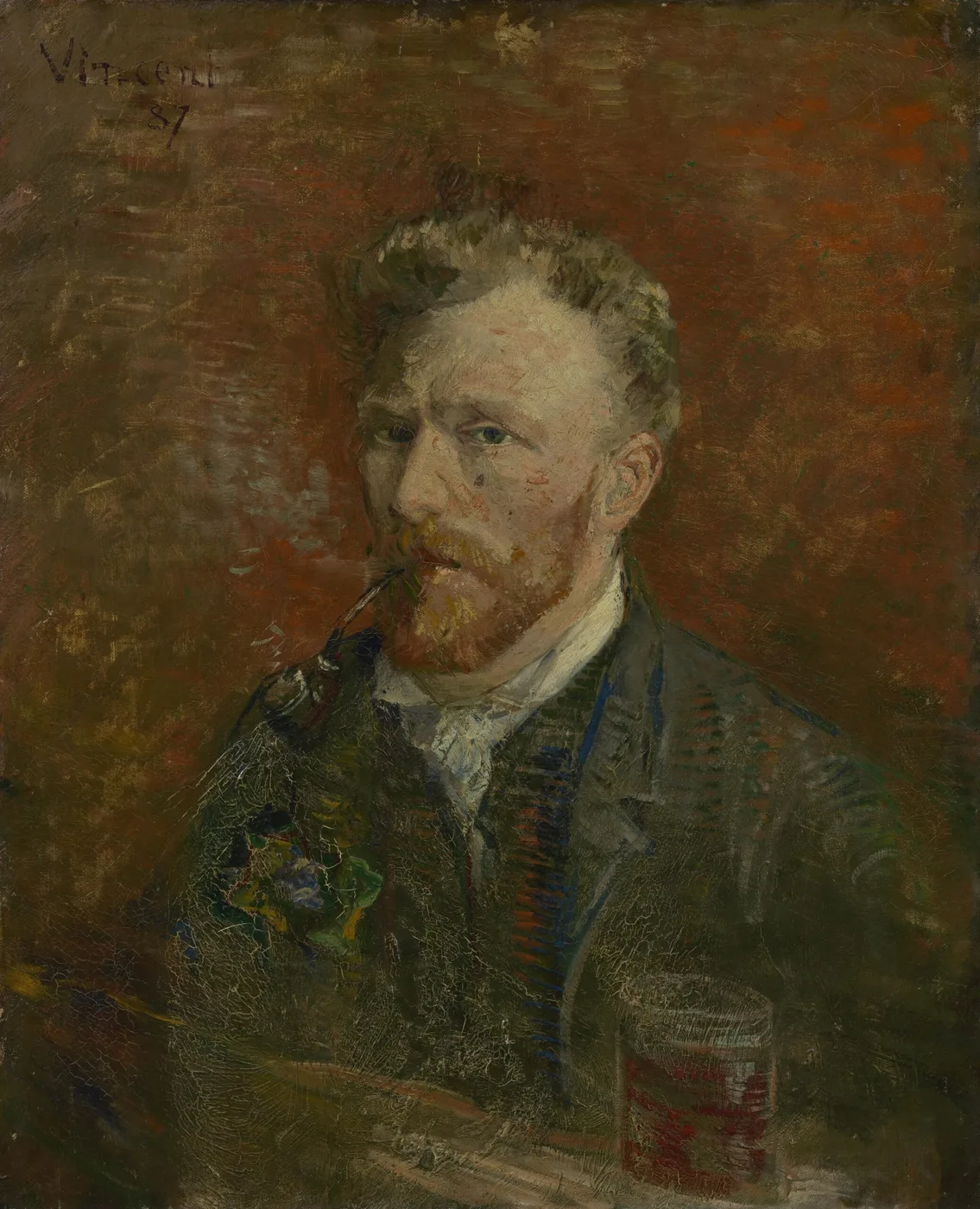
By the summer of 1887 Vincent van Gogh had been living in Paris for well over a year, sharing an apartment with his brother Theo on the Rue Lepic and spending his days among painters who talked about colour the way chemists talk about compounds. He had arrived from Antwerp still working in the dark, earthy palette of the Dutch countryside. Paris undid that habit fast.
He fell in with painters experimenting with broken colour, among them Signac and, through the print dealer Julien Tanguy, the example of Seurat. Van Gogh began laying paint in small, separate touches rather than blended passages, testing how red against green or blue against orange could make a surface seem to vibrate rather than simply describe a face. Self-Portrait with Glass, painted in 1887, is one of the results of that experiment.
A Sitter Who Cost Nothing
Models were a luxury Van Gogh could rarely afford in Paris. A mirror and his own face solved that problem, and he returned to it obsessively, producing more than twenty self-portraits during his two years in the city. Each one reads less as vanity than as practice, a way of pushing a new technique on a subject he did not have to pay or persuade to sit still.
This particular canvas carries his signature and the year in the upper left corner, written simply as Vincent 87. At 50 by 61 centimetres it is a modest, close-cropped picture, built for study rather than display, and it now belongs to the Van Gogh Museum in Amsterdam.
What the Canvas Shows
Van Gogh presents himself half length, turned slightly so that his gaze meets the viewer at an angle rather than head on. A pipe is clenched in his mouth, its stem angled down past his beard, and at the lower right corner a glass holding a dark red liquid sits on the unseen edge of a table or ledge.
His jacket is a deep, almost black blue-green, painted in short ribbed strokes that catch the light unevenly across the shoulders. A soft white collar opens at the throat, the one passage of the picture with no colour fighting for attention. Near the left shoulder a small patch of loose blue, green and ochre breaks the dark cloth, as though a rag or a smear of wet paint had brushed against it while he worked.
His face is where the technique shows most plainly. Pink, green and pale yellow strokes sit side by side across the forehead and cheeks, never fully mixed, so that the skin seems to flicker rather than sit still. His hair and beard, a ruddy ginger-blond, are built the same way, dabbed rather than shaded, and his blue eyes hold steady under brows drawn with a few dark, decisive lines.
Colour Built from Small Strokes
The background is where the new method is easiest to read at a distance. It is not a flat wall but a field of rust, ochre and dull red laid in short, directional dashes that run in different orientations around the head, closer in places to hatching than to a painted surface. Nothing in it describes a room; it exists only to set off the figure and to let one warm colour argue with another.
Across the whole picture there is a fine network of surface cracking, the kind of ageing common to oil paint of this date, which under raking light adds a second, unplanned texture to Van Gogh’s own restless brushwork. The paint itself is thick in places, almost dragged, and thin in others where the canvas weave still shows through.
What makes the picture cohere is restraint of a kind Van Gogh rarely gets credit for. The palette is narrow, built mostly from reds, greens and a handful of warm neutrals, and every stroke belongs to that limited family. It is a controlled experiment in how far broken colour can carry a likeness before the likeness dissolves into pattern, and here it stops just short of that point.
In a Room, Changing with the Light
Seen from across a room, the picture reads first as a face against a warm, unsettled ground, the glass and pipe registering only afterward as small, specific details. Come closer and the illusion breaks apart into hundreds of individual marks, none of them describing anything on its own.
Daylight and lamplight treat the surface differently. In the flat light of afternoon the reds and greens sit close together and the face reads calmly; under a lower, warmer bulb in the evening the ridges of paint throw small shadows of their own, and the picture takes on a rougher, more agitated character, closer to how it must have looked freshly finished on the easel.
It rewards the kind of looking that most paintings on a wall never get, a first glance from a doorway and a second one from a few inches away, each showing something the other missed. That is, in the end, what a self-portrait painted for practice rather than for a client still offers a room a century and more later: a face worked out stroke by stroke, still legible, still slightly unresolved.
Sizes and materials for Self-Portrait with Glass are listed on its product page.
More from this collection
Bring this painting home
Choose a hand-painted oil reproduction for real brushwork, or an archival canvas print for a crisp museum-image edition. Every size preserves the original proportions.
View this work & options
Further reading
Verify the original in the Van Gogh Museum collection record and continue through related works in the catalogue.