
The Mulberry Tree: Story, Meaning & Brushwork
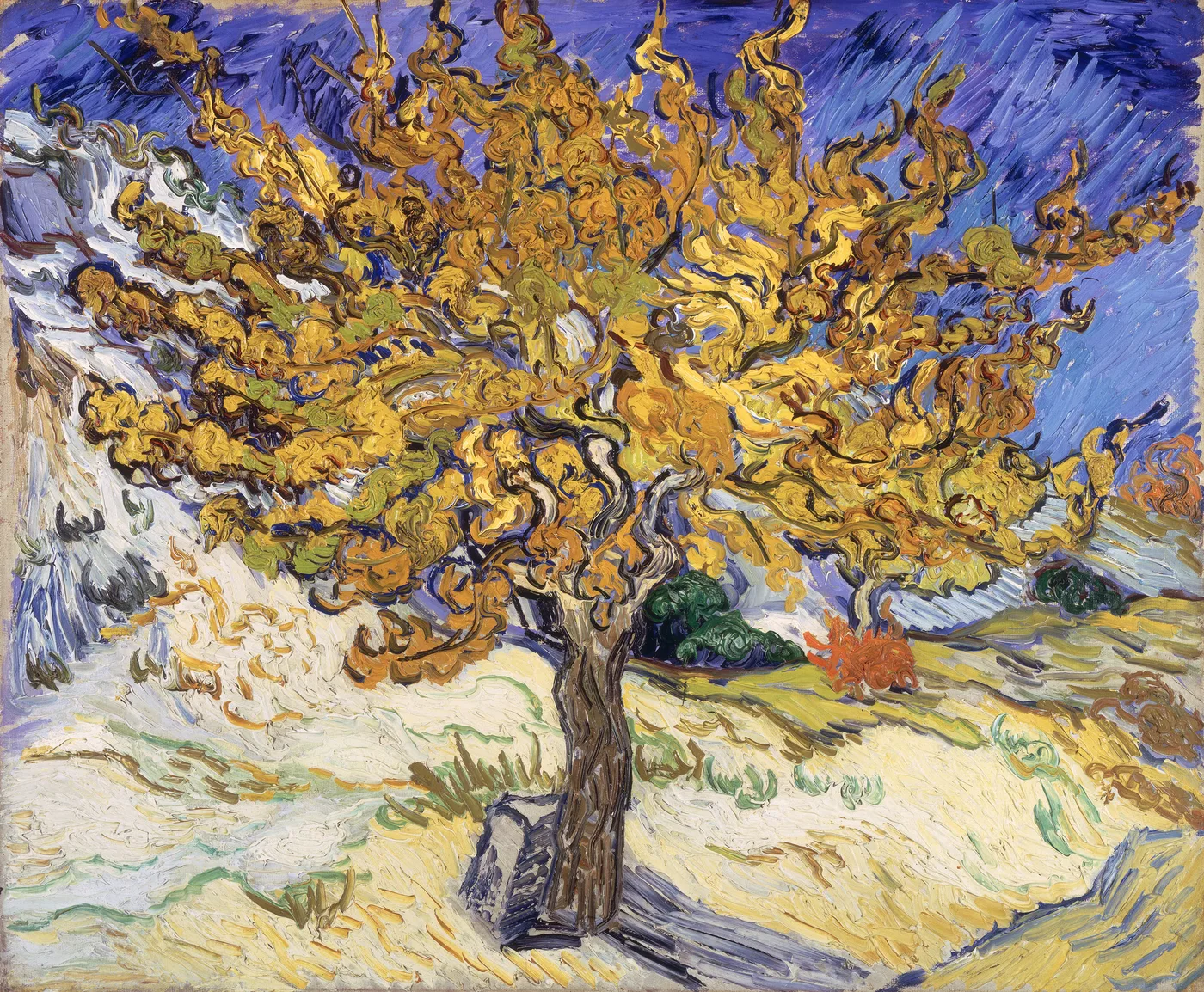
In the autumn of 1889 Vincent van Gogh was living behind the walls of the Saint-Paul-de-Mausole asylum at Saint-Rémy-de-Provence, working through one of the most demanding stretches of his career. He had admitted himself there in May, after the collapse in Arles, and for months his subjects were whatever the grounds and the view beyond the wall allowed him: olive groves, cypresses, wheat fields glimpsed through an iron gate. Late in October he turned to a mulberry tree growing within reach of the building and painted it in a single sustained campaign, working fast while the light and his own concentration held.
A Tree Within the Walls
Van Gogh’s range that autumn was narrow. He was allowed to paint in the asylum garden and, on better days, a short distance beyond it, and the mulberry tree stood close enough to reach without a long walk. Its autumn foliage, already turning, gave him exactly the kind of motif he had been chasing all year: something ordinary that could be pushed into intensity through colour alone.
He is known to have held the finished canvas in particular esteem among the pictures he made that season. It shows in the attention paid to it: this is not a quick study but a picture built up with real deliberation, the whole surface worked to the same pitch from the trunk to the outermost branch.
One Tree, the Whole Canvas
The composition is almost defiantly simple. A single mulberry tree fills nearly the entire 65 by 54 centimetre canvas, its trunk rising slightly off-centre and its crown spreading edge to edge, so that the sky survives only as a band and a few gaps glimpsed through the branches. There is no path leading the eye elsewhere, no incident to distract from the tree itself.
At the base, a pale stone sits against the trunk, and the ground around it is a field of cream, straw and white strokes rather than open grass. To the left the land rises in a paler, chalky slope; to the right a low dark green bush and a smaller cluster of orange-red foliage give the only other colour incidents in the lower half of the painting, small enough to register as accents rather than competition.
The trunk itself is worked as carefully as the crown. It twists as it rises, built from overlapping bands of brown, grey and white paint that read almost like the grain of real bark, and it forks low down into the tangle of limbs that carry the leaves.
Gold Against a Violet Sky
Colour does the work here more than drawing does. The foliage is a concentrated mass of yellow, ochre and amber, some leaves nearly orange, others shading toward a duller olive where the paint is thinner, and this gold is set directly against a sky of deep blue and violet that darkens toward the upper corners of the canvas.
That pairing, warm gold against cool violet, is the whole engine of the picture. Van Gogh had used complementary contrasts before, but here the proportions are extreme: the tree occupies so much of the frame that the sky reads as background pressure rather than open space, and the eye meets the crown first, its heat and density, before it ever reaches the trunk or the ground.
The palette stays disciplined despite the intensity. Beyond the gold and violet there is little else: the pale field, the two small patches of green and red-orange low on the right, and touches of grey in the trunk and stone. Nothing is added simply to fill space.
How the Paint Sits on the Canvas
The brushwork is where the tree becomes weather rather than botany. Each cluster of leaves is built from short, curling strokes, loops and commas of thick paint laid one against another, so that the crown seems to twist and lift even though nothing in the scene is actually moving.
Van Gogh varies the handling by area rather than keeping one technique throughout. The foliage is all curl and spiral; the sky is laid in longer, straighter diagonal strokes that give it a raked, wind-driven texture; the ground is looser again, streaked rather than looped. The trunk sits between the two, its strokes twisting but controlled, holding the picture together at the centre.
Paint is applied thickly enough in places that individual strokes still stand proud of the surface, catching real light unevenly across the canvas. That physical texture is part of what the picture is; it is not a smooth illusion of a tree but a built one, assembled stroke by stroke and left visibly so.
Living With the Tree
Hung in a room, this is not a quiet picture. The concentration of gold pulls the eye from across a space, and because the tree fills so much of its own canvas, it holds its scale even at a distance, reading as a single dense shape before any detail resolves.
Light changes it through the day in a way that suits a lived-in room rather than a gallery wall. Daylight sharpens the contrast between the gold crown and the violet sky; warmer evening light draws out the ochre and amber in the leaves and lets the darker blues recede, so the same canvas feels different at breakfast and after dark.
The mulberry tree that occasioned it no longer stands, so far as records show, but the painting itself, now held by the Norton Simon Museum, remains the only place that particular October afternoon in 1889 still exists.
Sizes and materials for The Mulberry Tree are listed on its product page.
More from this collection
Bring this painting home
Choose a hand-painted oil reproduction for real brushwork, or an archival canvas print for a crisp museum-image edition. Every size preserves the original proportions.
View this work & options
Further reading
Verify the original in the Norton Simon Museum collection record and continue through related works in the catalogue.