
The Siesta (after Millet): Story, Meaning & Brushwork
A Painter Without Models
In the spring of 1890, Vincent van Gogh was living under supervision at the asylum of Saint-Paul-de-Mausole, near Saint-Rémy-de-Provence, in what would prove to be the last year of his life. He was rarely free to hire local peasants to sit for him, and the confinement cut him off from the working subjects he had painted directly in Nuenen and Arles. Kept largely to the asylum grounds and its walled garden, he turned instead to prints and reproductions that Theo sent from Paris.
Among them was an engraving after Jean-François Millet, the painter Van Gogh had revered since his earliest years at work. Millet’s peasants, sowing, gleaning, resting between tasks, had shaped his sense of what painting was for: not decoration, but an honest record of labour and the people who carried it. Working from a black-and-white print of Millet’s design for a midday rest in the fields, Van Gogh set out not to copy it but to remake it in colour.
He described paintings made this way to Theo as translations rather than copies, likening his own part to that of a musician interpreting a score someone else had written. The poses, the composition and the two resting figures all came from Millet. The palette, the light and the urgency of the brush were Van Gogh’s own, and The siesta (after Millet), painted in 1890, is among the clearest examples of that method in his final body of work.
Rest in the Middle of the Harvest
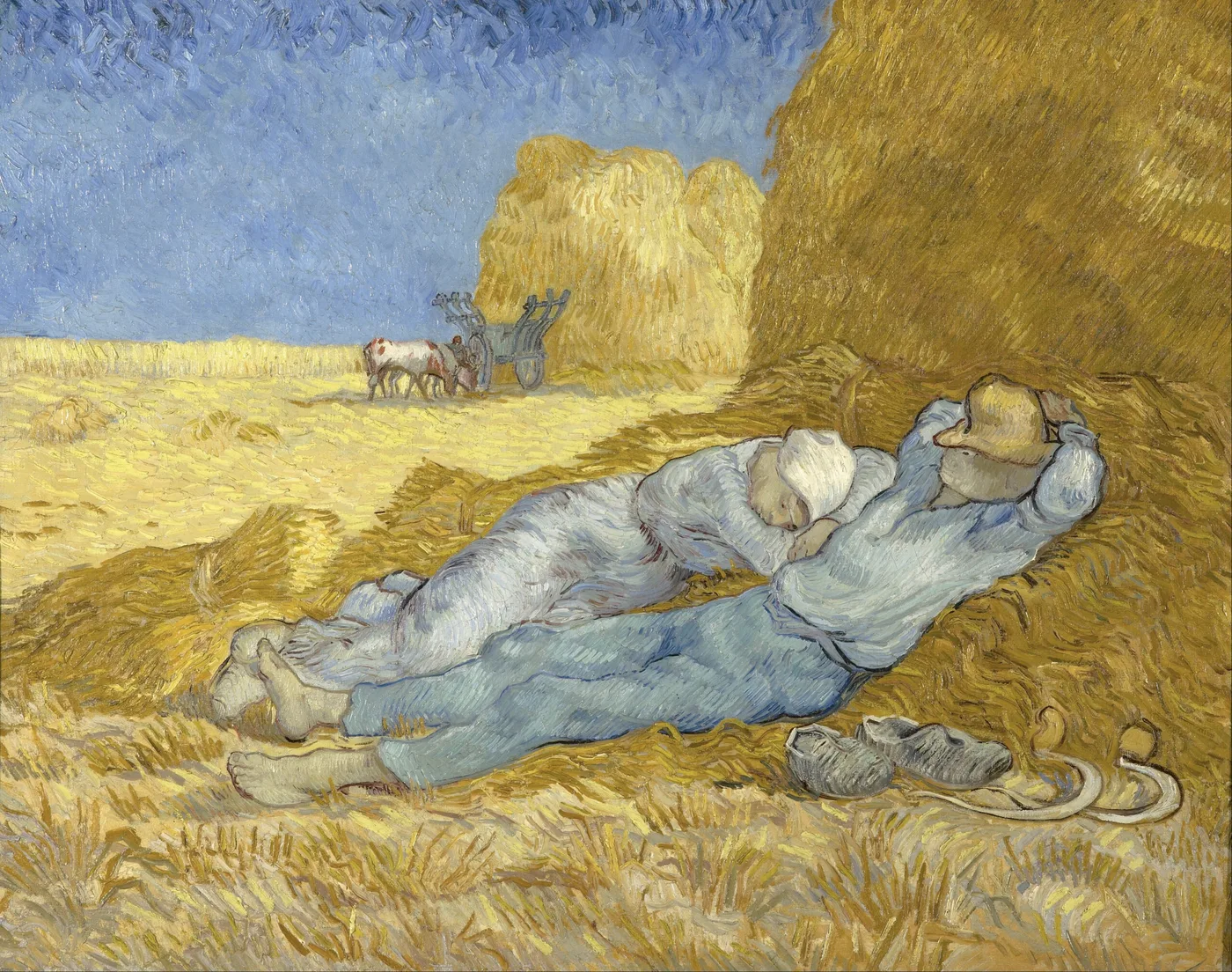
The painting shows a man and a woman lying head to foot in a bed of cut hay, taking their midday rest during the wheat harvest. The woman lies with her back to the viewer, her face turned into her forearm, a white cap covering her hair. The man lies opposite her, his straw hat pulled down over his eyes, one arm thrown back behind his head in the unguarded posture of someone who has stopped fighting sleep.
Their wooden clogs and sabots have been kicked off and left in a small pile at the front of the canvas, an ordinary detail that makes the stillness of the two bodies feel complete. Behind them a haystack rises in ochre and gold, its curved crown filling most of the right side of the picture. To the left, the harvest carries on without them: two further haystacks stand in the middle distance, and a cart with a pale ox waits near another figure still at work, so the field stays a place of ongoing labour even while its foreground belongs entirely to sleep.
Van Gogh set the scene at true noon, when the sun stands highest and shadows are shortest, and the whole field is washed in an even, flattening light. There is no tree, no roof, nothing to break the heat. The rest the two figures are taking reads as earned rather than incidental, a pause cut out of a day that will resume the moment they wake.
Blue Against Gold
The picture is built almost entirely from two opposed colours. The wheat, the straw and the haystacks are laid in warm yellows, ochres and gold; the sky and the pair’s cotton trousers and skirt are cool blues and violet. Van Gogh had written to Theo about the way complementary colours intensify each other when set side by side, and here the effect is direct: the gold looks hotter for the blue beside it, and the blue looks cooler for the gold.
The brushwork carries as much of the picture as the colour does. The sky is laid in short, diagonal strokes running all one direction, giving the air a kind of visible weather even though nothing in it moves. The haystack is built from long, curving strokes that follow its rounded form, thick ridges of paint that catch real light across their surface. The two sleepers are painted more simply, in flatter passages of pale blue and white, which lets them stand out clearly against the restless texture around them.
At 91 by 73 centimetres, the canvas is large enough for these differences in handling to register at a normal viewing distance. The eye tends to land first on the man’s raised arm and hat, the brightest passage of white in the picture, before travelling down the diagonal of the two bodies toward the discarded clogs and out into the field beyond. The whole composition assembles itself along that one sweeping line, from sleep in the foreground to work still going on behind it.
On a Wall Today
The siesta (after Millet) is held today by the Musée d’Orsay in Paris, alongside much of Van Gogh’s late work. It is a picture that rewards a room with changing daylight, since the diagonal strokes in the sky and the ridged paint of the haystack catch light differently through the day, shifting between flat gold in the morning and a sharper, raking texture by evening.
Hung at a height where the eye meets the sleeping figures directly, it tends to slow a room down rather than fill it. There is little incident in it beyond two people asleep and a field going on without them, and that plainness is exactly what carries.
Seen up close, it reads as a study in the discipline of rest, painted at the end of a year in which calm was not something Van Gogh found easily. Seen from across a room, it settles into a single warm shape, gold hay and blue figures, that holds its own against most other colour nearby.
Sizes and materials for The siesta (after Millet) are listed on its product page.
More from this collection
Bring this painting home
Choose a hand-painted oil reproduction for real brushwork, or an archival canvas print for a crisp museum-image edition. Every size preserves the original proportions.
View this work & options
Further reading
Verify the original in the Musée d'Orsay collection record and continue through related works in the catalogue.