
The Sower (Sunset): Story, Meaning & Brushwork
Arles, in the Season of Blossom
Vincent van Gogh reached Arles in February 1888, chasing a light he believed would sharpen his colour the way Japanese prints had sharpened his eye. By spring the orchards around the town were breaking into flower, and he painted them in quick succession, one canvas after another, working faster than he had ever worked in Paris.
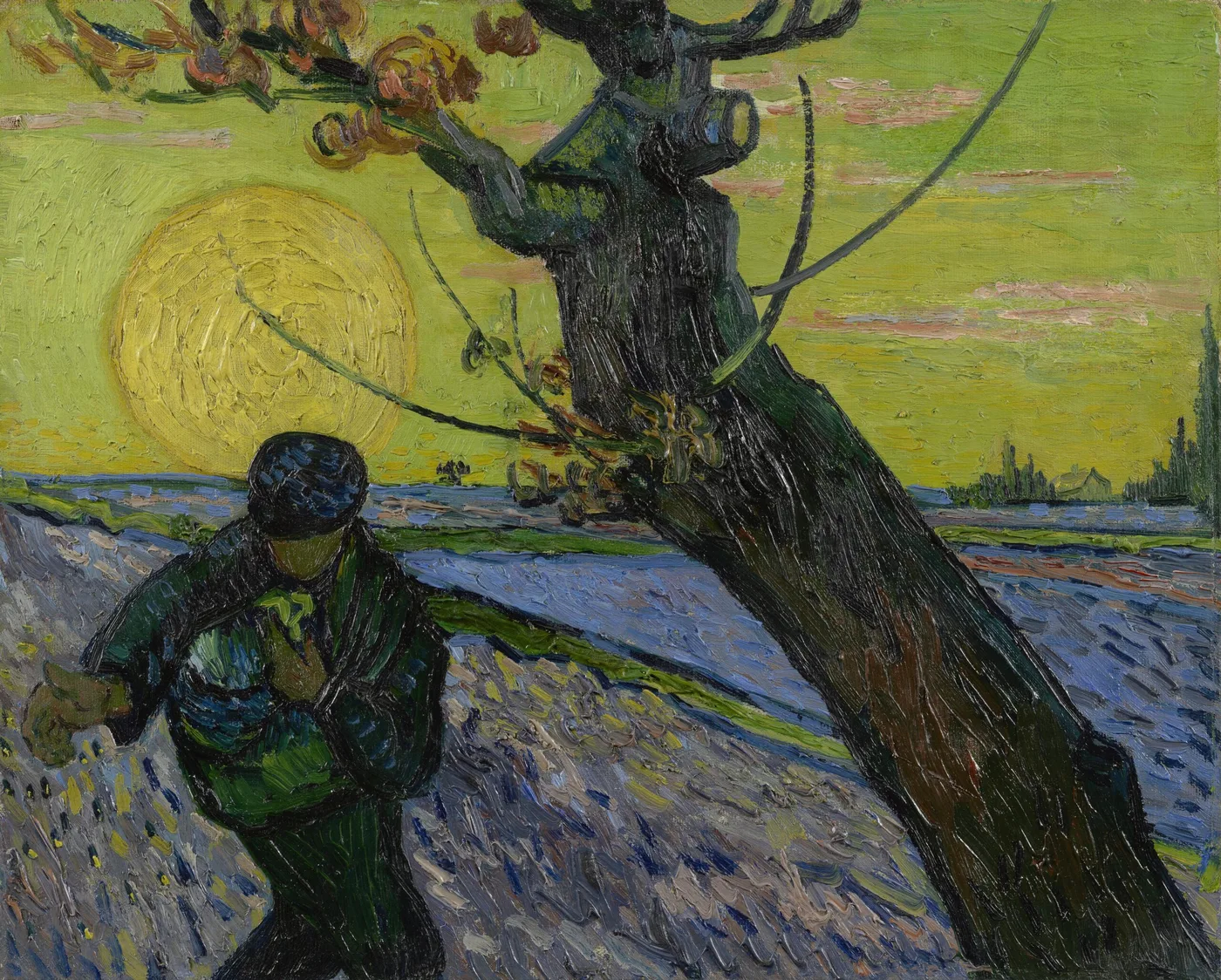
The sower belonged to a different register of ambition. It was not a study made directly from a model but a composition built from memory and long conviction, a subject he had carried with him since his earliest years as an artist. This canvas, catalogued as The Sower III (version 2), is one of several attempts he made at it that same year.
He worked on it in the same weeks as the blossoming orchards, and something of that season slipped into the picture. A flowering branch reaches in from the top of the canvas, slung across the trunk of the tree that dominates the scene, as though the orchard behind the painter had grown straight into the field in front of him.
A Pollarded Trunk Cuts the Field in Two
The picture surface is small, just 40.3 by 32.5 centimetres, yet Van Gogh crowds it with incident. A thick, dark trunk rises from lower right to upper left, its pollarded limbs splayed like fingers against a sky of acid yellow-green streaked with pink.
Slung across those limbs is a slender flowering branch, its blossom set down in short dabs of coral and white, curling loosely away from the main stem. The tree is not incidental scenery. It splits the canvas on the diagonal and pushes the sower, the picture’s nominal subject, into the lower left corner.
There he walks, a compact figure in a dark blue-green jacket and cap, scattering seed with an outstretched arm over a field rendered in broken strokes of lilac, grey and pale ochre. Behind him a narrow band of blue, more a passage of colour than a literal river, separates the field from a low horizon where a distant town and a single dark cypress are set down in a few economical touches.
Above it all, low and huge, sits a sun of pure chrome yellow, built up in circular strokes so the paint itself seems to turn. It does not blaze so much as glow flat against the acid sky, closer to a coin pressed onto the canvas than to a source of heat.
A Borrowed Figure, Made to Compete
The sower was not Van Gogh’s invention. He had drawn and painted the subject since his years in the Netherlands, following Jean-François Millet, whose peasant labourers he copied and revered as models of honest, unsentimental subject matter.
In Arles he pushed the figure into colour Millet never used, testing himself, as he described in his letters, against the painters he most admired by translating their sober tonal compositions into raw complementary hues. Yellow sun against a violet-leaning field, the oldest pairing in his colour thinking, does the emotional work here that drawing and tone had done in Millet’s originals.
The subject carried weight beyond its composition. For Van Gogh the sower stood for a cycle that outlasted any single life, seed committed to earth on the promise that it would return as grain. He returned to the image often enough that his letters treat it as something close to a private article of faith.
Paint Handled at Speed
The brushwork throughout is fast and declarative. The field is laid in with short diagonal strokes that follow the furrows rather than describe them one by one, the sky in longer horizontal sweeps broken by streaks of pink cloud, the bark scored with dark, twisting lines that let the ground colour show through.
Nothing here is smoothed. Paint sits in ridges where the brush loaded and released it, and the sun’s disc in particular carries a visible impasto, a raised, textured surface that catches real light differently depending on where a viewer stands.
That variability is part of the picture’s character rather than a flaw of a hurried sketch. Van Gogh was working towards a decisive, placard-like clarity, flat planes of strong colour bounded by drawn strokes, closer in spirit to the prints he collected than to conventional landscape painting of his day.
How It Sits in a Room
Hung where daylight reaches it, the picture changes hour to hour in a way flatter paintings do not. Morning or overcast light lets the violet and grey of the field read clearly against the yellow sky; direct sun across the impasto catches the ridges of paint and throws the chrome disc into sharper relief.
Small as it is, at 40.3 by 32.5 centimetres, it holds a wall through density rather than scale, the crowded diagonal of the trunk giving it more presence than its dimensions would suggest at a glance.
The original is held by the Van Gogh Museum, Amsterdam, catalogued among the group of sower compositions Van Gogh made in Arles that year. Seen close up or across a room, it rewards the kind of unhurried, repeated looking that a painting this compressed and this fast in its making was built to survive.
Sizes and materials for The Sower III (version 2) are listed on its product page.
More from this collection
Bring this painting home
Choose a hand-painted oil reproduction for real brushwork, or an archival canvas print for a crisp museum-image edition. Every size preserves the original proportions.
View this work & options
Further reading
Verify the original in the Van Gogh Museum collection record and continue through related works in the catalogue.