
Self-Portrait with Straw Hat: Story & Meaning
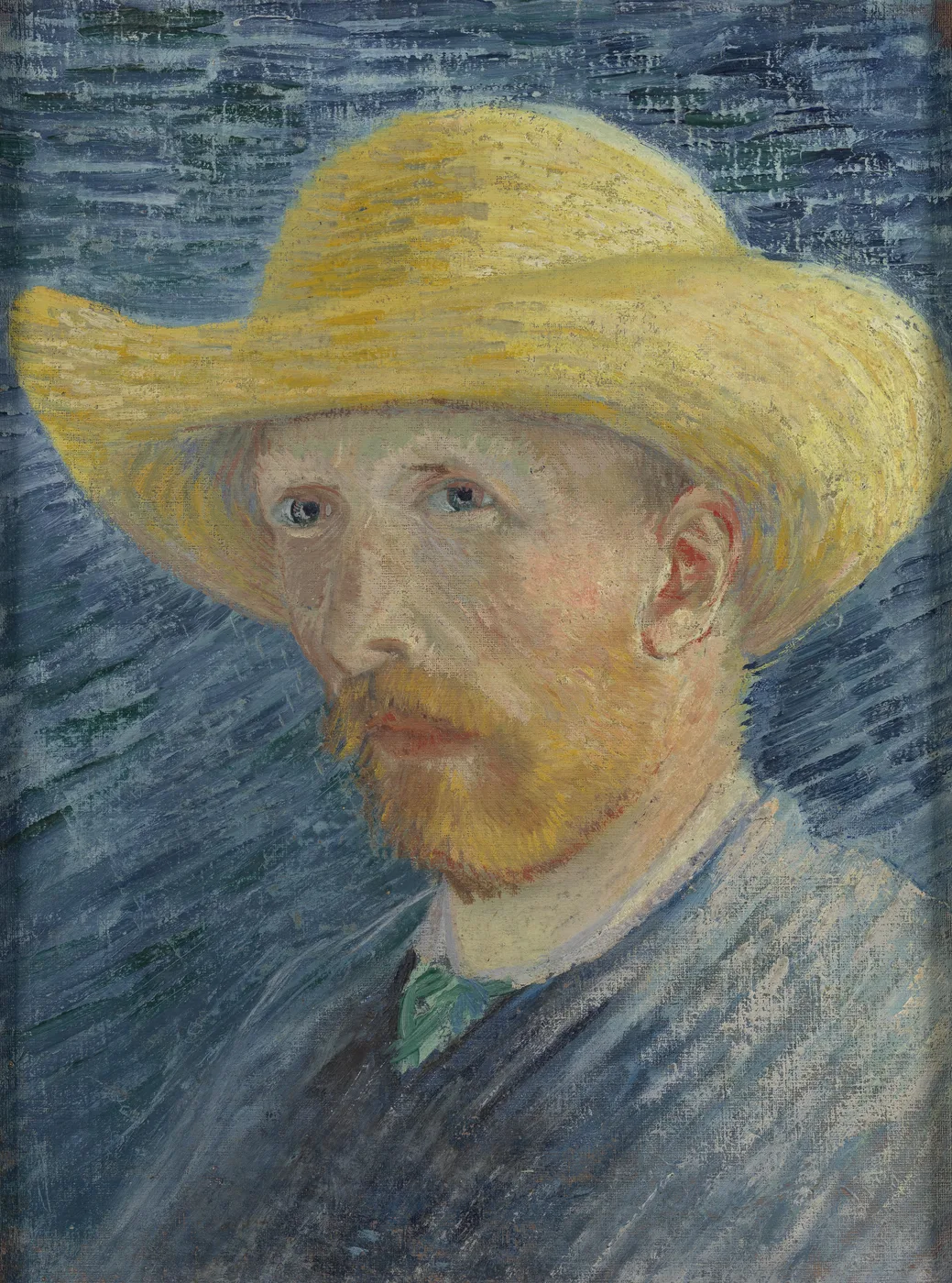
In 1887 Vincent van Gogh had been in Paris for a little over a year, sharing an apartment with his brother Theo on the Rue Lepic, and money for hired models rarely stretched further than a loaf of bread. He solved that problem the way he often did: he propped up a mirror and painted himself. Self-Portrait with Straw Hat, dated to 1887, is one result of that habit, a small canvas that catches him mid-experiment rather than posing for posterity.
The Paris years mattered because they exposed him, almost overnight, to painters he had barely known in the Netherlands, from Pissarro to the circle around Seurat. This picture, now in the collection of the Van Gogh Museum, shows a painter still working out what their example meant for his own hand.
A Face Turned Sideways, Not Toward the Viewer
The head fills most of the small canvas, 31 by 41 centimetres, and it turns just off centre, so the eyes meet the viewer at an angle rather than head on. That slight twist keeps the picture from reading as a straightforward mirror check.
A wide-brimmed straw hat sits low on his head, its crown and brim built from short, curved strokes of yellow, ochre and a paler cream where the light catches the weave. The brim throws a soft shadow across the upper half of the face, so the forehead sits in cooler colour while the cheeks and nose carry the warmth of direct light.
Below the hat, a red-gold beard and moustache, laid down in loose upward strokes, frame a mouth held in a flat, closed line. The eyes, a pale blue-grey, are the one area of real stillness on the canvas, fixed on something just past the viewer’s shoulder rather than on the viewer.
Blue Answering Yellow
Van Gogh built the whole picture on a single colour contrast: the warm yellow of the hat against a background worked entirely in blues, laid in short diagonal strokes that run almost like combing lines across the canvas. Darker teal and green touches break up that blue field, so it never settles into a flat wash.
His jacket sits in the same blue family as the background, so the coat nearly dissolves into it, and only a pale greenish cravat at the throat and a sliver of white collar separate figure from ground. That closeness of hue looks deliberate, the kind of yellow-against-blue pairing the Parisian painters he was learning from used to make a canvas seem to hum rather than sit still.
Nowhere on the surface is colour blended smooth. Every stroke stays visibly itself, set beside its neighbour rather than merged into it, so the paint keeps a faint flicker even when the picture is viewed from across a room.
Paint as a Record of Speed
The brushwork is short and repeated rather than long and descriptive, and van Gogh makes no effort to hide it. Strokes in the hat run one way, strokes in the background another, strokes in the beard a third, so the picture reads almost like a diagram of the hand that made it.
That directness came from necessity as much as ambition. Working from his own reflection meant working fast, before the pose or the light shifted, and the quick, separate marks of paint are partly a record of that urgency.
By 1887 it was also a settled method rather than an accident. Across his run of Paris self-portraits, of which this is one of many, van Gogh used his own face again and again to test how far broken colour and short, directional strokes could go before likeness gave way to the paint itself.
A Small Canvas That Holds a Room
At 31 by 41 centimetres, the original is close in scale to a large book, made to be met at close range rather than read from across a hall. Reproduced at that size or larger, the same closeness holds: the hat and the eyes remain the first thing a room notices.
Morning light tends to flatten the blues into a single quiet field, so the yellow hat reads almost alone against the wall behind it. Evening or lamplight warms the same blues toward violet and pulls the green out of the cravat, so the picture shifts in mood without a single stroke changing.
What stays constant is the angle of the gaze. Wherever the painting hangs, that sideways look keeps meeting whoever enters the room from an angle, never quite straight on, which is part of why it rewards a second and third look rather than settling after the first.
Sizes and materials for Self-Portrait with Straw Hat are listed on its product page.
More from this collection
Bring this painting home
Choose a hand-painted oil reproduction for real brushwork, or an archival canvas print for a crisp museum-image edition. Every size preserves the original proportions.
View this work & options
Further reading
Verify the original in the Van Gogh Museum collection record and continue through related works in the catalogue.