
Self-Portrait with Grey Felt Hat: Story & Meaning
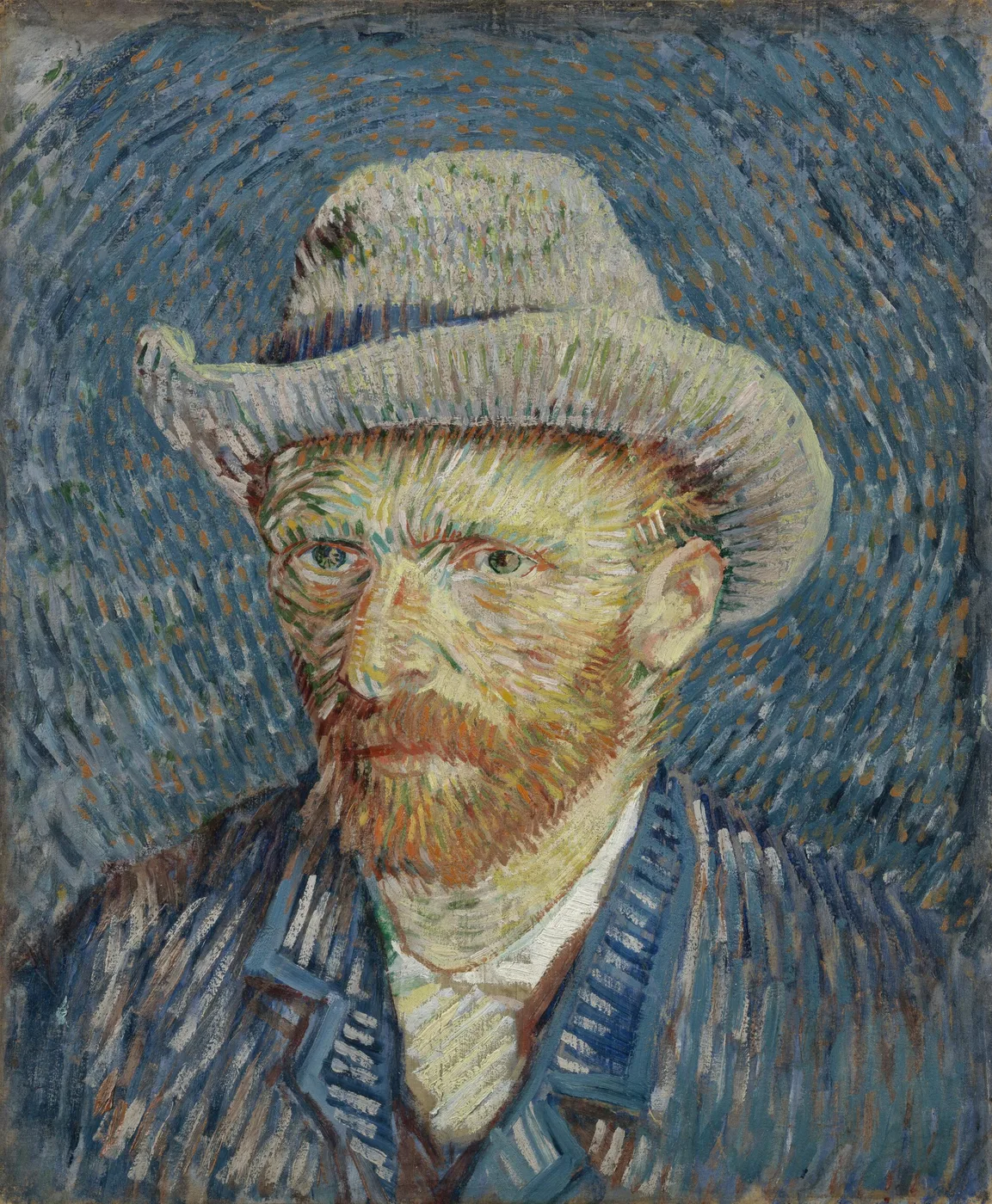
By the winter of 1887, Vincent van Gogh had been living in Paris for close to two years, sharing a cramped flat on the Rue Lepic with his brother Theo. Money was short, and professional models cost more than he could spare, so he did what he had already started doing that year: he set up a small canvas, propped a mirror nearby, and painted his own face.
He had arrived in the city still working in the dark, earthy palette of the Dutch years. Within months, through Theo’s contacts and the studios and cafes of Montmartre, he had met Signac, Bernard and Toulouse-Lautrec, seen Seurat’s dotted canvases, and begun testing the new theories of colour for himself, on the one model who never sent a bill.
A Head Ringed in Blue and Orange
The background of this small canvas does not sit still. It turns in tight concentric arcs of cobalt and turquoise blue, flecked with dashes of burnt orange that seem to spin outward from behind the sitter’s head like a halo caught mid-rotation.
Van Gogh built that field from short, comma-shaped strokes laid side by side rather than blended, so the orange and blue keep working against each other even at a distance. Blue and orange sit opposite one another on the colour wheel, and placed edge to edge like this they will not settle: the effect is a background that hums rather than recedes.
The face carries the same restlessness. Ochre, pale yellow, sage green and rust are hatched in short diagonal strokes that follow the structure of cheekbone, brow and jaw, so the paint itself seems to model the bone underneath it. Nothing on this surface is smoothed; every plane of the face is built from visible, directional marks.
Grey Wool Against Cobalt
Above that restless face sits the grey felt hat that gives the picture its name, its brim painted in strokes of pale sage, lavender and dull white that catch a cooler light than the warm colours below. It is an ordinary hat, the kind a working Parisian might wear without a second thought, set slightly back so the whole face is left open to the viewer.
Below the collar, a blue jacket with darker stripes closes over a white shirt and a loosely knotted cravat, painted in the same quick, parallel strokes that fill the background, so that figure and setting share one continuous rhythm of marks. The clothing reads as modest and respectable rather than fashionable, the dress of a man with little money who still kept himself presentable.
What meets the eye first, though, is the gaze. The eyes are a cool grey-green, set beneath heavy brows, and they look straight out of the canvas with a level, unflinching directness that the surrounding colour does nothing to soften.
A Face Standing in for a Model
Van Gogh painted more than twenty self-portraits during his two years in Paris, and practical need was part of the reason: a mirror and a canvas cost nothing beyond his own patience, at a time when hiring a model for even an afternoon was a luxury. But the sittings also became a laboratory, a way to try out the broken, separated brushwork of the Neo-Impressionists on a subject he knew better than any other.
Seurat and Signac worked with tiny, even dots applied with an almost scientific detachment, building form through optical mixing at a careful remove from the subject. Van Gogh borrowed the vocabulary, the separated touches of complementary colour, but pushed the mark itself further: longer, more urgent, following the emotion of the face rather than a fixed system. The result reads as personal where the Neo-Impressionist paintings that inspired it read as calculated.
By this point in his stay he was painting fast and constantly, absorbing a new way of seeing colour almost in real time. This portrait sits near the end of that Paris apprenticeship, just before he left the city for Arles in early 1888 in search of stronger light and cheaper living.
Held at the Van Gogh Museum, Amsterdam
The original measures 37.5 by 44 centimetres, small enough to have been painted in a single sustained sitting in front of a mirror in that Montmartre flat. It now belongs to the Van Gogh Museum in Amsterdam, part of the institution’s deep holding of his self-portraits from these Paris years.
That modest scale matters in front of the canvas. There is no distance to stand back into; the face fills the frame at close to life size, and the ringed background presses in around it, so the encounter feels immediate rather than staged.
Hung on a wall at home, the painting keeps that same restlessness. Morning light draws out the cool blues of the background and hat; warmer lamplight in the evening pulls the oranges and ochres of the face forward, so the same canvas seems to shift its temperature through the day. The eyes, wherever the light falls, keep meeting the room straight on.
Sizes and materials for Self-Portrait with Grey Felt Hat are listed on its product page.
More from this collection
Bring this painting home
Choose a hand-painted oil reproduction for real brushwork, or an archival canvas print for a crisp museum-image edition. Every size preserves the original proportions.
View this work & options
Further reading
Verify the original in the Van Gogh Museum collection record and continue through related works in the catalogue.