
Flowering Plum Tree (after Hiroshige): Story
By 1887 Vincent van Gogh had been in Paris for a year, living with his brother Theo and absorbing an art world that had little in common with the dim, earthbound palette he had left behind in Nuenen. He was seeing Impressionist and Neo-Impressionist canvases at first hand, meeting painters such as Bernard and Signac, and building, alongside all of it, a private obsession with Japanese woodblock prints.
He and Theo collected hundreds of them, bought cheaply from the Paris dealer Siegfried Bing, and for a time Vincent pinned sheet after sheet to the walls of his rooms and studied them the way a student studies a master. He wanted, he wrote, to look at the world the way a Japanese artist did, simplified, direct, unclouded by the conventions of his own training.
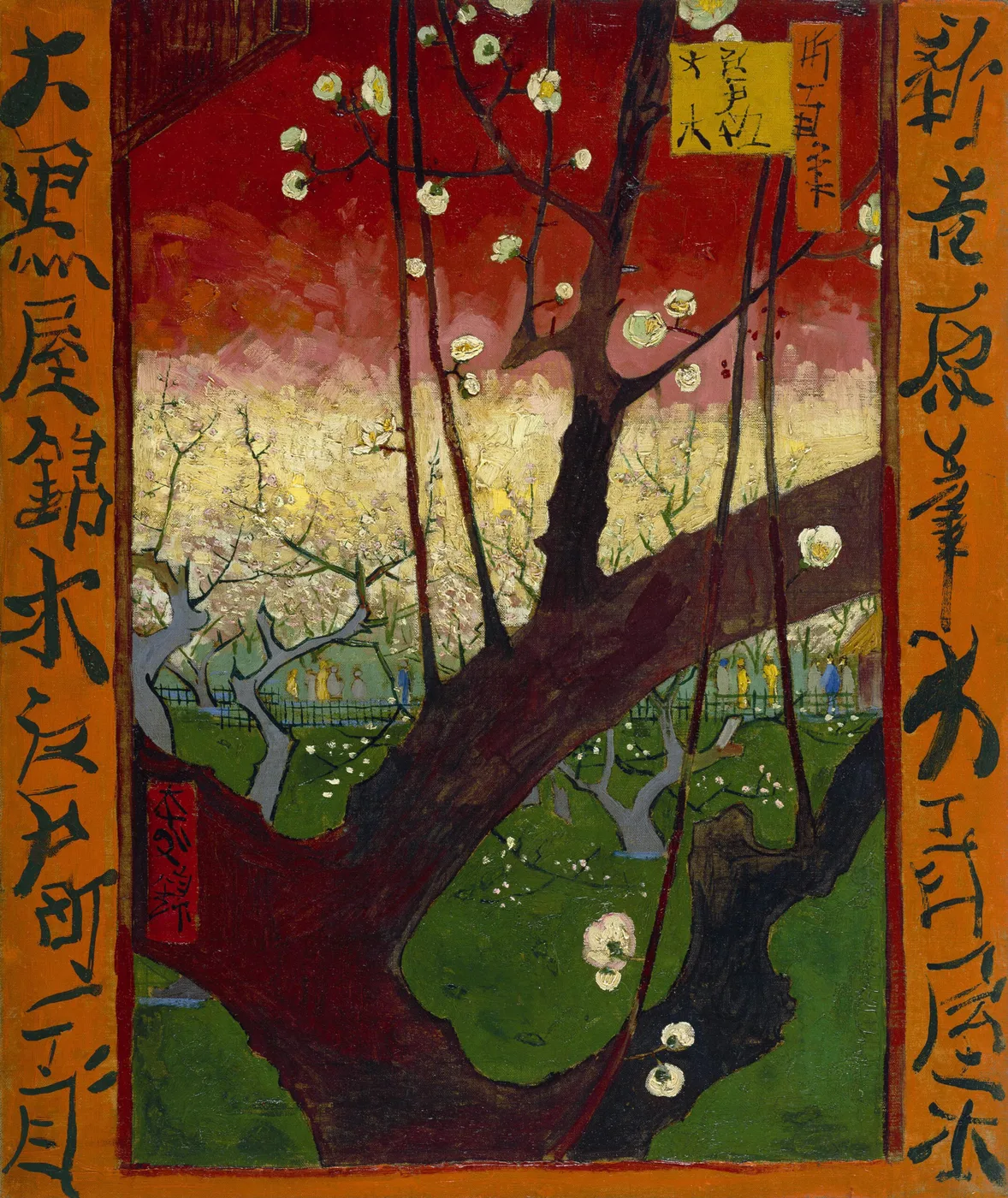
Flowering plum tree, after Hiroshige, painted in Paris in 1887, is one of two paintings in which that ambition became literal. Rather than only absorbing what Japanese prints had to teach him, Van Gogh took an existing sheet and worked it up in oil paint on canvas.
Copying as a way of thinking
The print behind this painting is Utagawa Hiroshige’s Plum Park in Kameido, part of his series One Hundred Famous Views of Edo. Van Gogh knew it through the magazine Paris Illustre, which reproduced Japanese prints for a French audience, and very likely through his own collection.
He did not trace the print so much as rebuild it. He squared up its composition and enlarged it onto canvas, adjusting what the change of medium demanded while keeping the design’s audacity intact: a tree trunk filling almost the entire picture, the ground given almost no space, the eye offered no easy route to a horizon.
Copying was never, for Van Gogh, a lesser kind of work. It was a way of thinking through another artist’s hand, a discipline he returned to across his life with Millet and Delacroix just as he did here with Hiroshige.
What the canvas holds
A plum trunk splits the painting on a sharp diagonal, its bark built from dry, dragged strokes of maroon, black and ochre that give the wood a rough, almost geological weight. Thin branches shoot upward and sideways from it, each tip loaded with white blossom set down in short, deliberate dabs.
Behind the tree the sky is not blue but a deep, saturated red, softening toward pink and cream near the horizon, where a whole orchard of pale blossoming trees stands in flat, unmodelled colour. Small figures in blue and yellow move along a fence at the base of that orchard, barely more than a stroke or two each, present to give scale rather than incident.
The palette throughout is reduced to a handful of forceful colours, red, green, black and white, laid on with none of the smooth blending Van Gogh’s academic training would once have demanded. It is a picture built to strike from across a room, then rewarded on closer inspection by the roughness of its surface.
The borders he invented
Van Gogh added something Hiroshige’s original print never had: two vertical strips of Japanese characters on an orange ground, framing the scene as a shop sign or a scroll mount might. The characters are not a faithful transcription of anything specific; he adapted them from other sheets in his collection, drawn more to their graphic weight than to their meaning, which he could not read.
The effect is to make the borrowing visible rather than hidden. This is not a disguised copy but an open homage, a Dutch painter’s tribute to a Japanese print, built in part from characters admired purely as shapes.
On a wall, in changing light
At 46 by 55 centimetres, the original is a modest object that argues for itself through colour rather than scale. That is part of why it can hold a wall from across a room and still reward standing close, where the dragged, unblended paint of the trunk becomes its own subject.
The red ground shifts with the light around it, warmer and heavier in the evening, cooler and sharper under a north-facing window. Few paintings change mood through the day as visibly as one built almost entirely from a single saturated colour.
Van Gogh painted it the same year he began pushing his own palette toward the intensity that would define his final years in the south of France. Seen today in the Van Gogh Museum in Amsterdam, it reads as a hinge picture, the moment a painter trained in the browns of Dutch tradition decided that colour alone could carry a whole picture’s meaning.
Sizes and materials for Flowering plum tree, after Hiroshige are listed on its product page.
More from this collection
Bring this painting home
Choose a hand-painted oil reproduction for real brushwork, or an archival canvas print for a crisp museum-image edition. Every size preserves the original proportions.
View this work & options
Further reading
Verify the original in the Van Gogh Museum collection record and continue through related works in the catalogue.