
A Wheatfield with Cypresses: Story, Meaning & Brushwork
Summer at Saint-Paul-de-Mausole
In May 1889 Van Gogh admitted himself to the asylum of Saint-Paul-de-Mausole, on the edge of Saint-Rémy-de-Provence, after the breakdown that had ended his time in Arles. The institution occupied a former monastery ringed by walls, olive terraces and wheat country, and within weeks the staff allowed him out, under escort at first, to paint the fields around it.
By June the wheat was ripening below the walls, cut in places by scythe, and the cypresses that stood along the field edges had begun to occupy him completely. He wrote to his brother Theo that he wanted to do with the cypresses what he had already done with the sunflowers, to find a way of painting their dark, upright mass that matched their presence in the landscape.
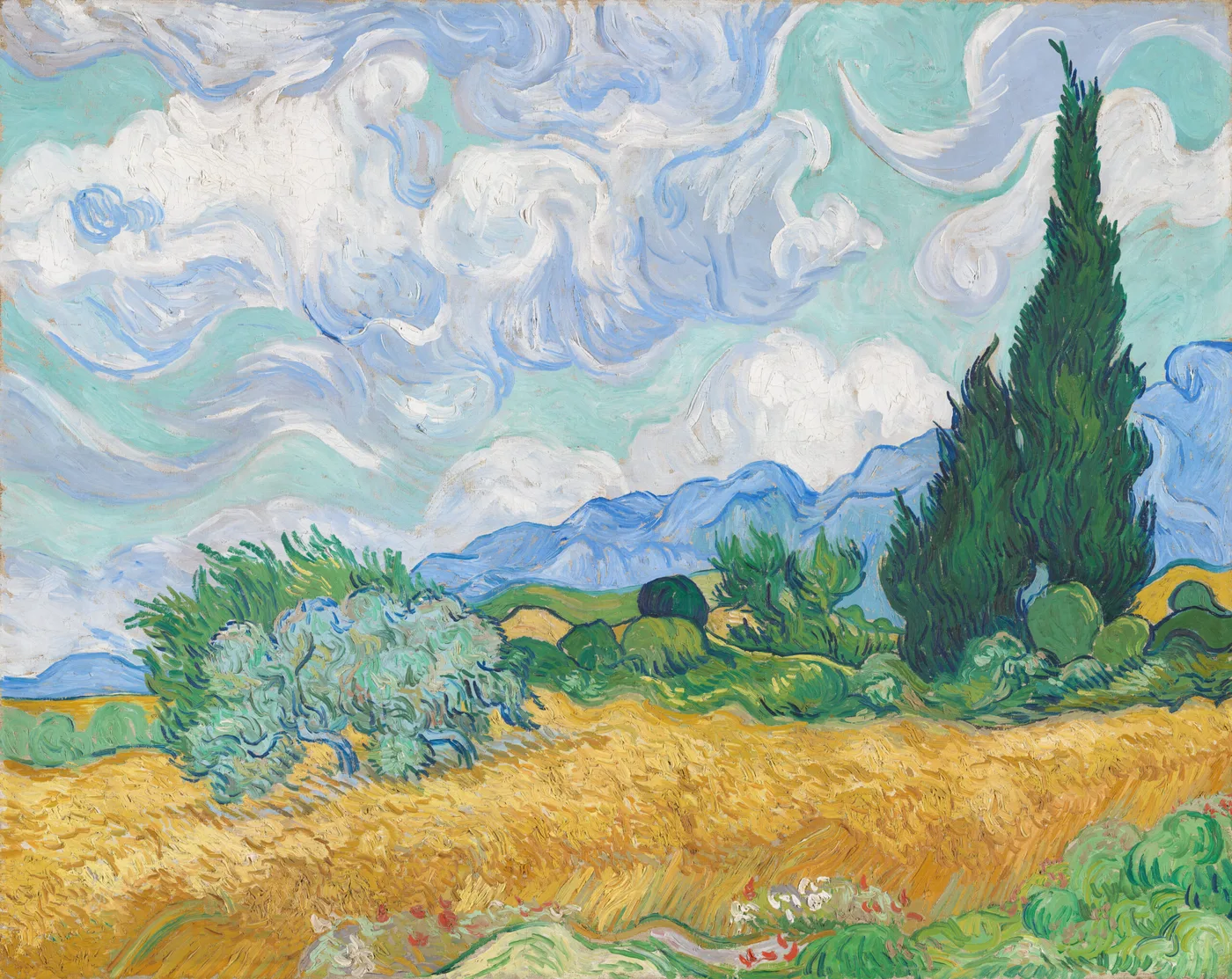
A Wheatfield, with Cypresses, painted in 1889, belongs to that short, urgent stretch of work. It is one of several canvases from the same weeks in which he returned to this same stand of trees and the same rolling field, testing the motif until he judged he had got it right.
Wheat, Wind and a Single Green Flame
The lower half of the canvas is given over to the wheatfield itself, a broad sweep of gold and ochre broken by short red and white touches where poppies and other field flowers show through the stalks. The furrows run on a diagonal from the lower left, pulling the eye back across the field toward the trees rather than letting it settle.
On the left a pale sage-green bush curls and spikes across the middle distance, its cooler colour setting off the warmth of the grain. Beyond it the ground rises into low, rounded hillocks of darker green, then to the blue-grey ridge of the Alpilles, painted soft and flattened so that it reads as backdrop rather than incident.
The cypresses stand at the right of centre, two trunks fused into one dense, flame-shaped mass that climbs almost to the top edge of the canvas, taller than anything else in the scene. Their green is the darkest note in the picture, and against the pale field and paler sky it holds the whole composition together, the point the eye returns to after travelling out across the wheat.
Above it all the sky takes up nearly half the canvas, painted in curling bands of white, pale blue and a cool mint green that echo the shapes of the clouds rather than describe them literally. Nothing in the sky is still. The same rolling, restless line that shapes the wheat and the cypress is repeated overhead, so that field, tree and sky all seem to move to a single rhythm.
How the Paint Was Put Down
Van Gogh worked this canvas, measuring 90.9 by 72.1 centimetres, out of doors and at speed, in the manner he had developed through that summer of intense production. There is no sign of underdrawing showing through, no hesitation in the strokes: each mark appears to have been laid once, decisively, and left.
The wheat is built from short diagonal strokes, thick enough to catch a raking light and cast their own small shadows across the surface. The cypresses are worked in tighter, near-vertical marks that twist and flick upward, giving the trees a sense of growth rather than simple mass, while the sky is handled in longer, looping strokes that curl back on themselves.
What unifies all of this is not colour alone but the consistency of the gesture. The same curling, energetic touch appears in the grass, the cloud and the tree, so that the painting reads less as three separate zones of field, hill and sky than as one continuous surface in motion.
A Painting That Answers to Daylight
Hung in a room that gets real daylight, this canvas keeps changing through the day in a way a flatter, more evenly lit picture never does. Morning light picks out the ridges of paint in the wheat and along the cypress, throwing tiny shadows that sharpen the texture; by late afternoon, with the light lower and warmer, the gold of the field intensifies and the cypress reads darker, almost black against it.
It rewards being looked at twice, once from across the room, where the sweep of field and sky and the dark accent of the tree register as a single strong shape, and once up close, where the individual strokes separate out and the making of the picture becomes visible. Few landscapes give both readings so generously.
The original is held by the National Gallery, where it remains one of the clearest statements of what Van Gogh was reaching for in that last full year of work: a landscape built entirely from movement, in which wheat, tree, hill and cloud all answer to the same restless hand.
Sizes and materials for A Wheatfield, with Cypresses are listed on its product page.
More from this collection
Bring this painting home
Choose a hand-painted oil reproduction for real brushwork, or an archival canvas print for a crisp museum-image edition. Every size preserves the original proportions.
View this work & options
Further reading
Verify the original in the National Gallery collection record and continue through related works in the catalogue.