
Mountains at Saint-Remy: Story, Meaning & Brushwork
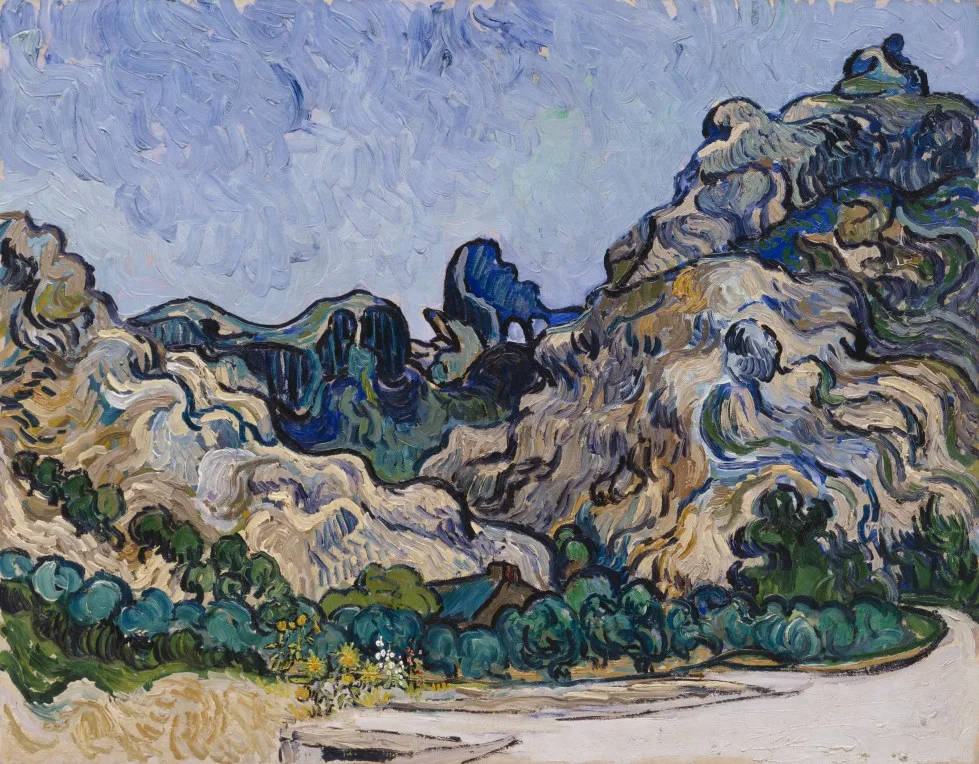
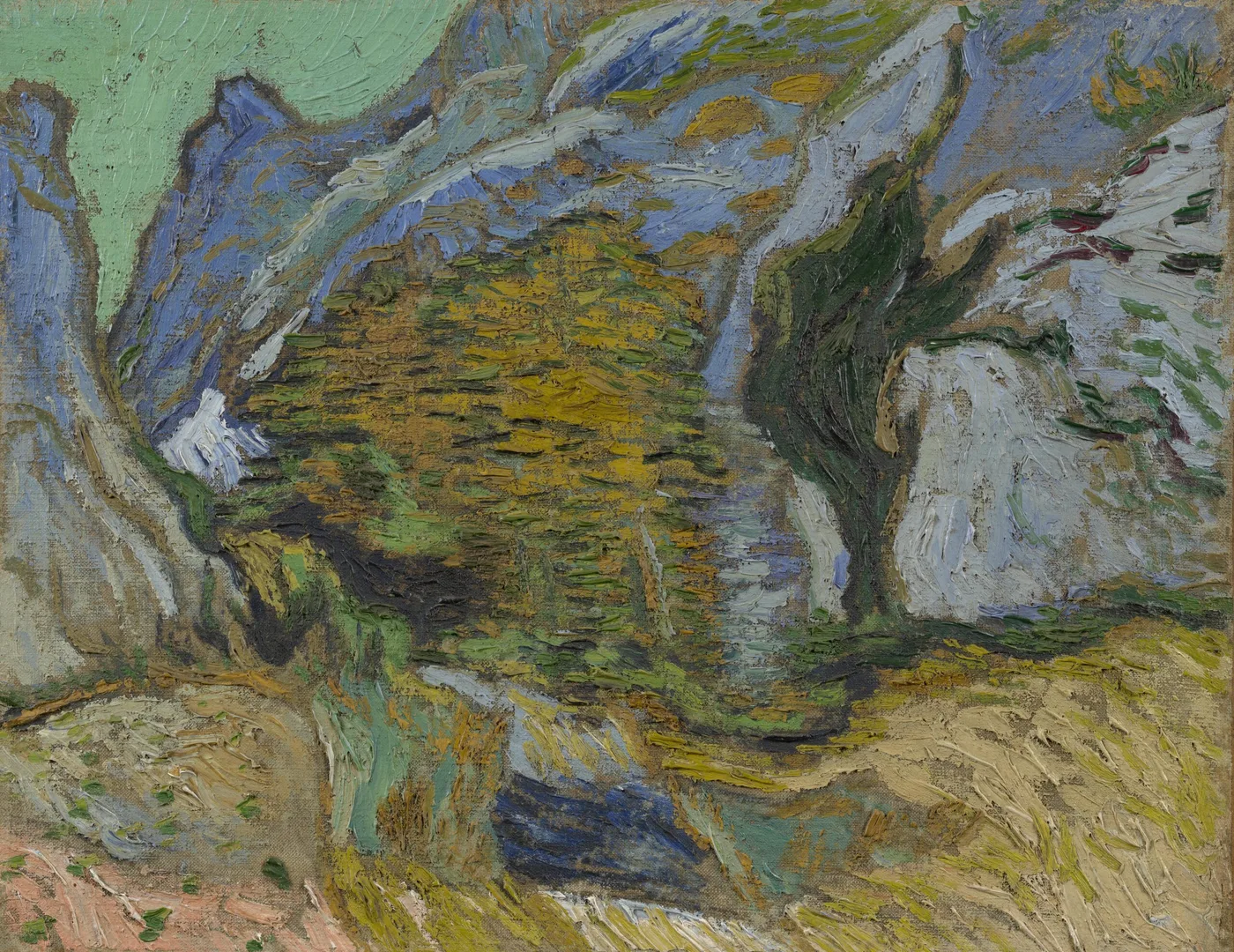
By May 1889 Vincent van Gogh had committed himself to the asylum of Saint-Paul-de-Mausole, on the edge of Saint-Rémy-de-Provence, and from behind its walls he began to paint the limestone ridge of the Alpilles that closed off the horizon to the south. Mountains at Saint-Rémy, painted that year, is one of the results of those months: a canvas built from a view he saw almost daily, returned to and reworked until the rock stopped reading as scenery and started to feel like something in motion.
He was thirty-six, recovering from the crisis at Arles that had led him to seek admission voluntarily, and painting was by his own account the thing that kept him steady. The Alpilles gave him a subject he did not have to travel for. He could stand in the asylum grounds, or walk a short distance under guard, and find the same jagged skyline waiting.
A Year Spent Watching One Ridge
Saint-Rémy sits at the northern foot of the Alpilles, a short limestone range that rises abruptly out of otherwise flat Provençal farmland. Van Gogh painted the chain repeatedly through 1889, from different distances and in different weathers, treating it less as a fixed landmark than as a subject that changed each time he looked at it.
This canvas, at 90.8 by 71.8 centimetres, gives the ridge room to fill almost the whole upper half of the picture. There is no attempt to soften its scale or set it at a comfortable distance; the mountains simply occupy the view, the way they would have occupied his.
Rock Turned to Current
The peaks are built from short, curling strokes that follow the logic of the rock rather than a fixed light source, cream and pale ochre on the sunstruck faces, blue-grey and violet dropped into the folds and clefts between them. A dark, almost black outline runs along the ridgeline and through the deep notch at its centre, giving the silhouette a jagged, torn edge against the sky.
Nothing in the rock face sits still. The same rhythm of curved marks that Van Gogh used for cypresses and for the sky in his night pictures is at work here, so that solid limestone reads as if it were folding and rolling under its own weight. It is a way of painting that insists a mountain is not inert, that it has been pushed into shape by forces still working on it.
The sky above is a pale, restless blue, laid on in the same loose, curling strokes as the rock below, so the transition from stone to air is one of colour and temperature rather than a hard line.
A Roof Among the Bushes
Below the ridge, the land drops into a band of dense, rounded trees and scrub, painted in deep blue-green with the same energetic touch. A single small building with a dark reddish roof sits low among them, almost swallowed by the foliage, the only sign of habitation in the whole scene.
In the near foreground, a cluster of yellow and white wildflowers breaks the ground at the left, a small passage of close, delicate detail against the broader sweeps of colour around it. A pale, sandy track curves through the lower edge of the canvas, the one part of the painting where the paint lies flat and calm rather than turning.
The hut and the flowers are easy to miss at first glance, set low against the towering rock behind them, but they are what give the mountains their scale. Without that small roof the ridge would be an abstraction; with it, the viewer understands how far above the valley floor those peaks actually rise.
Colour Pushed Toward Its Edges
Van Gogh worked from a tight, deliberately limited palette here: violet-blue, sage and bottle green, ochre, cream and touches of near-black. Nothing in the picture is a naturalistic colour exactly, and yet the combination reads as a hot, dry Provençal midday, the light hard enough to bleach the pale stone and throw its crevices into blue shadow.
The paint itself is thick, laid on wet into wet in places, so that ridges of pigment catch real light across the surface of the canvas. Up close the mountain dissolves into individual loaded strokes; standing back, those same strokes resolve into rock, shadow and sky.
What Changes With the Light
A painting built this heavily out of directional brushstrokes behaves differently depending on where the light in a room comes from. Raking light from a side window catches the ridges of paint across the mountain face and makes the impasto stand up in relief; flatter, overhead light lets the colour do more of the work and calms the surface down.
Hung where daylight reaches it through the day, it shifts along with the room, brighter and more blue-toned in the morning, warmer as the ochre and violet come forward toward evening. That was already true of the rock it depicts, a range that Van Gogh painted again and again because it never looked quite the same twice.
The original hangs today in the Solomon R. Guggenheim Museum, one landscape among the group of Saint-Rémy pictures that trace a single view held onto, and reworked, across a difficult year.
Sizes and materials for Mountains at Saint-Rémy are listed on its product page.
More from this collection
Bring this painting home
Choose a hand-painted oil reproduction for real brushwork, or an archival canvas print for a crisp museum-image edition. Every size preserves the original proportions.
View this work & options
Further reading
Verify the original in the Solomon R. Guggenheim Museum collection record and continue through related works in the catalogue.