
Olive Picking: Story, Meaning & Brushwork
In the spring of 1889 Vincent van Gogh admitted himself to the asylum of Saint-Paul-de-Mausole, just outside Saint-Rémy-de-Provence. He had a room and, eventually, permission to work in a second room set aside as a studio, and on calmer days an attendant would walk him out into the countryside beyond the asylum walls. It was there, among the olive groves that covered the surrounding hills, that he found one of the subjects that would occupy him most persistently that year.
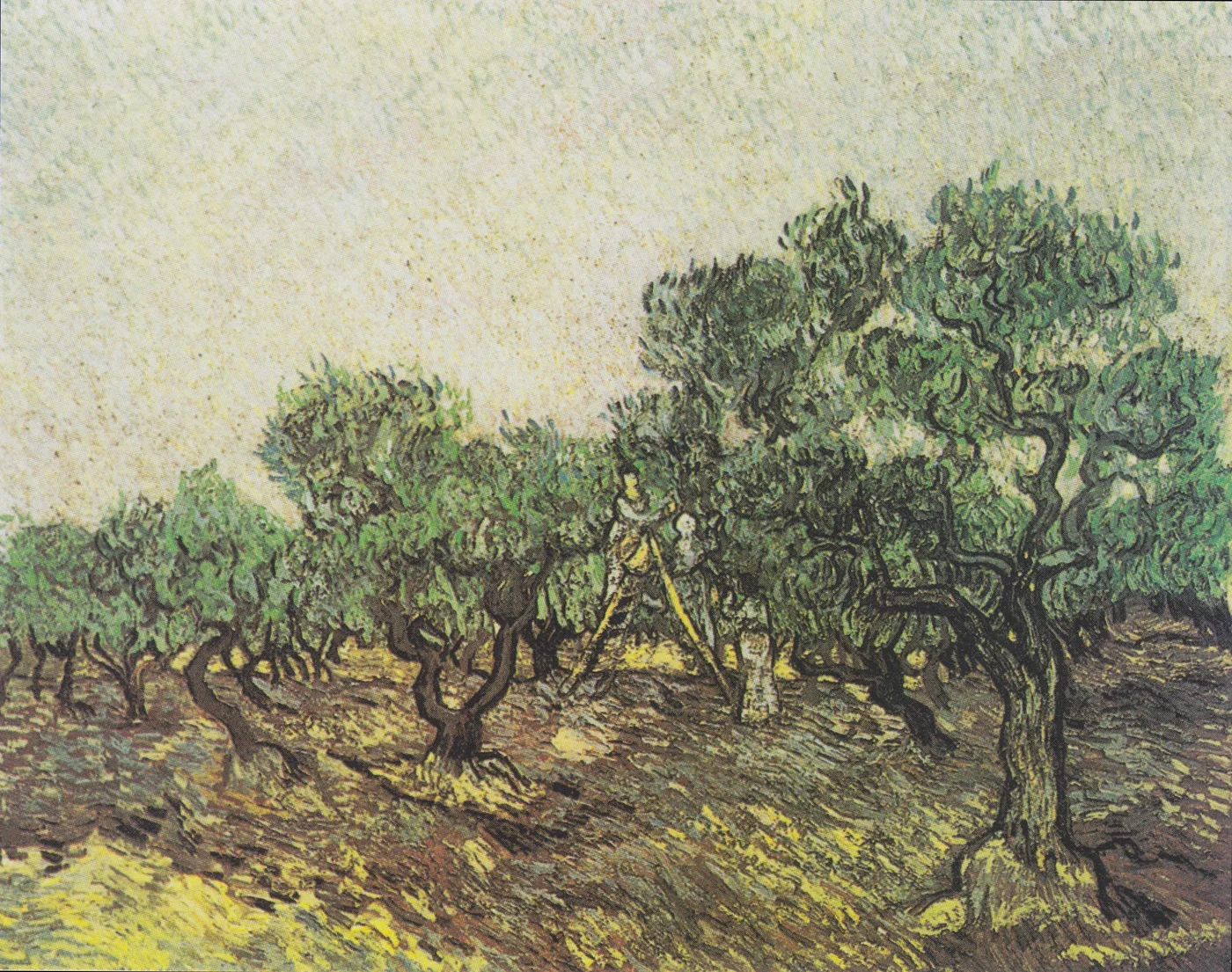
Olive Picking, painted in 1889 and measuring 92 by 73 centimetres, belongs to a group of canvases he made of these orchards over several months. He returned to the same rows of trees again and again, in different light and different weather, as if no single picture could hold what he was seeing in them.
A hillside worked in autumn
The picture shows a grove on rising ground, the olive trees set out in loose, irregular rows that climb toward the pale horizon. Two figures work among them: one stands on a ladder propped against the branches, reaching up into the foliage, while a second figure in pale clothing waits nearby, perhaps holding a basket or a cloth spread to catch the fallen fruit.
The trees dominate the scene far more than the people do. Their trunks are dark, low and heavily twisted, thickening at the base into knots and burrs before splitting into limbs that curl back on themselves. Van Gogh gives the nearest trunk, at the right of the canvas, a whole vocabulary of loops and hooks, so that it reads almost as a figure in its own right, bent and gesturing.
Above the trunks the canopies open into soft, rounded masses of leaf, painted in short, close strokes that never quite resolve into individual leaves. The foliage carries the grey-green colour particular to olive trees, cooler and paler than ordinary summer green, and it catches enough light to seem to shimmer rather than sit still.
Ground, sky and the pull between them
The earth beneath the trees takes up the lower half of the canvas and is worked in dense, directional hatching, ochre and ash-brown broken through with strokes of yellow and touches of red-brown. It has the texture of ploughed or raked soil, ridged by the rhythm of the brush rather than by any drawn furrow.
Against that warm, busy ground, the sky is almost startling in its plainness. It is painted pale, a hazy off-white leaning toward yellow-green, laid on in the same short parallel strokes as the earth but with none of its colour incident. There is no blue in it, and no cloud shape; it reads as heat and glare rather than as weather.
That pairing, an animated ground and an emptied sky, pulls the eye down into the grove itself rather than out toward any distance. The trees stand between the two zones, dark enough to hold the composition together, and it is along their twisting trunks that the eye finally comes to rest.
Why the olive trees held him
Van Gogh had arrived in Provence expecting cypresses and wheat, and found the olive tree waiting alongside them, a species he had barely painted before. He wrote to his brother Theo about the difficulty of getting it right, of how the tree changed character with every hour and every season, silver at noon, almost violet toward evening.
The olive-orchard paintings from Saint-Rémy sit alongside his wheat-field canvases from the same year and the same stretch of countryside, two harvests observed within sight of one another. Where the wheat fields gave him horizontal sweeps of gold, the olive groves gave him something more knotted and enclosed, a subject he had to work his way into tree by tree.
The presence of pickers in this canvas, rather than empty trees, ties it to that harvest more directly than many of the other olive pictures from the series. It records labour as much as landscape, the seasonal work that brought people out among the trees at exactly the time he was there to see it.
Handling and mark
Every part of the canvas is built from the same family of short, curved, repeated strokes, whether Van Gogh was describing bark, leaf, soil or sky. The consistency of that touch is what unifies a picture with so much incident in it, so that grove, ground and air feel like variations on one motion rather than separate passages stitched together.
The paint is not laid flat. Ridges of pigment catch real light across the trunks and the tilled earth, giving the surface a texture that shifts as a viewer moves past it, an effect no photograph fully carries.
The original of Olive Picking is held today by the Basil and Elise Goulandris Foundation, part of a body of work from Van Gogh’s year at Saint-Rémy that continues to be studied and shown as a group.
On a wall
Hung in a room with changing daylight, a picture built this densely from directional strokes behaves differently through the day. Morning light along the canvas will catch the ridges of paint across the tree trunks and the tilled ground, throwing tiny shadows that soften again by evening.
Its palette, the grey-greens of the olive canopy against warm ochre earth, sits comfortably with the muted greens often chosen for a bedroom or a living room, without depending on any one wall colour to work. It rewards being looked at up close, for the brushwork, and from across a room, for the pull of the dark trees against that bare, pale sky.
Sizes and materials for Olive Picking are listed on its product page.
More from this collection
Bring this painting home
Choose a hand-painted oil reproduction for real brushwork, or an archival canvas print for a crisp museum-image edition. Every size preserves the original proportions.
View this work & options
Further reading
Verify the original in the Basil and Elise Goulandris Foundation collection record and continue through related works in the catalogue.