
Thatched Sandstone Cottages in Chaponval: Story
A Village North of the City
In May 1890, Vincent van Gogh left the asylum at Saint-Rémy and settled in Auvers-sur-Oise, a village on the Oise river within easy reach of Paris by train. He rented a room above the Ravoux inn and worked at a rate that still startles historians, often finishing a canvas a day. Chaponval, the hamlet this painting takes its name from, lay a short walk from the centre of Auvers, its lanes lined with old sandstone cottages roofed in thatch.
Van Gogh had been drawn to thatch since his years in the Dutch province of Brabant, where he filled sketchbooks with the low cottages of Nuenen. In Auvers he found the same subject again, weathered and overgrown, and painted it with none of the caution of his earlier grey studies. Thatched Sandstone Cottages in Chaponval, dated 1890, belongs to this final and most rapid phase of his working life.
A Roof That Fills the Canvas
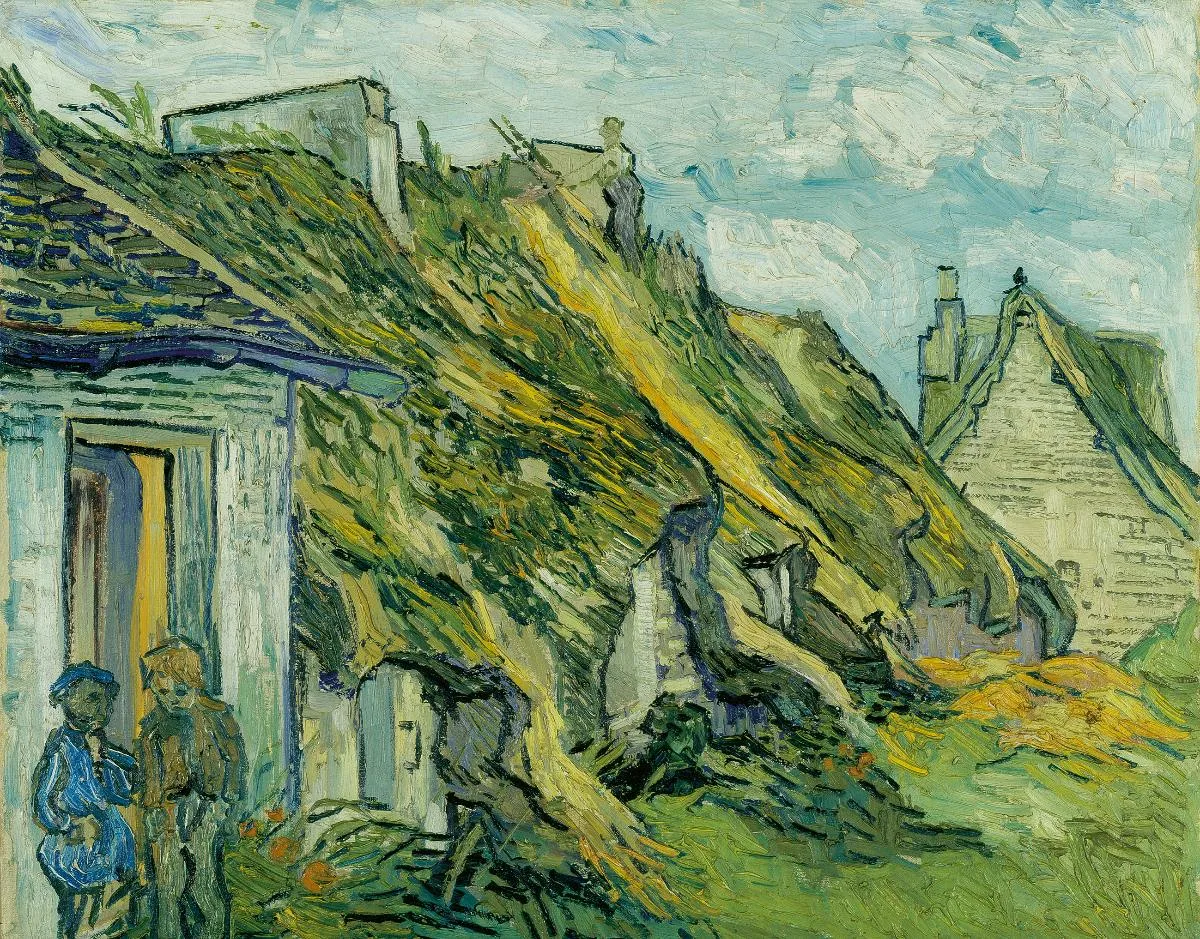
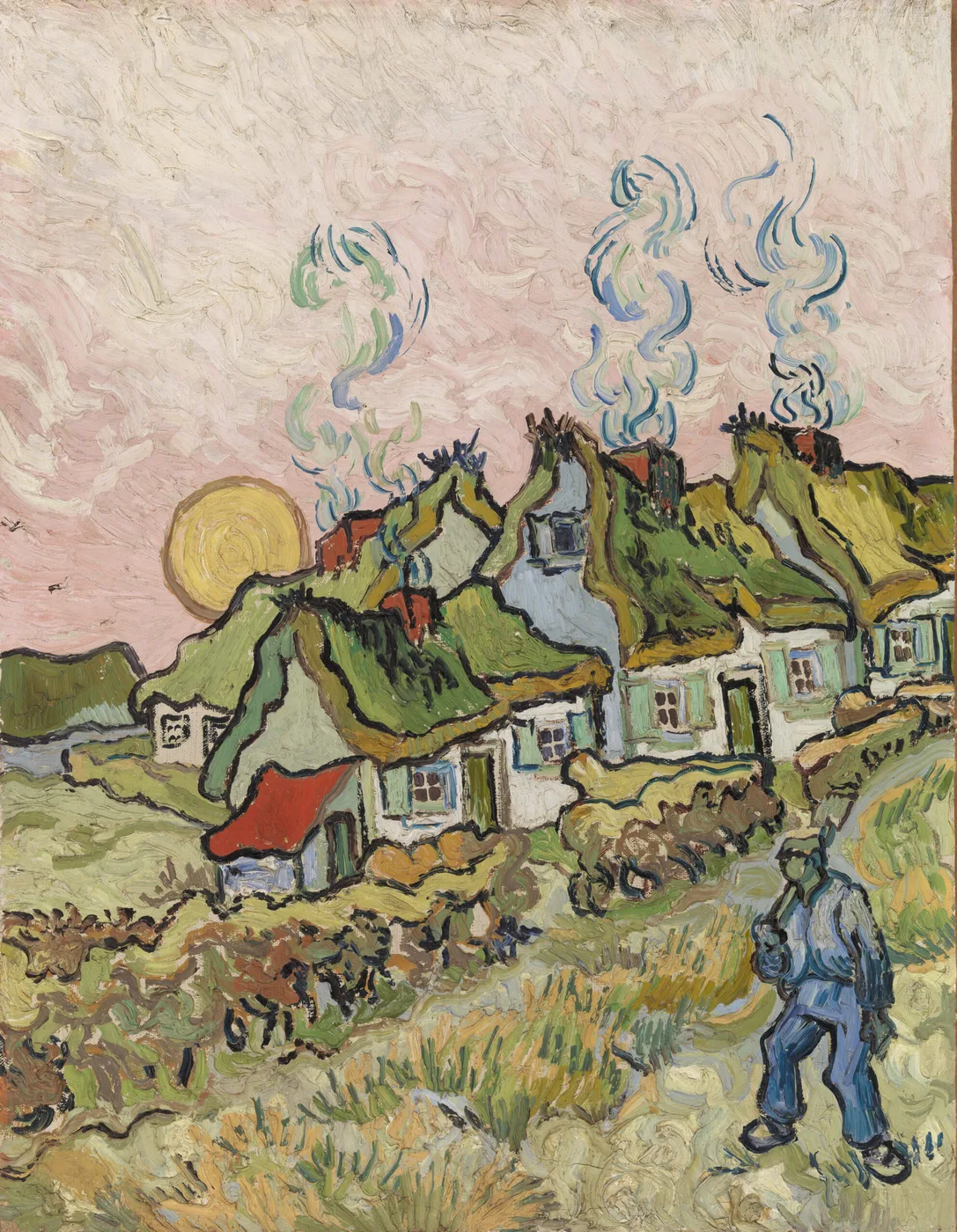
The picture is built around one extraordinary decision: the thatched roof is not a detail but the subject. It rises from the lower left corner and sweeps across almost the entire canvas on a steep diagonal, so that the row of cottages reads less like buildings and more like a long green slope, closer to a hillside than a street.
At the foot of that slope, on the left, a doorway stands open in a whitewashed wall. Two figures pause beside it, a woman in a blue dress and a smaller companion in brown, small enough against the roof above them to give the whole scene its sense of scale. Further along, chimneys break the thatch, and a second, paler house closes the row on the right against a strip of open sky.
A wooden ladder leans against the thatch partway along the row, evidence of the endless repair such roofs demanded. It is a small, practical detail among the sweeping brushwork, the kind of thing Van Gogh would have noticed on his walks and set down without sentiment.
Thatch Painted as Moving Water
Van Gogh does not describe the texture of straw so much as reinvent it. The roof is built from long, parallel strokes of paint, laid on thickly and pulled in the same downward direction, so that the surface has the rhythm of a current running downhill rather than the static bristle of dried reeds.
Where the thatch catches the light, the strokes turn to a hot golden ochre, almost yellow in places, running in ribs through the surrounding green. In shadow they darken to bottle green and near black, and the two ranges of colour interlock across the roof like the pattern on a woven basket.
Below the roofline the walls are handled far more calmly, in short flat touches of grey blue and white, which makes the thatch above them feel even more agitated by comparison. This contrast between a restless roof and a still ground floor is one of the picture’s quiet organising ideas.
Colour Under an Auvers Sky
Above the roofs, the sky is pale, a wash of soft blue broken by loosely brushed white cloud. Van Gogh keeps this upper register calm and comparatively thin, so that all the density of paint and colour in the picture is pulled down into the roof and the ground.
The grass in the foreground picks up the same greens as the thatch, dashed through with small strokes of orange and red that read as poppies or fallen leaves caught in the verge. It is a narrow palette, green, gold, blue and white, but Van Gogh works it hard enough that the painting never feels thin or repetitive.
The result is a canvas that holds together at a distance as a simple, legible village scene, and comes apart at close range into hundreds of individual, directional marks. Both readings are available at once, which is part of why the picture rewards a second and third look.
The Painting Today
At 81 by 65 centimetres, Thatched Sandstone Cottages in Chaponval is a substantial canvas, large enough for the roof’s diagonal sweep to carry real physical force rather than remaining a modest sketch. It is held today by the Kunsthaus Zürich, part of a collection that has long given serious weight to Van Gogh’s late work.
On a wall in a room with changing daylight, that sweep of ochre and green shifts with the hour. Morning light picks out the gold ribs in the thatch and pushes the shadows toward black; softer evening light lets the greens dominate and pulls the whole roof closer to the blue grey of the walls beneath it.
It is not a quiet picture, even in a quiet room. The diagonal keeps pulling the eye down and across, from sky to thatch to doorway, in the same direction Van Gogh’s own hand moved across the canvas, and that motion does not really stop once the picture is hung.
Sizes and materials for Thatched Sandstone Cottages in Chaponval are listed on its product page.
More from this collection
Bring this painting home
Choose a hand-painted oil reproduction for real brushwork, or an archival canvas print for a crisp museum-image edition. Every size preserves the original proportions.
View this work & options
Further reading
Verify the original in the Kunsthaus Zürich collection record and continue through related works in the catalogue.