
The Drinkers (after Daumier): Story & Meaning
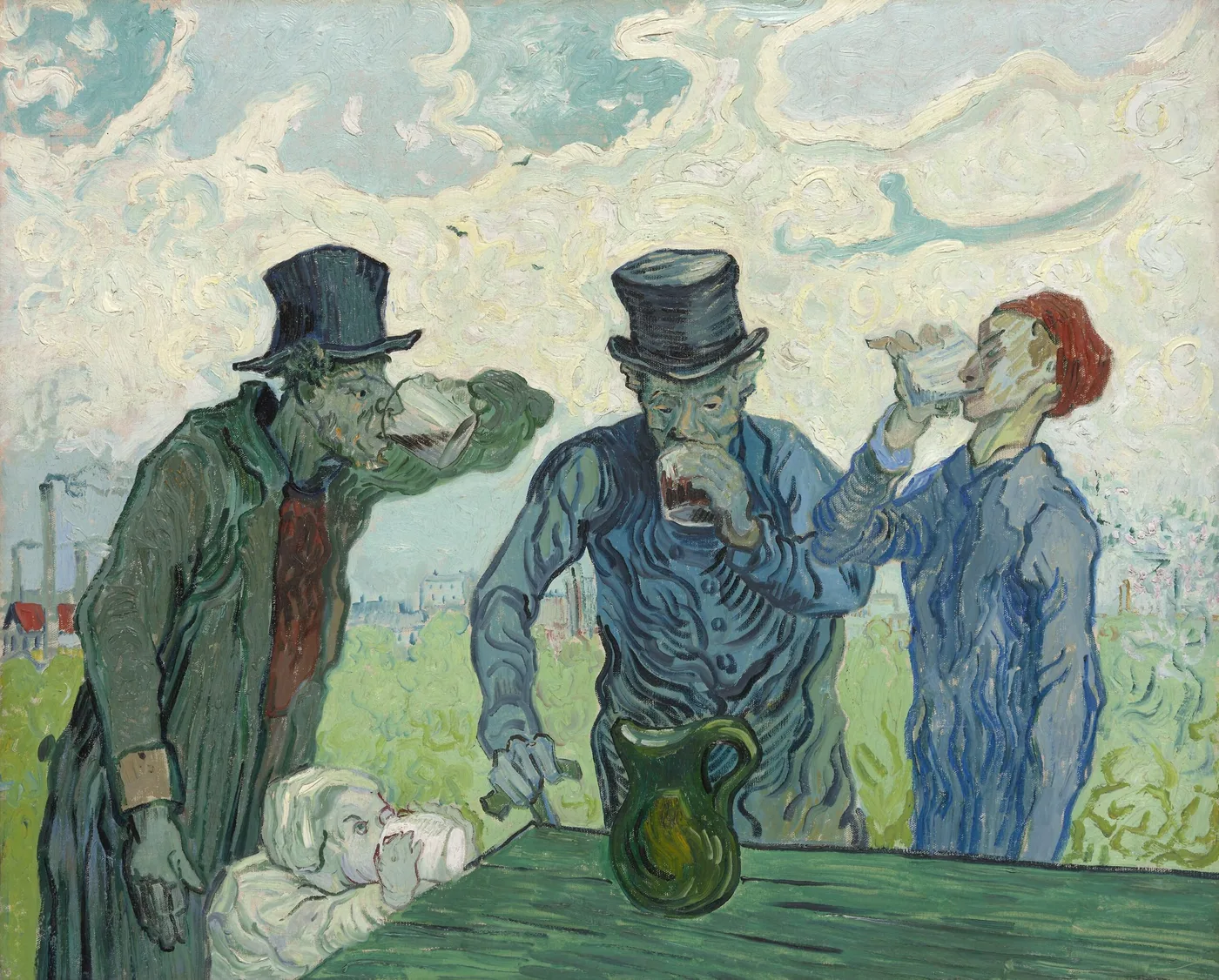
By the spring of 1890, Vincent van Gogh had spent the better part of a year inside the walls of the asylum at Saint-Rémy-de-Provence. Model sitters were hard to come by there, so he turned to a practice he had used before in difficult stretches: working from black-and-white prints by artists he admired, and rebuilding them in his own colour. The Drinkers, painted in 1890, belongs to this small, private body of work.
The source was a print by Honoré Daumier, the great Parisian caricaturist and lithographer whose sharp, economical drawings of ordinary people van Gogh had followed for years. Daumier’s design gave him the figures, their poses, the whole arrangement of the scene. What van Gogh added was everything a lithograph could not hold: weight of paint, temperature of light, the particular blues and greens of a specific imagined afternoon.
He described this kind of work to his brother Theo as something closer to musical interpretation than to copying, a way of translating another artist’s black and white into his own key. It let him keep working through a period when leaving the grounds to paint from life was not always possible, without abandoning the figure as his subject.
Four Ages Around a Green Table
The painting is built around a plain green table that cuts across the lower edge of the canvas, close enough to the viewer that the four drinkers seem to stand almost within arm’s reach. There is no room, no interior, no clutter, only the table, a jug, and the figures themselves, drinking in what reads as an open, slightly bleak outdoor setting.
On the left stands a man in a long dark green coat and a black top hat, a rust-red tie knotted at his throat, tipping a glass to his mouth. His face is rendered in the same sickly greens as his coat, gaunt and hollow-cheeked, closer to caricature than to portraiture, which is exactly the register Daumier worked in.
At the centre, and larger than the others, an old man in a blue smock and another black top hat lifts a tumbler with both hands. He anchors the whole composition, his bent posture and heavy features carrying the sense of a lifetime already spent. A green jug sits on the table directly in front of him, the single still object in a painting otherwise full of motion.
To the right, a younger man with red hair and a blue collarless shirt drinks from a glass held up almost level with his eyes, his sleeve pushed back to show a forearm reaching across the old man’s shoulder. Low at the bottom edge, almost cropped out of the picture, a child leans on the table and drinks too, small hands wrapped around a cup. Infancy, youth, middle age and old age are set out in a single row, an old subject given a plainly modern setting.
Sky, Smoke and a Restless Brush
Above the figures, the sky takes up nearly half the canvas, a mass of pale blue broken by thick white clouds that curl and loop across the surface. The brushwork here is the most agitated in the picture, laid down in long looping strokes that owe more to van Gogh’s own late style than to anything in Daumier’s print.
The palette overall is cool and slightly acid: bottle greens, slate and cobalt blues, with the tie, the hair and the warm brown of the drinks providing the only real warmth in the picture. Dark outlines run around each figure, a visible trace of the print’s linework still showing through the paint.
Behind the drinkers, a low landscape opens out, fields in yellow-green, a scatter of red-roofed houses, and on the far left two factory chimneys sending up thin trails of smoke. It places the scene at the edge of a town rather than in open countryside, an ordinary working margin rather than a picturesque view.
The table itself is painted as a single flat plane of dark green, broad brushstrokes running in one direction, giving the lower third of the canvas a steadiness that offsets the turbulence of the sky above. Between that calm foreground and the churning clouds, the four heads and their raised glasses sit in a narrow, busy band of activity.
In the Room
The original measures 73.4 by 59.4 centimetres and is held today by the Art Institute of Chicago. It is a modest size for a composition with this much incident in it, four figures and a full sky compressed into a canvas a person could carry under one arm.
Hung at eye level, the closeness of the table and the figures leaning over it gives the painting an odd directness, as though the drinkers have simply been interrupted mid-gesture rather than posed. There is little distance offered to the viewer, and the picture asks to be read up close, where the individual strokes in the sky and the greenish shadows on the faces are still legible.
Because so much of the canvas is sky, the painting responds to changing light in a room across the day. Under warmer evening light the clouds pick up a yellowish cast that softens the picture; under cooler daylight the blues and greens sharpen, and the four figures, still and drinking, seem to hold their ground against all that movement overhead.
Sizes and materials for The Drinkers are listed on its product page.
More from this collection
Bring this painting home
Choose a hand-painted oil reproduction for real brushwork, or an archival canvas print for a crisp museum-image edition. Every size preserves the original proportions.
View this work & options
Further reading
Verify the original in the Art Institute of Chicago collection record and continue through related works in the catalogue.