
Undergrowth with Two Figures: Story, Meaning & Brushwork
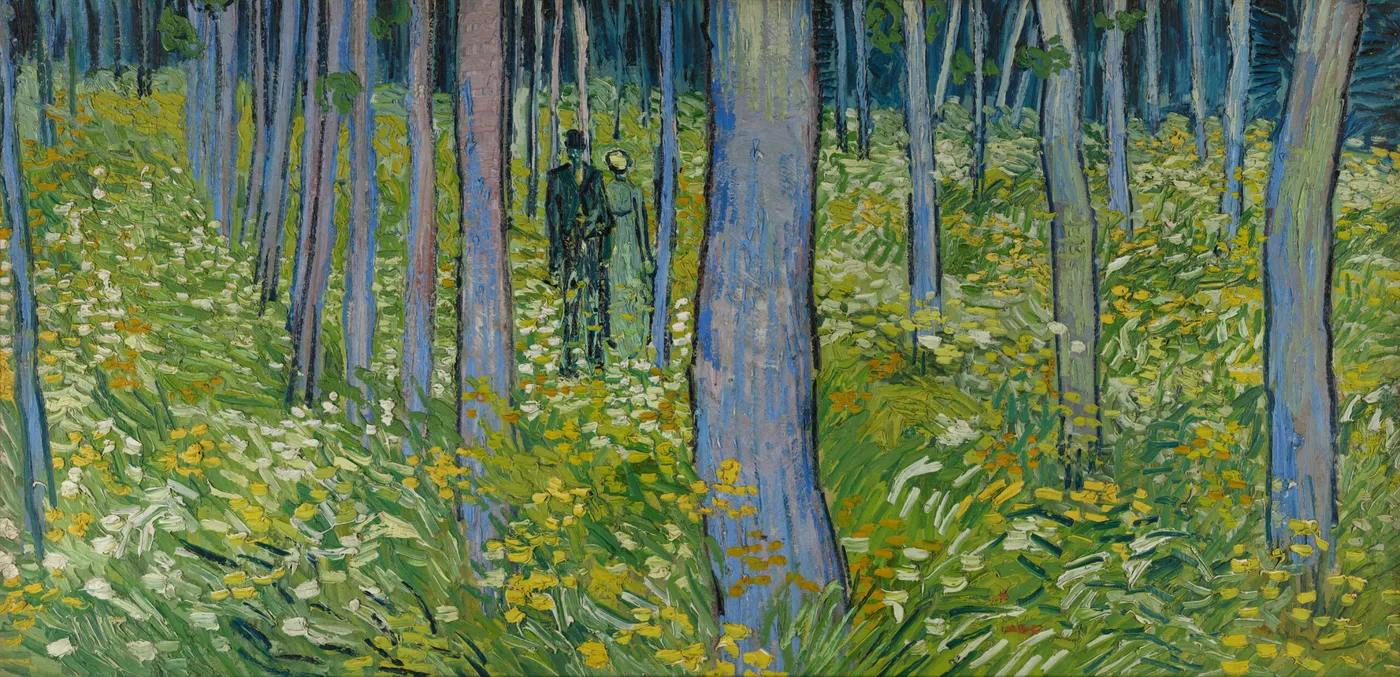
In May 1890 Vincent van Gogh left the asylum at Saint-Remy-de-Provence and travelled north to Auvers-sur-Oise, a village on the Oise river within easy reach of his brother Theo in Paris. He had perhaps nine weeks left to live, and he painted at a pace that still unsettles anyone who tries to catalogue his output from that summer. Undergrowth with Two Figures, made in 1890, belongs to the last and strangest group of pictures from those weeks, a set of woodland views in which the sky is left out entirely and the trees close over the viewer like a curtain.
A Wood Without a Horizon
Van Gogh painted several versions of this motif at Auvers, tramping into the woods above the village with a canvas cut long and low, then filling it edge to edge with tree trunks. There is no sky in any of them, no distant field, nothing to place the viewer at a fixed distance. The trunks simply rise past the top of the frame, and the eye has nowhere to go but along the ground.
That refusal of a horizon is the picture’s most deliberate decision. Van Gogh had spent the previous year, at Saint-Remy, painting cypresses and olive groves that still obeyed a conventional middle distance. Here he shuts that option off, and the wood becomes a single continuous surface rather than a scene glimpsed from a fixed spot.
The Couple Among the Trunks
Two figures stand slightly left of centre, dressed in dark greens and blacks that read almost as silhouettes against the paler bark around them. They are small, no taller than the gap between two neighbouring trunks, and Van Gogh gives them no faces to speak of, just a dab of flesh tone above the collar. Whoever they are, they are passing through rather than posing.
Their placement is exact rather than incidental. Van Gogh has set them in the one patch of the canvas where three or four trunks part slightly, so the paler ground behind them frames the dark shapes of their clothing. Take the couple away and the painting still holds together as a study of trees and undergrowth; leave them in and the wood suddenly has a scale, a distance you could actually walk.
They also give the picture its quiet unease. Two people this small in a screen of trunks this dense feel watched rather than watching, closer to figures glimpsed through a hedge than to subjects out for an afternoon stroll.
Blue Trunks, Yellow Ground
The trunks themselves are not painted brown. Van Gogh renders them in cool blues, lilacs and pale violets, with one central trunk built up in a thick, almost turquoise blue that anchors the whole composition. Warmer notes, a rose pink, a streak of ochre, appear only on one or two trunks at the left, as if the light were catching bark at a single angle.
Below the trunks, the ground is a dense tangle of green, laid in short strokes that tip toward yellow wherever dandelions push through, and toward white where a scatter of small blossom sits over the grass. There is no bare earth anywhere in the picture. Every inch of ground is accounted for in paint, grass over grass, flower over grass, until the surface reads as thickly as a woven textile.
Held together, the palette is built almost entirely from the pairing of blue-violet and green-gold, a combination Van Gogh had used before to charge a picture without raising its temperature. The result feels shaded and cool even where the yellow is at its brightest, more like the light two steps inside a treeline than an open field at midday.
The Marks the Brush Left
Look closely and the trunks turn out to be built from long, single strokes of paint dragged straight up the canvas, loaded thickly enough to leave ridges you could feel with a fingertip. Van Gogh does not blend these strokes into the ground behind them; trunk and undergrowth meet in a hard edge, one colour laid directly against another wet on wet.
The undergrowth is handled completely differently, in short dashes and commas of paint set at every angle, greens crossing greens, a fleck of yellow dropped in wherever a flower needed marking. Where the trunks are vertical and disciplined, the ground is scattered and quick, and the contrast between the two kinds of mark does much of the work of separating near from far.
This is paint applied fast, straight from the tube in places, with barely any medium to slow it down. Nothing here has been corrected or softened afterwards. It is the record of a hand moving as quickly as the eye could feed it instructions, consistent with the furious rate of work Van Gogh kept through his final weeks at Auvers.
Living With the Wood
The canvas is long and low, some 99.7 by 49.5 centimetres, a shape closer to a wide window than to a conventional portrait or landscape frame. Hung at eye level, that proportion puts the viewer roughly where the two walking figures stand, looking along the trunks rather than down into a distant view.
Because the picture has no sky and no single source of light, it does not settle into one mood the way a sunlit landscape might. Under warm evening light the blues in the trunks pull forward and the wood feels closer and cooler; under a bright, flat daylight the yellows in the undergrowth take over and the same canvas reads as an open, sunstruck clearing.
The original hangs today in the Cincinnati Art Museum, one of the last woodland paintings Van Gogh made before his death at Auvers-sur-Oise in July 1890. Seen in reproduction or in life, it keeps the quality that makes it worth returning to: a wood painted not as scenery but as a place you are standing inside, with two people about to disappear between the trees.
Sizes and materials for Undergrowth with Two Figures are listed on its product page.
More from this collection
Bring this painting home
Choose a hand-painted oil reproduction for real brushwork, or an archival canvas print for a crisp museum-image edition. Every size preserves the original proportions.
View this work & options
Further reading
Verify the original in the Cincinnati Art Museum collection record and continue through related works in the catalogue.