
Vase with Irises: Story, Meaning & Brushwork
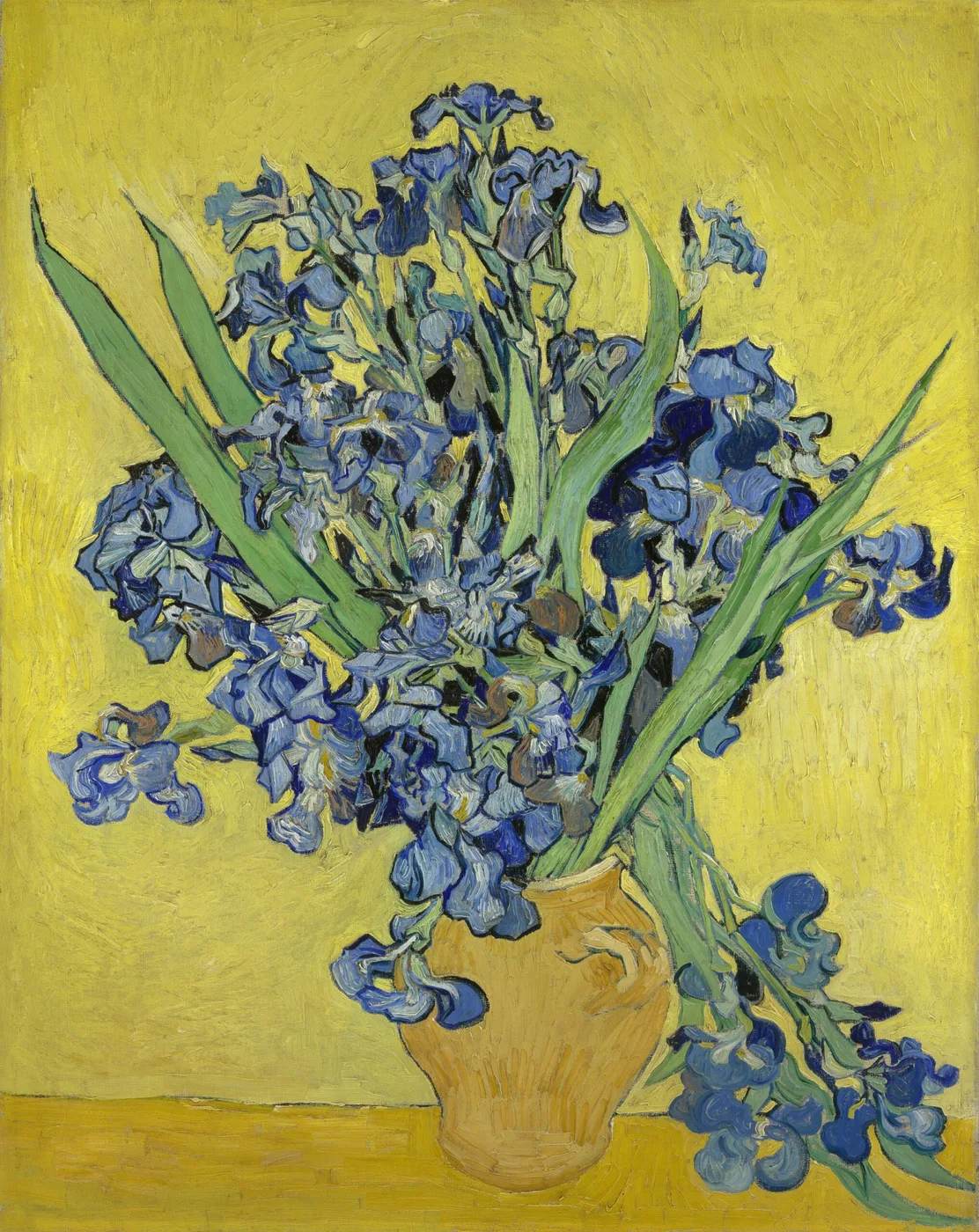
Vase with Irises was painted in 1890, in the last days Vincent van Gogh spent at the asylum of Saint-Paul-de-Mausole, on the edge of Saint-Rémy-de-Provence.
A last week at Saint-Rémy
By the spring of 1890 Van Gogh had spent close to a year at the asylum, having admitted himself there after the crisis in Arles that cost him part of an ear. Within its walled garden, under its own irises and plane trees, he had already worked through a long run of paintings, from cypresses and olive groves to the swirling night sky over the surrounding hills. Now he was preparing to leave, arranging to travel north to Auvers-sur-Oise, closer to Paris and to his brother Theo.
In his final days there he set landscape aside and turned to something he could paint indoors, at his own pace: cut flowers gathered into a vase. It was a subject he had used before, useful precisely because it asked nothing of the weather or his nerves, only of his eye for colour.
He worked on two vase arrangements of irises and two of roses that week, painting them in quick succession, almost as a set. ‘They are studies of flowers,’ he wrote of them, made for the pure pleasure of colour after a year that had tested him hard. Vase with Irises, at 73.5 by 92 centimetres, is one of that pair.
A spray of violet on a field of yellow
The painting is built from almost nothing: a plain earthenware vase, a crowded bunch of irises, a table and a wall. Van Gogh gives the flowers the whole of the canvas, letting their bent stems and curling petals fill the frame from edge to edge.
The irises spill outward and downward as much as up. Some blooms turn to face the viewer square on, others slip over the rim of the vase and hang toward the table below.
Long, blade-like leaves cut across the bouquet in pale green, straight where the flowers themselves are folded and knotted. Behind and beneath it all runs a single unbroken yellow, wall and tabletop painted in nearly the same warm ochre, so the vase seems almost to float free of any horizon.
There is no other object in the room to look at, no window, no clock, no second vase. The flowers are the entire event, and the eye has nowhere else to go.
The push and pull of complementary colour
Van Gogh was working here from a principle he had studied closely: violet and yellow sit opposite one another on the colour wheel, and set side by side each pushes the other toward its most intense pitch. He had used the same device before with the blue and orange of his sunflowers and chairs; here it is violet against yellow instead, and the choice is just as deliberate.
Up close the irises are not one blue but a moving range of ultramarine, cobalt and violet, some petals dragged through near black at their centre, others lightened toward grey-blue at the edge. He drew each flower with a dark, curling contour line, not unlike the lead lines in stained glass, then filled the shape with short, loaded strokes of the brush.
The yellow ground is handled more openly, in longer strokes that let the weave of the canvas show through in places. It is a plainer surface, built to hold the eye on the flowers rather than compete with them.
Paint sits thick where the irises crowd together at the centre of the bouquet, and thins toward the edges of the canvas. Nothing here is smoothed over: the brushwork stays visible throughout, in the vase’s rough clay surface, in the leaves’ quick diagonal strokes, in the small flicks of white and pale blue that catch a petal’s turned edge.
On a wall, in changing light
Vase with Irises is held by the Van Gogh Museum in Amsterdam, and it is a painting that behaves differently depending on where and how it is seen. In flat daylight the yellow reads warm and settled; under a lamp at night it tips toward gold, and the violets deepen until some petals look almost black.
Given a plain wall around it, the painting has room to do what Van Gogh built it to do: pull the eye in on colour alone, with no anecdote required and nothing else in the frame to compete with the vase. It rewards a minute of looking rather than a glance, the kind that notices how one loaded stroke can stand for an entire petal.
It is, in the end, a picture made quickly under real pressure, in the last days of a long stay in an asylum, by a man about to move on to somewhere and something else entirely. That urgency has not dulled with time. If anything, the violet and the yellow still pull against each other as hard as they did the week they were painted.
Sizes and materials for Vase with Irises are listed on its product page.
More from this collection
Bring this painting home
Choose a hand-painted oil reproduction for real brushwork, or an archival canvas print for a crisp museum-image edition. Every size preserves the original proportions.
View this work & options
Further reading
Verify the original in the Van Gogh Museum collection record and continue through related works in the catalogue.