
Undergrowth: Story, Meaning & Brushwork
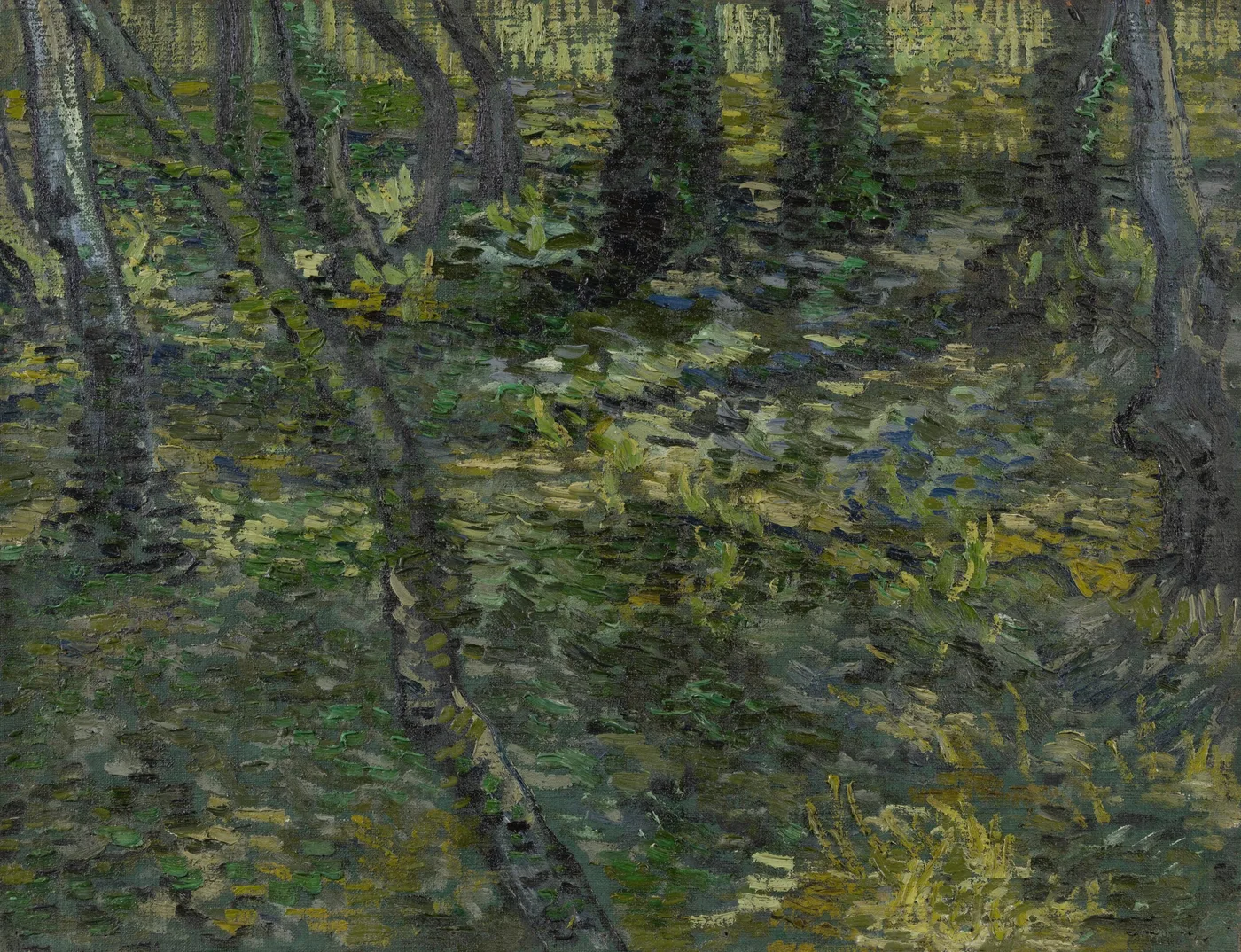
In May 1889, Vincent van Gogh committed himself to the asylum of Saint-Paul-de-Mausole, on the edge of Saint-Rémy-de-Provence. He had asked to go there after the crises of the previous winter in Arles, and for the first weeks he was permitted to work only within the walls of the old monastery and its overgrown garden. The world he was allowed to paint had shrunk to a few enclosed acres, and Undergrowth, painted that same year, is one of the results of that narrowing.
Rather than treat the restriction as a limitation, he pushed his eye closer to what was actually in front of him. Instead of a view with a horizon, a road or a distant hill, he chose a patch of ground beneath the trees and painted it as though nothing else existed. The painting measures 64 by 49 cm, a modest size that suits its subject: this is not a landscape meant to be surveyed, but a corner meant to be entered.
Confined to a Garden, in the Spring of 1889
The asylum grounds included stretches of untended woodland, ivy climbing over old stone, saplings growing thin and crooked where they had seeded themselves. Van Gogh painted this same corner of ground more than once that spring and summer, drawn back to it as a subject he could return to without needing an escort beyond the gates.
He was, by his own account in letters from this period, trying to work steadily through difficult months, and the tangled, self-contained motif of the undergrowth gave him a subject that did not depend on weather, distance or permission to travel. It was there, close at hand, every day he was well enough to set up his easel.
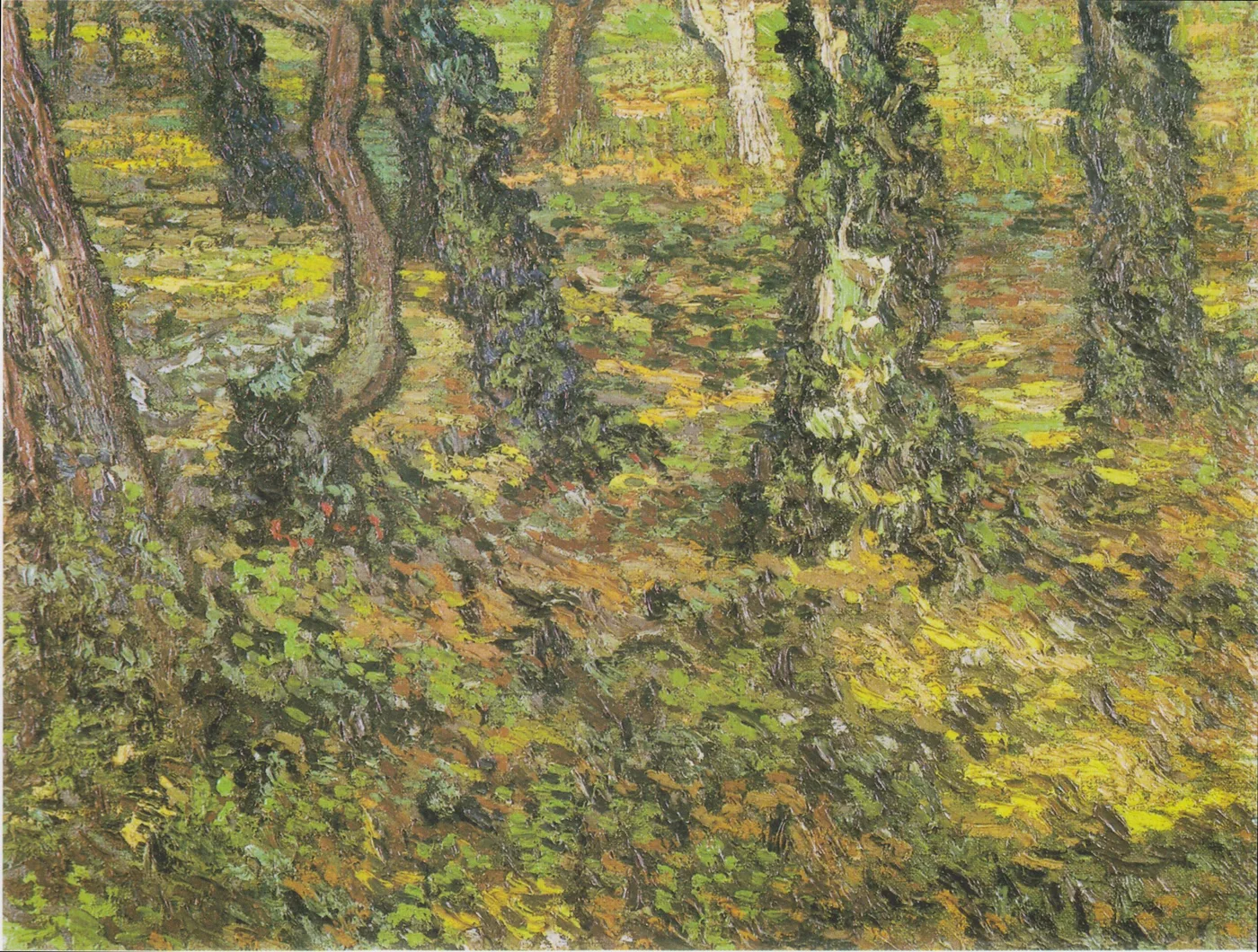
That circumstance shapes what the picture shows. There is no sky, no clearing, no path leading the eye out of the scene. The canvas is filled edge to edge with trunks and ground cover, so that looking at it is close to standing inside the wood itself rather than looking upon it from outside.
Inside the Green Wall
Slender tree trunks rise vertically through the composition, some straight, some leaning at odd angles as young trees do when they compete for light. They are painted in greys, browns and a cold blue-black, with none of the warm ochre bark tones he used for the olive trees and cypresses he painted elsewhere at Saint-Rémy.
Between and beneath the trunks lies a dense floor of ivy and low growth, rendered in a wide range of greens: deep bottle green in the shadows, a sharper acid green where light catches the leaves, and passages of ochre yellow scattered through like fallen light. Small touches of blue sit among the greens, cooling the mass and stopping it from reading as a single flat colour.
There is no single focal point in the usual sense. The eye enters wherever a lighter patch of ground or a pale trunk breaks the density, then moves sideways and back through the tangle, the way it would if you were actually standing in such a place trying to find a way through.
A Dense Weave of Strokes
Van Gogh built the undergrowth from short, loaded strokes of paint, laid one against another without blending. Each mark reads as a leaf, a blade, a fleck of light on wet ground, but none is a leaf drawn in detail; the effect is made by the accumulation of marks rather than by any single one.
The trunks are painted more directly, with longer strokes that follow their lean and taper, some scraped or dragged so the darker underlayer shows through. This contrast between the loaded, choppy marks of the ground cover and the leaner strokes of the trunks gives the surface a rhythm you can trace even in reproduction.
Up close the picture almost dissolves into pure paint, ridges and troughs of colour with no clear image. Stepping back, those same marks resolve into ivy, shadow and dappled light, a shift that happens more or less at arm’s length from the canvas, which is roughly the distance from which it would have been made.
On a Wall, in Changing Light
Hung in a room, this is not a picture that announces itself from across the space. It rewards the kind of looking usually reserved for a real patch of woodland, where the eye has to adjust before the detail comes forward.
Daylight brings out the blues and the pale ground where the paint sits thickest, while lamplight in the evening pulls the greens down into something closer to black, the whole surface reading darker and more enclosed. A room with shifting natural light will show a different painting at different hours, which is very much in keeping with a picture made from a single close, changing patch of ground.
The original is held by the Van Gogh Museum, which records the work under its title Undergrowth, painted in 1889. Seen there or in reproduction, it remains one of the more private pictures from Van Gogh’s time at Saint-Rémy, made from a subject he did not have to travel to find.
Sizes and materials for Undergrowth are listed on its product page.
More from this collection
Bring this painting home
Choose a hand-painted oil reproduction for real brushwork, or an archival canvas print for a crisp museum-image edition. Every size preserves the original proportions.
View this work & options
Further reading
Verify the original in the Van Gogh Museum collection record and continue through related works in the catalogue.