
The Banks of the Seine with Boats: Story
Paris Loosens His Palette
By the spring of 1887 Vincent van Gogh had been living in Paris for over a year, sharing an apartment with his brother Theo in Montmartre. He had arrived from Antwerp still painting in the murky browns and greys of his Dutch years, but Paris was changing him fast. Through Theo’s contacts in the art trade he met Camille Pissarro, Paul Signac and Georges Seurat, painters who were breaking colour down into small, separate touches rather than blending it on the palette.
That year Van Gogh began carrying his easel out beyond the city, along the Seine to Asnières and Clichy, where barges moored under poplars and the river caught the changing sky. He often worked there alongside Signac, and the two painted the same stretches of bank from different angles, trading ideas about colour as they went. Banks of the Seine with Boats, painted in 1887, is one of a group of small riverside canvases that came out of those sessions.
The Asnières and Clichy pictures mark a turning point that lasted only a season or two before Van Gogh pushed his colour further and left for Arles, but they were where he first tested how far broken colour could carry a picture on its own. This canvas is a modest, close-focused example of that testing, a single barge rather than a sweeping panorama.
A Barge Drawn Up on the Bank
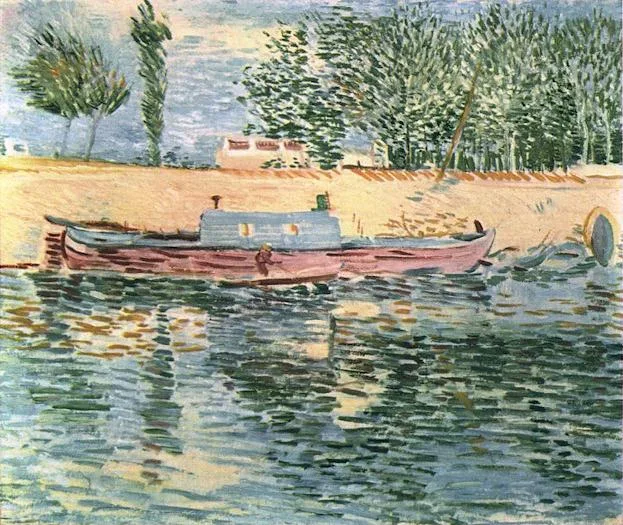
The painting, 55 by 48 centimetres, sets a single moored barge across the width of the canvas, its hull in dusty rose and violet-pink against a pale blue-grey cabin. A figure in yellow sits low in the stern, small enough that the eye finds the boat before it finds him. Behind the barge a second craft rides half-hidden, cropped by the frame at the right edge.
The bank rises behind the boats in a strip of ochre sand, dotted with a red-roofed house and paler buildings set back among the trees. Above that, a run of poplars and chestnuts in broken greens closes off the horizon, their trunks left as bare, thin verticals against a soft, unclouded blue sky. Nothing in the upper half of the canvas asks for attention twice; the incident stays low, at the waterline.
Water fills nearly half the picture, and it is where Van Gogh spent his effort. The barge’s pink and blue repeat in the reflection below it, broken into short strokes of colour that never quite resolve into a mirror image. Dashes of gold, mauve and dark green ripple across the surface, so the river reads less like still water and more like a place in continuous, quiet motion.
Painting in Separate Touches
Van Gogh laid this canvas in the broken, comma-like strokes he was picking up from Signac and Seurat that spring, small dabs of pure colour set side by side rather than mixed on the palette. It is a method built on contrast: a stroke of orange next to one of blue, pink against green, each colour left to sharpen its neighbour instead of blending into it.
He never fully adopted the dot-by-dot discipline of Seurat’s pointillism, and this canvas shows why. The strokes on the barge are longer and more varied in direction than a strict Divisionist would allow, following the curve of the hull rather than a fixed system, and the water is where he lets the method loosen further still, the brush moving in short horizontal dashes that build texture as much as colour.
The palette itself marks the distance travelled since Antwerp. Where his Dutch pictures worked in umber and bitumen, here the darkest passage in the whole canvas is a bottle-green shadow under the hull. Everything else sits in the upper register of the colour wheel: rose, sky blue, straw yellow, the pale ochre of the towpath.
Morning Pink, Evening Blue
Hung where daylight reaches it, the canvas shifts with the hour in a way a darker picture never could. Morning light picks out the pink of the hull and the gold flecks on the water; by evening the blues in the reflection deepen and the whole scene reads cooler, closer to dusk on the actual river.
Up close, the surface breaks into hundreds of individual strokes, each one a distinct decision about colour. Standing back, those strokes resolve into a barge, a bank, a stand of trees, the trick shared by Impressionist and Neo-Impressionist painting alike, and one that rewards the extra few steps back a living room allows.
It is a quiet picture rather than a dramatic one, built for slow looking rather than a single glance. That suits a wall where it will be seen every day, at breakfast light and at evening light, rather than a wall meant to be passed once and forgotten.
Sizes and materials for The Banks of the Seine with Boats are listed on its product page.
More from this collection
Bring this painting home
Choose a hand-painted oil reproduction for real brushwork, or an archival canvas print for a crisp museum-image edition. Every size preserves the original proportions.
View this work & options
Further reading
Verify the original in the collection record and continue through related works in the catalogue.