
A Pair of Shoes (1887): Story, Meaning & Brushwork
Paris, and a Change of Subject
By 1887 Vincent van Gogh had been living in Paris for about a year, sharing an apartment with his brother Theo and working through the ideas he found among the Impressionists and the younger painters he met at Fernand Cormon’s studio. His palette was lightening and his brush growing shorter and more broken, and he was testing what he had learned on whatever sat in front of him.
Shoes were one of those subjects. He returned to worn boots and clogs several times in this period, setting them on a table or the studio floor and painting them as if they were sitters rather than props. A Pair of Shoes, dated 1887 and signed at lower right, belongs to that small group.
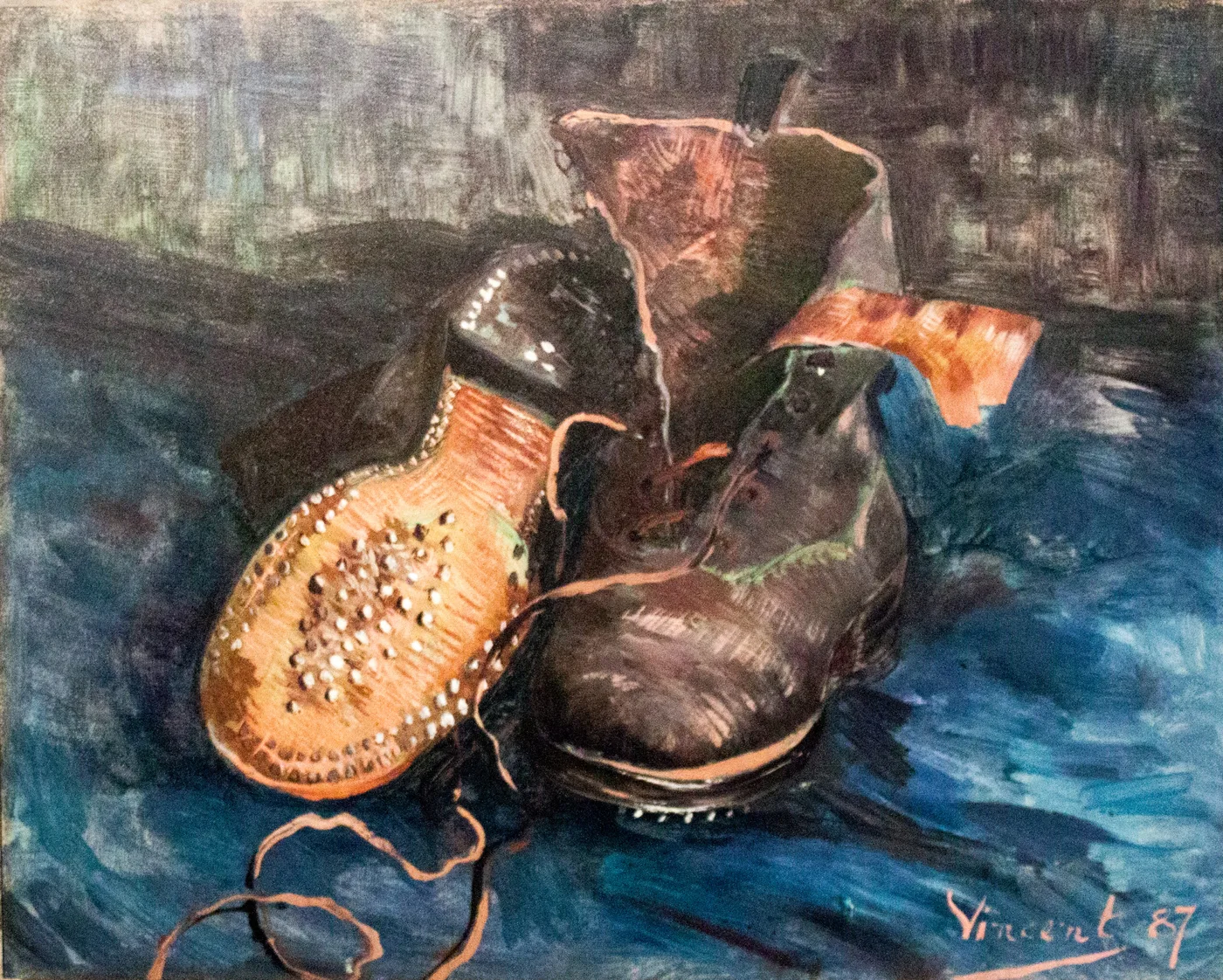
There is nothing staged about the arrangement. The boots look set down rather than composed, one resting on its side, the other upright with its laces loose, as though someone had just stepped out of them.
One Boot Upright, One Laid Open
The upright boot faces the viewer almost squarely, its leather worn to a dull sheen at the toe and creased hard across the instep. Its laces hang undone, trailing loose ends of cord that drop toward the bottom edge of the canvas.
Beside it the second boot lies on its side, sole turned outward, so that a row of iron studs hammered into the leather catches the light in small, separate dabs of white and ochre. The exposed lining shows in warm rust and tan, a contrast to the black-brown of the uppers.
Behind both, the tongue of a third opening rises stiffly, a triangle of pale hide that reads almost like a small flag against the darker leather around it. Van Gogh gives this detail as much attention as the boots themselves, painting its frayed edge with the same searching, short strokes he uses throughout.
The setting is left deliberately spare. A dark, mottled surface, somewhere between wall and floor, closes off the top half of the canvas, while the boots sit on a passage of deep blue that could be floorboards or shadow.
Leather in Blue and Rust
The picture works from a narrow, sober range: blue-black, umber, and a warm rust that flares up in the exposed sole and the torn lining. Against so restrained a scheme, even a small patch of orange reads as an event.
Van Gogh built the leather in short, dragged strokes that follow the creases of the boots rather than smoothing over them, so the paint itself seems to crack and fold the way old hide does. The studs on the raised sole are set down as separate touches of pigment, almost countable, each catching the light differently from its neighbours.
The background is handled more loosely, in a scrubbed, hatched application that keeps it from competing with the boots while still giving the canvas a restless surface. Nothing in the picture is smooth; even the blue ground carries visible ridges of paint.
At 41.5 by 34 centimetres, the canvas is small enough that this handling reads as a close study made at close range, not a grand statement.
A Small Picture With a Long Afterlife
Van Gogh never explained what these boots meant to him, and no letter survives that names this particular canvas. What is certain is that he kept returning to the motif, and that later writers, philosophers among them, would treat his shoe paintings as a case study in how much feeling a plain object can carry.
Whatever the boots once carried, walking or working, is left for the viewer to supply. Van Gogh gives only the object, closely observed, and trusts that to be enough.
The Baltimore Museum of Art now holds the painting, catalogued there under its original title, Pair of Shoes, A, an inverted phrasing typical of museum indexing rather than any change to the plain, worn object it names.
On a Wall
Hung at eye level, the painting rewards the kind of looking it was made with: slow and close, willing to follow a single crease or a row of studs rather than take in the whole boot at once. Morning light picks out the ridges of paint on the blue ground; by lamplight the same surface flattens and the rust-coloured lining glows instead.
It sits easily among other kitchen and dining still lifes, but it asks something different of a room than a bowl of fruit does. It is a picture about labour and wear, and it holds that mood quietly, without insisting on it.
Sizes and materials for A Pair of Shoes are listed on its product page.
More from this collection
Bring this painting home
Choose a hand-painted oil reproduction for real brushwork, or an archival canvas print for a crisp museum-image edition. Every size preserves the original proportions.
View this work & options
Further reading
Verify the original in the Baltimore Museum of Art collection record and continue through related works in the catalogue.