
Vase with Fifteen Sunflowers: Story, Meaning & Brushwork
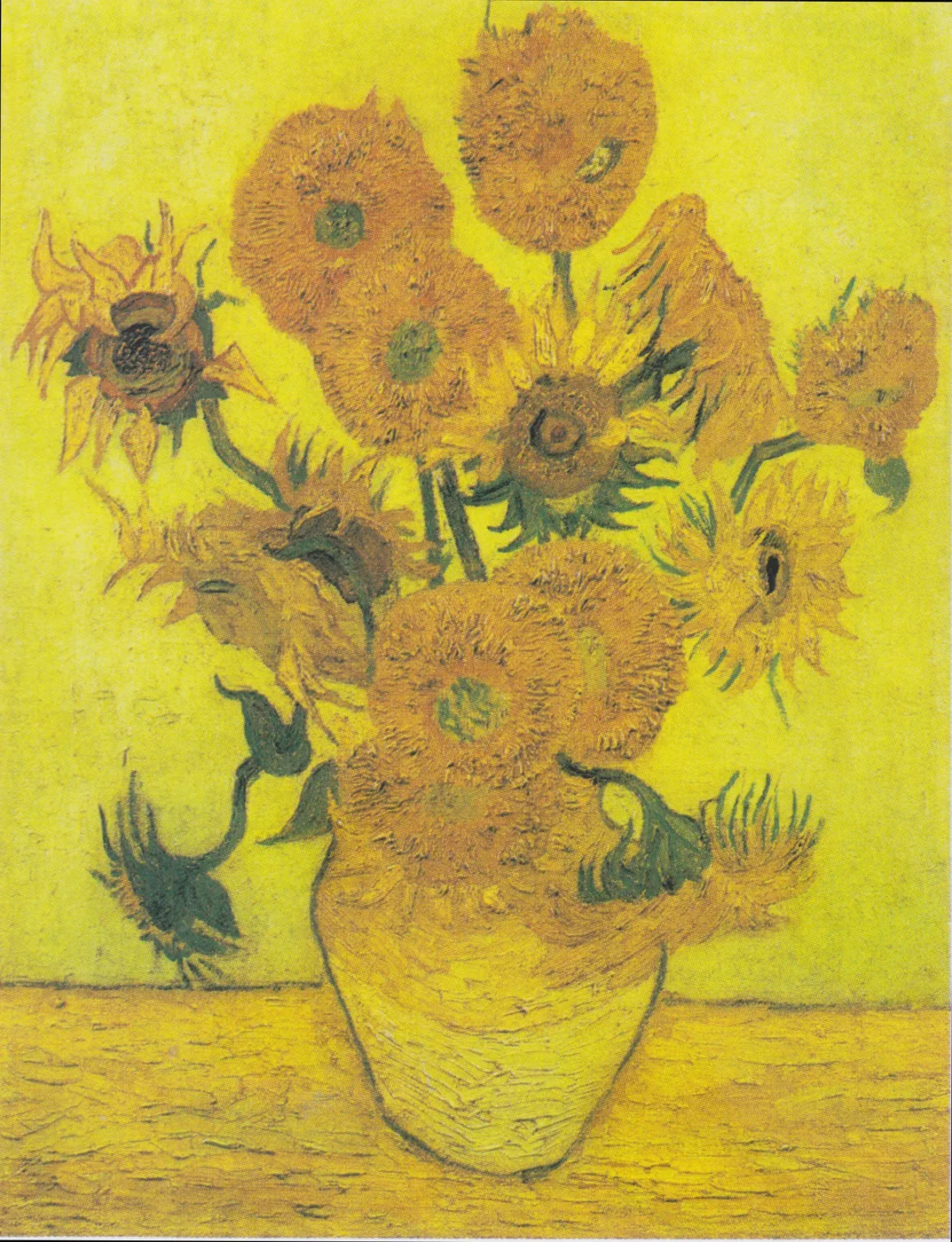
By January 1889 Vincent van Gogh was back in the Yellow House at Arles, alone. Paul Gauguin had left the previous month, after the quarrel that ended with Van Gogh’s ear wound and a stay in hospital, and the two rooms Van Gogh had decorated for his friend’s visit stood mostly empty. Sunflowers do not flower in a Provençal winter, so when he decided to make more of the pictures that had hung on Gauguin’s wall the previous August, he worked from his own earlier canvas rather than from a vase of fresh blooms.
The result was Still Life: Vase with Fifteen Sunflowers, painted that January and now held by the Sompo Museum of Art in Tokyo. At 76.5 by 100.5 centimetres it is close to life size, a considered repetition rather than a quick study, made with the same attention Van Gogh had given the first version five months earlier.
A Second Version, Made With Care
Van Gogh used the word repetition for pictures like this one, and he meant it precisely. He was not copying in the sense of tracing, but reconstructing a composition he already trusted, matching the tilt of each flower head and the exact count of fifteen blooms from memory and from his own earlier canvas.
He had written to his brother Theo about wanting a decoration built from several sunflower canvases, a set of yellows that would hold together as a scheme. Making repetitions let him produce more than one picture from a single successful arrangement, so that scheme could travel or hang in more than one room at once.
He had already told Gauguin, half in jest and half not, that the sunflower was his alone among painters. By January that claim had become truer than when he first made it. This picture is the flower repeated on his own terms, in his own house, once the argument that had brought Gauguin to Arles was over.
Fifteen Heads Against a Field of Yellow
The picture holds nothing but a plain earthenware vase and its flowers, set on a bare table, against a wall broken only by a single horizontal line dividing it from the tabletop. Fifteen sunflower heads crowd out of the vase’s mouth on thick green stems, some upright and fully open, others turned side on or drooping past their best.
A few heads have gone to seed, their petals thinned to a fringe around dark, bristling centres; others are still broad discs of gold with a green eye at the middle. One flower at the upper left has curled and browned entirely, a small note of decay set against the freshness of the blooms beside it.
Colour carries almost the whole picture. Van Gogh worked the background, the table and the vase in close variations of a single yellow, from pale chrome near the top to a deeper, almost orange gold at the base, so the flowers themselves have to be built from small shifts of green, brown and ochre rather than any contrast of hue. The eye lands first on the tallest, most frontal head at the centre of the bunch, then works outward around the ring of flowers surrounding it.
Paint Thick Enough to Cast a Shadow
Van Gogh laid the paint for the flower heads in high relief, loading his brush and dragging it so the ridges of pigment stand physically off the canvas. Petals are built as short, separate strokes radiating from each centre, and the seed heads are worked with the same thickness, so that from an angle the surface reads almost as a low sculpture.
Into some of that wet paint he scratched thin lines with the end of his brush, marking out the fine ribs of a petal or the texture of a seed head faster than he could have painted them stroke by stroke. The vase and table, by contrast, are handled more thinly, so the picture holds a deliberate contrast between the built up flowers and the flatter ground they sit on.
He was, by his own account, testing how far a picture could hold together on almost one colour alone, a study in yellow against yellow rather than in contrasting hues. Small touches of blue green in the stems and outlines are really all that stop the picture dissolving into a single field of gold.
On a Wall, in Changing Light
At a metre tall, the canvas reads less like a vase of flowers glimpsed on a table and more like a wall of gold that happens to hold fifteen sunflowers. Hung at eye level it fills more of the field of view than its modest width suggests, an effect Van Gogh would have understood, since he already thought of his sunflower pictures as decoration built to be lived with rather than studied from a distance.
Because the paint sits so high off the surface, the picture changes through the day as real light crosses it. Morning light picks out the ridges of every petal in small shadows; by evening, under a lamp, those same ridges soften and the whole canvas settles back into the flat glow of a single colour.
That was more or less Van Gogh’s ambition for the sunflowers from the start, to paint a colour so completely that it behaved like light rather than pigment. Seen now in the Sompo Museum of Art, or on a wall at home, this repetition still does exactly that, a picture that keeps changing while everything in it stands perfectly still.
Sizes and materials for Still Life: Vase with Fifteen Sunflowers are listed on its product page.
More from this collection
Bring this painting home
Choose a hand-painted oil reproduction for real brushwork, or an archival canvas print for a crisp museum-image edition. Every size preserves the original proportions.
View this work & options
Further reading
Verify the original in the Sompo Museum of Art collection record and continue through related works in the catalogue.