
Fishing Boats on the Beach at Saintes-Maries: Story & Meaning
Five Days to the Sea
In February 1888 Van Gogh left Paris for Arles, chasing a light he believed only the south could give him. By June he had been painting there for four months, working through the wheat fields and orchards around the town at a pace that alarmed even his brother Theo. He wanted the Mediterranean next, and in early June he set off by diligence for Saintes-Maries-de-la-Mer, a fishing village on the Camargue coast he had not yet seen.
He stayed five days. It was his only sight of open sea during his time in the south, and he spent it walking the dunes, sketching the flat marshland and the fishing fleet, and writing to Theo about a coastline unlike anything he had painted before.
Colours Like a Mackerel
Van Gogh was struck most by the sea itself, which he described as changing colour the way a mackerel does, sliding between green, violet, pink and grey almost as he watched it. He made rapid pencil and reed-pen drawings on the beach, recording the boats hauled up on the sand rather than the water, since the fleet went out early and the sand held its subjects still.
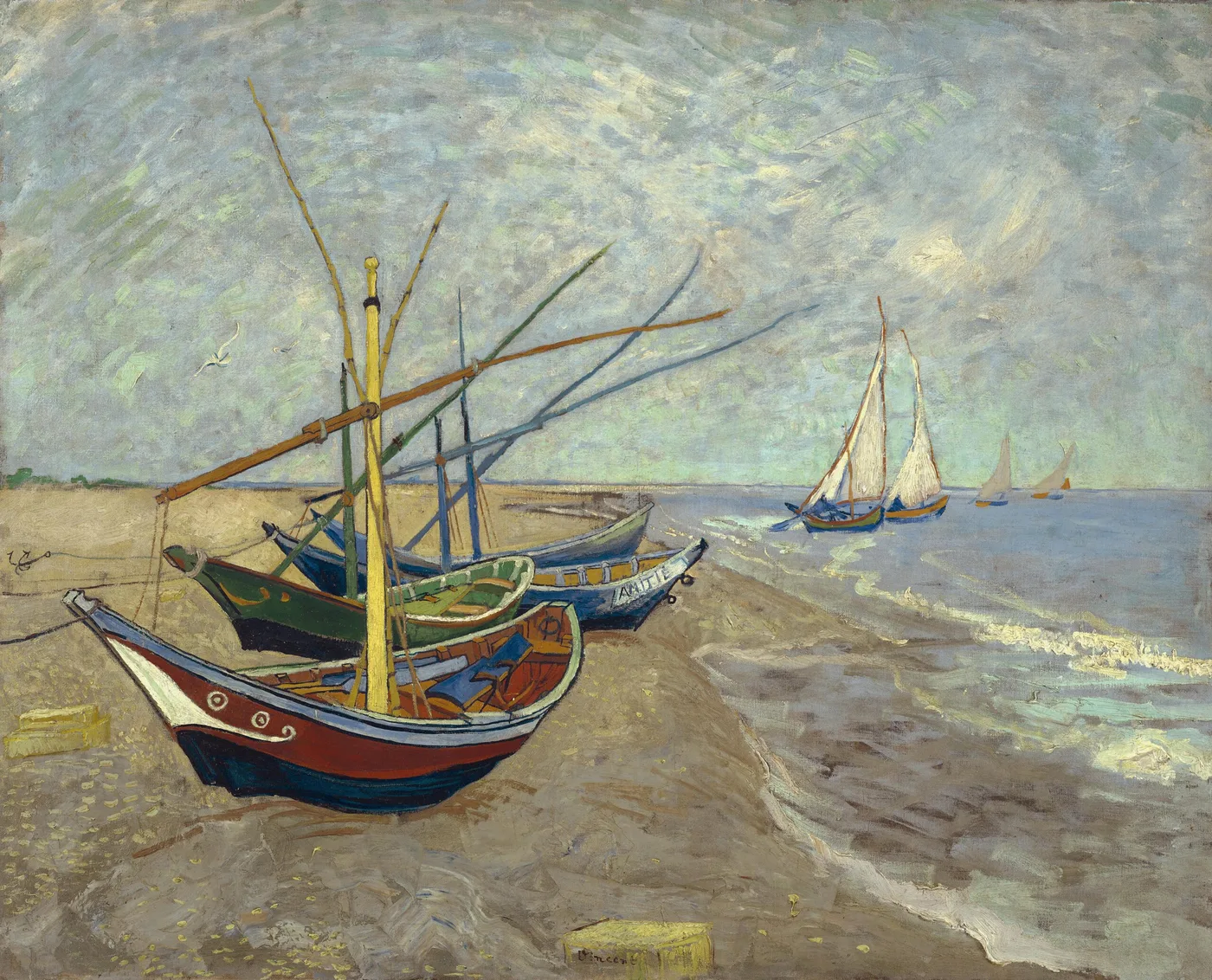
Back in his rented studio on the Place Lamartine in Arles, he turned those drawings into paint, working fast to keep the freshness of what he had seen at the coast. Fishing Boats on the Beach at Les Saintes-Maries-de-la-Mer, painted in June 1888 and now in the Van Gogh Museum, is one result, a canvas of 81 by 65 centimetres built from memory and a handful of sketches rather than from long sessions in front of the motif.
Boats Named for Friendship
Four boats sit drawn up on the sand in the foreground, their hulls painted in blunt, unmixed colour: a red and black hull nearest the viewer, a green one behind it, others in blue and ochre. Tall raked masts and spars cross the sky at odd angles, some bare, some still hung with rigging, so that the boats read as much as a thicket of lines as a group of vessels.
One hull carries a name along its side, Amitié, French for friendship, the kind of detail Van Gogh could only have taken from looking closely at an actual boat on an actual beach. He wrote that the boats’ shapes and colours reminded him of flowers, and the canvas bears that out: the reds, greens and blues of the hulls sit as bright and separate as petals against the flat sand.
Further out, past the line of surf, two boats sail with their white canvas raised, and two more are visible as small coloured marks near the horizon. The sea between them and the shore is broken into short dashes of green, grey-blue and white, choppy rather than calm, with foam curling in along the tideline.
The sky takes up the upper half of the canvas and carries none of the high blue of Van Gogh’s later Provençal skies. It is pale, greenish-grey and clouded, laid in with long sweeping strokes that curve above the boats like weather moving through, closer to a Channel sky than to the Mediterranean cliché.
Line, Colour and the Arles Summer
The boats are drawn with a firm, almost calligraphic outline, each hull and mast fixed by a dark contour before colour was laid inside it. That combination of drawn line and flat, saturated fill was something Van Gogh had been developing all that Arles summer, learned in part from the Japanese prints he collected and adapted here to French working boats.
Complementary colour does the rest of the work: the orange-red hull is set against blue-green sea, the ochre sand against violet-grey shadow under the boats. Van Gogh was reading and thinking about colour theory intensely that year, and this canvas puts the theory to a plain, practical test on a beach full of ordinary working craft.
The sand itself is built from short, dragged strokes of buff, grey and pale yellow, with two small wooden blocks, chocks used to steady the hulls, set in near the bottom edge almost like signature details. Nothing in the paint handling is laboured; the whole canvas has the directness of something finished before the light, or the memory of it, could fade.
On a Wall, in Changing Light
Hung in a room that gets any daylight at all, the picture shifts with it through the day. Morning light picks out the yellow mast and the pale hulls; by evening the reds and greens of the boats still hold their own against a dimmer room, because Van Gogh built them from colour strong enough to survive low light.
It rewards a second and third look. The eye goes first to the nearest red hull, then follows the masts up into the grey sky, then out along the line of surf to the small sails on the horizon, a path across the canvas that a glance never quite completes in one pass.
Sit with it for a while and it reads less as a picture of Provençal sun than as a picture of a working coastline on an ordinary day, caught by a painter who had five days at the sea and used every one of them.
Sizes and materials for Fishing Boats on the Beach at Les Saintes-Maries-de-la-Mer are listed on its product page.
More from this collection
Bring this painting home
Choose a hand-painted oil reproduction for real brushwork, or an archival canvas print for a crisp museum-image edition. Every size preserves the original proportions.
View this work & options
Further reading
Verify the original in the Van Gogh Museum collection record and continue through related works in the catalogue.