
Self-Portrait with Bandaged Ear: Story & Meaning
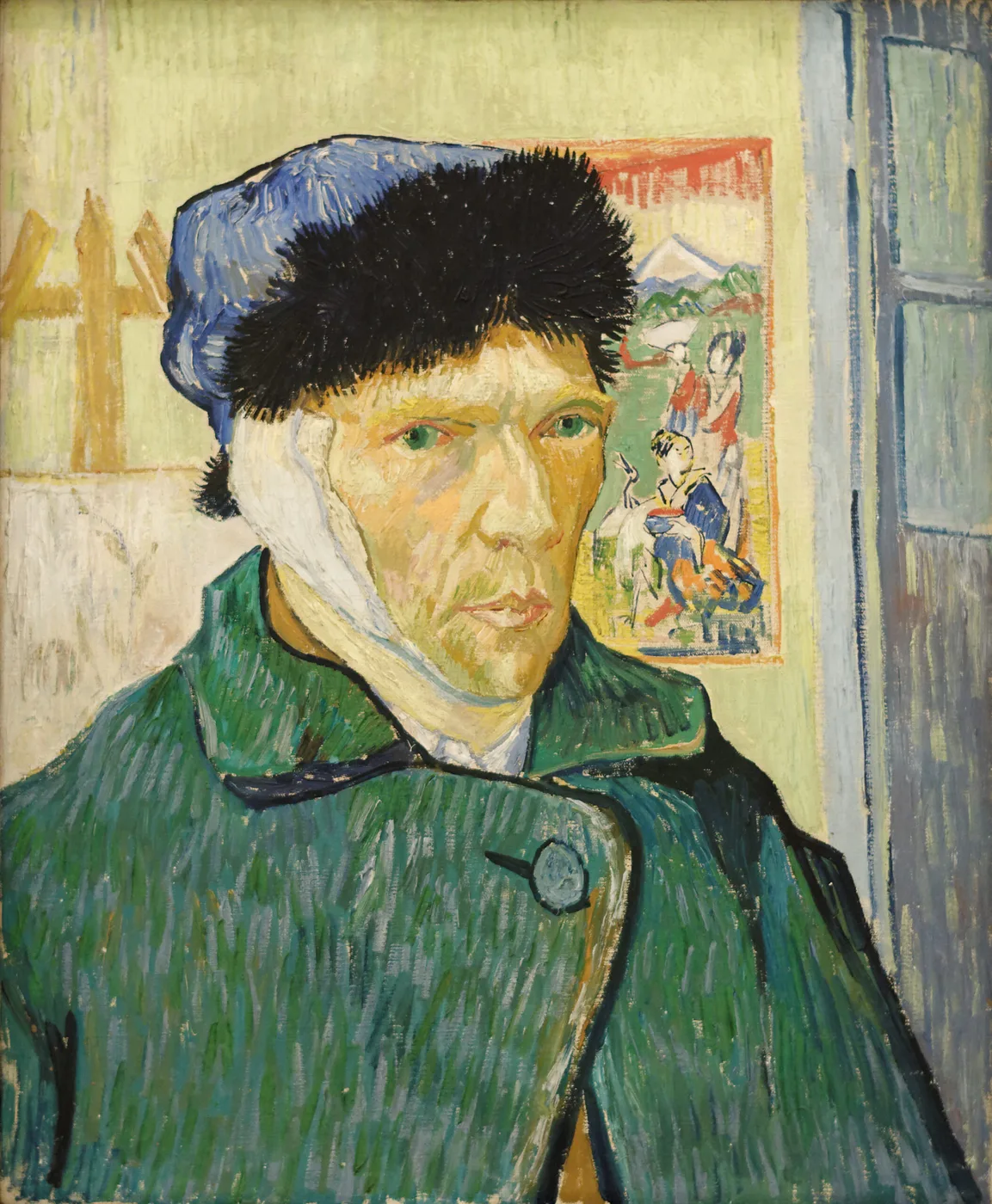
Vincent van Gogh had spent much of 1888 in Arles trying to build something he called a studio of the south, a house of artists working side by side. Paul Gauguin arrived that October, and by December the arrangement had curdled into arguments neither man could let go. On the night of 23 December 1888 the strain broke Van Gogh, and he cut off part of his own ear. He was admitted to the hospital in Arles within hours, and for a time it was not clear he would recover his footing at all.
Arles, the turn of the year
He was released from hospital in early January 1889, still bandaged, still shaken, and went straight back to his rented room. Painting was not a diversion from what had happened. It was how he tested whether he could still see clearly and still hold a brush steady, and how he told his brother Theo, without needing to say it in a letter, that he meant to keep going.
This self-portrait is the result. It carries no self-pity and no theatre. A man looks out at us from his own easel, days after the worst night of his life, and the picture he makes is composed, watchful, entirely under his own control.
A face that gives nothing away
Van Gogh sits close to the picture plane in a heavy green coat buttoned to the throat, a dark fur cap with a blue-green brim pulled down over his head. A white bandage wraps the right side of his face, covering the ear and jaw and knotted somewhere beneath the cap, the one plain fact of the picture that needs no explanation.
His eyes are pale green and meet ours directly, without flinching and without appeal. The mouth is set, the skin built up in strokes of ochre, rose and sickly yellow that read, close up, as bruised rather than merely painted. There is no pipe, no prop of any kind. He gives the viewer his face and nothing more.
What hangs on the wall behind him
Behind his shoulder is a Japanese woodblock print, pinned flat against the yellow wall: small figures in a landscape, a pale mountain, patches of red and blue that ring out against the print’s cream ground. Van Gogh had collected prints like this in Paris and leaned on them constantly for ideas about flat colour and clean outline, and its presence here, in a room he had barely left, says something about where his eye still wanted to go even in recovery.
To the right, a tall window or door frame in cool blue-grey closes the composition and holds the warmth of the room in check. The print and the window sit at opposite temperatures, one a flash of colour brought in from elsewhere, the other the plain grey light of an Arles winter pressing against the glass.
How the paint is laid down
The coat is built from short, insistent strokes of green laid over a darker green ground, so the fabric seems to hold its own shadow. The fur cap is thicker still, worked in blunt dabs of black and blue that catch real light off the canvas surface. Against all this the bandage is painted almost flat and very white, the one passage in the picture with no visible struggle in it.
Van Gogh set that green coat against a wall of warm yellow-ochre, a pairing of near-complementary colours he used again and again to make a picture hum without raising its voice. The effect here is not celebratory. It steadies the picture, the way a held breath steadies a hand.
On a wall, in real light
The original measures a modest 50 by 60.5 centimetres and is held by the Courtauld Gallery in London, close enough in scale that the face reads at something near life size. That size matters more than it sounds: this is a picture built for a close encounter, not a grand one.
Under warm evening light the yellow wall behind him deepens and the green coat sinks into shadow, leaving the bandage and the pale eyes as the two things still catching light. Under the flatter light of morning the print regains its colour and the whole surface reads more evenly, closer to how Van Gogh himself would have seen it drying in his rented room in January 1889.
What stays constant, whatever the light, is the gaze. Wherever the picture hangs, it is the one element that does not shift with the room around it.
Sizes and materials for Self-Portrait with Bandaged Ear are listed on its product page.
More from this collection
Bring this painting home
Choose a hand-painted oil reproduction for real brushwork, or an archival canvas print for a crisp museum-image edition. Every size preserves the original proportions.
View this work & options
Further reading
Verify the original in the Courtauld Gallery collection record and continue through related works in the catalogue.