
Three White Cottages in Saintes-Maries: Story
Six Days by the Sea
In the first week of June 1888, Van Gogh left Arles for a short stay at Saintes-Maries-de-la-Mer, a fishing village on the Camargue coast where the Rhône delta meets the Mediterranean. He travelled there by a slow public coach across a flat, wind-scoured plain, chasing something he had not yet found among the orchards and wheat fields outside Arles: open sky, salt air, and a horizon with almost nothing built on it.
He had come south to Arles that February, pulled by an idea of stronger colour and a brighter, more direct light than Paris could give him. By early summer he was working fast and painting outdoors nearly every day, and the trip to the coast gave him something new to look at: boats drawn up on the sand, women in local dress, and small reed-thatched cottages built for fishermen and shepherds rather than for anyone’s picturesque taste.
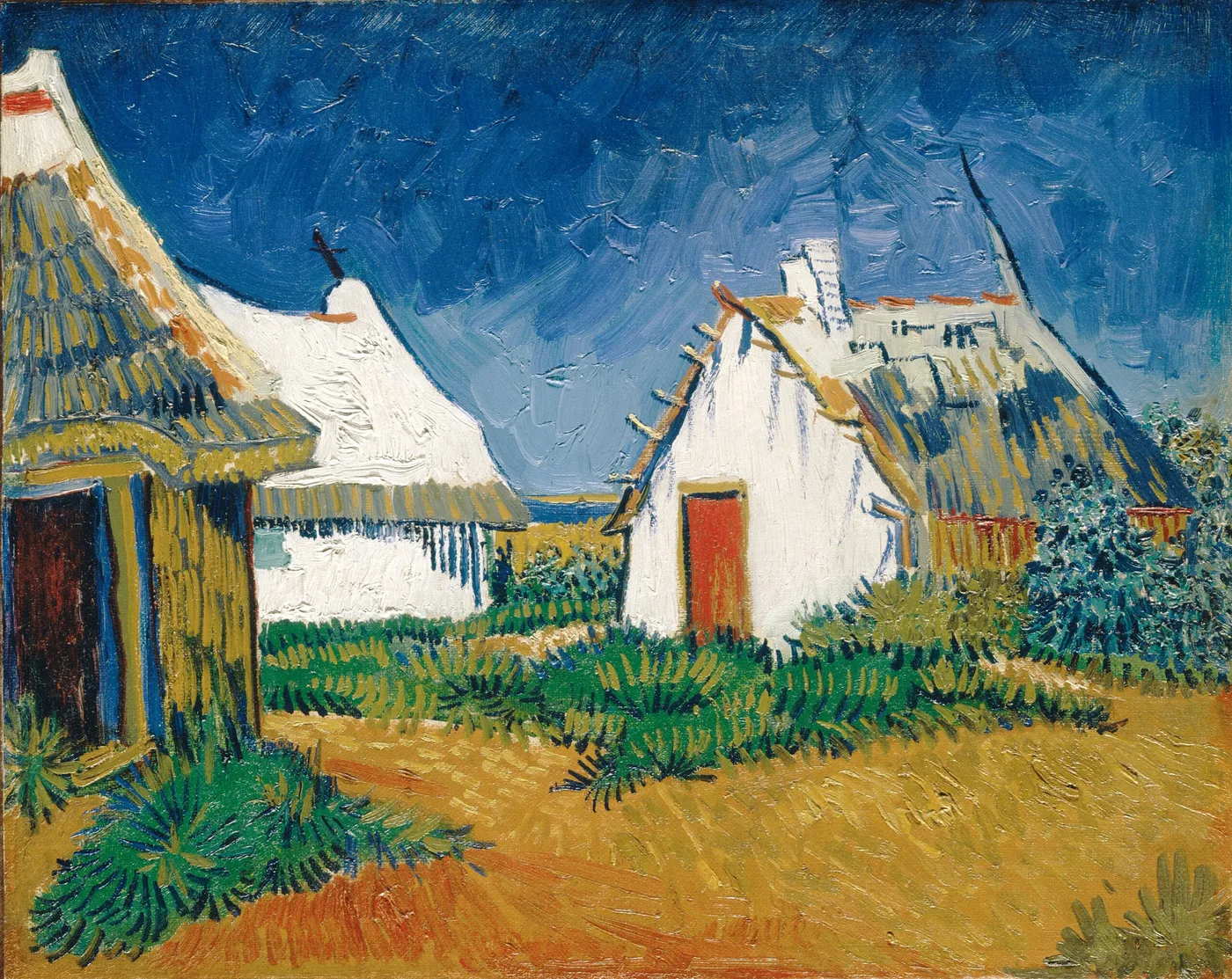
Three White Cottages in Saintes-Maries is one of the paintings that came out of that short visit. Van Gogh worked it in 1888 on a canvas of 41.5 by 33.5 centimetres, small enough to have been carried and finished quickly, in front of the actual huts rather than from memory back in his room.
Three Roofs Against the Sky
The painting is built around a cluster of low, whitewashed buildings, their walls almost pure white where the sun catches them and streaked with blue and grey where it does not. Each has a steep, pointed roof of reed thatch, rendered in ochre and tan strokes with darker blue-grey marks laid across them to suggest the rough, layered thatching and the weather it has taken.
A red door stands open in the middle cottage, and a second, darker doorway shows on the low outbuilding at the left, its plank walls painted in raw ochre and outlined in blue. On the ridge of one roof a thin dark shape, part finial and part weathervane, breaks the line of the thatch against the sky. Behind the group, further gables and a chimney suggest that this is a working cluster of buildings rather than a single isolated hut.
Nothing here is grand. These are modest, functional dwellings, the kind Van Gogh had described in his letters as closer to prehistoric huts than to conventional houses, and he paints them with the same attention he gave to a chair or a pair of boots: as things worth looking at hard, exactly as they are.
A Sky That Presses Down
What a viewer meets first is not the cottages but the sky above them, an unusually deep, saturated blue that fills almost half the canvas. It is built from dense, mostly diagonal strokes of ultramarine and cobalt, laid close together so the surface has a woven, almost fabric-like texture rather than the airy blend of a conventional sky.
That blue is heavier and darker than the gentle Provençal weather the subject implies, and it changes the whole mood of the picture. Against it, the whitewashed walls of the cottages read as startlingly bright, almost luminous, and the warm ochre of the thatch and the red of the doors gain an intensity they would not have under an ordinary pale sky.
This is Van Gogh working with complementary contrast quite deliberately: blue against orange, and white against a colour dark enough to make it glow. The paint itself is thick, applied wet into wet in places, so the ridges of the brushwork catch real light on the canvas surface and shift slightly as a viewer moves.
Ochre Ground and Green Scrub
Below the buildings, the ground takes up the lower third of the canvas in warm ochre and burnt orange, laid down in loose, dragging strokes that leave the weave of the canvas visible in places. It reads as bare, sun-baked earth of the kind common around the Camargue’s coastal villages, without grass to soften it.
Scattered across that ground are clumps of dark green scrub, painted as short, spiky dabs rather than blended foliage, some almost black-green in the shadows and some picking up flashes of a lighter, more yellowish green where the sun hits them directly. They sit in loose rows leading the eye from the front of the canvas back towards the cottages.
There is no sea in view and no horizon line beyond the buildings; the picture is entirely about this one cluster of huts, the ground in front of them, and the sky behind. It is a tightly cropped, almost intimate view of a place Van Gogh had only a matter of days to look at.
On a Wall at Home
Held today by the Kunsthaus Zürich, the original is a small, dense, high-contrast painting, and that intensity carries well into a domestic room. Because the composition is so simple, three roofs, a strip of ground, a wall of blue, it reads clearly from across a room and rewards a closer look at the brushwork once you are near it.
In daylight the white walls and red doors sit forward against that heavy blue sky; under warmer evening lamplight, the ochre ground and thatch tend to dominate instead, and the blue recedes into something closer to dusk. Few paintings this size carry that much shift in mood as the light around them changes through the day.
Sizes and materials for Three White Cottages in Saintes-Maries are listed on its product page.
More from this collection
Bring this painting home
Choose a hand-painted oil reproduction for real brushwork, or an archival canvas print for a crisp museum-image edition. Every size preserves the original proportions.
View this work & options
Further reading
Verify the original in the Kunsthaus Zürich collection record and continue through related works in the catalogue.