
The Zouave: Story, Meaning & Brushwork
Arles, early summer 1888
By June 1888 Vincent van Gogh had been in Arles for several months, still testing whether the light of the south could give him the colour he had been chasing since he left Paris. He had rented rooms, was working at a punishing pace, and had begun turning that energy toward portraiture, convinced that a face rendered in strong colour could carry more of a person than an accurate likeness ever would.
Zouave regiments, French infantry whose uniform and origins lay partly in North Africa, kept a garrison in the town that summer. Van Gogh, always alert to costume and to colour he could not invent, found in one young soldier exactly the subject he was after: skin toughened by outdoor duty, and a uniform built from red, blue and gold.
He worked fast, in the manner of that season, pushing to finish a portrait in a sitting or two rather than labour over it for weeks. The urgency shows in every stroke of the picture that resulted.
A face built from four colours
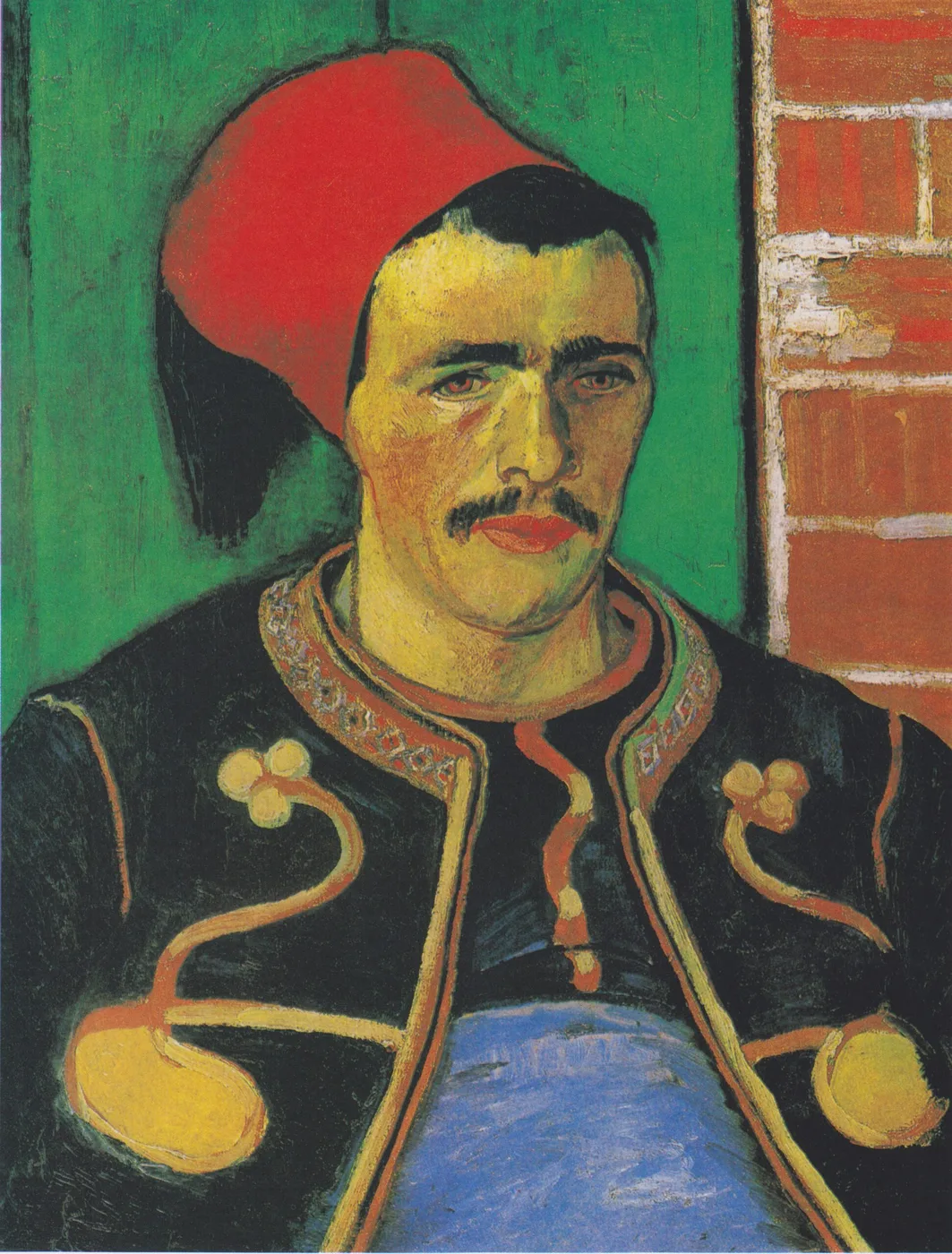
Painted in Arles in 1888, the canvas measures 54 by 65 centimetres, a modest size that brings the sitter close rather than holding him at a distance. The Zouave is cropped at the chest, his head and shoulders filling almost the whole picture, and he looks past the viewer’s shoulder rather than meeting the eye directly.
His fez, tipped back over dark cropped hair, is a slab of red that dominates the upper half of the canvas, its shadowed underside sliding toward black. His face is built from ochre, yellow-green and touches of raw sienna, the sunburn recorded as a shift in colour temperature rather than as conventional shading.
His jacket is a dense, near-black blue picked out with looping gold braid and two round tasselled fastenings hanging like buttons on cord. A pale blue sash shows beneath it, the one passage of cool colour low in the picture, steadying the reds and yellows massed above it.
Behind him the wall splits into two fields: a flat green door or panel to the left, and a wall of orange-red brick picked out with pale mortar lines to the right. Neither reads as description so much as counterweight, a green and an orange set there because each intensifies the red of the cap and the ochre of the skin between them.
Colour set against colour
That summer Van Gogh was working from a theory of complementary colour he had absorbed from Delacroix and from his own reading, setting red against green and blue against orange so each pushed the other toward its fullest strength. The Zouave reads almost as a demonstration of the idea.
The paint is laid in broad, flat passages rather than blended gradually, each area of colour closed off by a firm, often dark outline that owes something to the coloured prints Van Gogh studied closely. There is little conventional modelling: the face is a plane, the cap a plane, the brick a plane.
That flatness is a decision, not a shortcut. By refusing to soften the transitions between colours, Van Gogh keeps every hue at full pitch, so the picture reads across a room the way a piece of stained glass reads, in blocks of colour rather than in gradual shading.
Harsh and not easy to handle
Writing to his brother Theo about this portrait, Van Gogh described the combination of tones he was attempting as harsh, even savage, and not easy to bring under control. He also remarked on the sitter’s features in terms that show how much the encounter itself excited him, well beyond the ordinary business of finding a model.
That admission matters, because it shows the picture was not an easy success handed to him by a willing sitter. It was a deliberate risk, a test of how far colour alone could carry a portrait before it tipped into discord, and Van Gogh was not entirely sure, as he wrote it, that he had stayed on the right side of that line.
The Zouave belongs to a short run of portraits from that Arles summer, among them local working people Van Gogh treated with the same seriousness he gave to landscape, part of a wider effort to remake portraiture through pure colour rather than through description.
On a wall, in changing light
The original is held today by the Van Gogh Museum in Amsterdam, among the group of paintings from that Arles summer kept there. Seen in a room, the picture behaves less like a record of a face and more like a mass of ordered colour that resolves into a face as the eye settles on it.
Morning or artificial light tends to pull the red of the cap and the orange brick forward; softer evening light lets the green of the wall and the blue of the sash come up instead. It rewards a second look, once from across a room, where it reads as a hot, ordered block of red, green and gold, and again up close, where the outlines, the unblended patches of paint and the speed of the brush become plain to see.
Sizes and materials for The Zouave are listed on its product page.
More from this collection
Bring this painting home
Choose a hand-painted oil reproduction for real brushwork, or an archival canvas print for a crisp museum-image edition. Every size preserves the original proportions.
View this work & options
Further reading
Verify the original in the Van Gogh Museum collection record and continue through related works in the catalogue.